Employee Advocacy on LinkedIn: An Essential Guide for B2B Growth
Wilmer KarlssonTarstad
Last Updated: February 25, 2026
Key Takeaways
- Employee networks reach 10x more people than company pages alone
- Content shared by employees gets 2x higher engagement and 8x more trust
- Formal advocacy programs increase brand visibility by 79% and attract 58% more talent
- Leads from employee advocacy convert 7x faster than traditional channels
- Success requires leadership buy-in, clear systems, and consistent recognition
What Is Employee Advocacy on LinkedIn?
Employee advocacy on LinkedIn is straightforward: it's the practice of empowering your team members to authentically share company content, insights, and values within their personal networks. But here's what makes it different from traditional marketing. Rather than broadcasting corporate messages from your brand account, you're leveraging the genuine voices and professional credibility of real people who work for you.
Think of it this way. When your CEO posts about company culture, it reaches your followers. When 50 employees share that same message? Content shared by employees gets 2x higher engagement than the same content shared by the company page. That's not coincidence. People trust people more than they trust logos.
LinkedIn is the ideal platform for this because it's where B2B decision-makers actually spend their professional time. Unlike Instagram or TikTok, LinkedIn users expect thoughtful business content. Your employees already have networks of relevant contacts: clients, prospects, industry peers, and former colleagues. Those connections are warm audiences who value their recommendations.
The key distinction here is authenticity. Employee advocacy isn't about forcing scripted posts or corporate-speak. It's about giving employees the tools, content, and confidence to share in their own voice. A sales rep explaining how your product solved a client problem carries far more weight than your marketing team making the same claim.
This matters for your bottom line. Employees who actively share company content on LinkedIn help you reach qualified prospects, build trust faster, and create a talent magnet that attracts ambitious professionals who want to work for companies their networks respect.

The Business Case: Why Employee Advocacy Drives Results
The numbers tell a compelling story. When employees share company content on LinkedIn, the impact multiplies exponentially compared to brand-only posting strategies.
Start with reach. Employee networks typically have 10x more connections than company followers, which translates directly into audience expansion. That advantage compounds: companies using employee advocacy see up to 561% more reach than content shared by brand channels alone. Your marketing team's posts reach thousands; your employees' posts reach millions.
Engagement tells an equally strong story. Employee-shared content generates 2x to 8x higher engagement rates compared to brand channel posts. This isn't random. LinkedIn's algorithm prioritizes content from individual profiles because it signals authentic conversation rather than corporate messaging.
But here's where employee advocacy becomes genuinely strategic: trust. 92% of B2B buyers trust recommendations from employees over traditional advertising. This preference isn't marginal; it's overwhelming. Buyers skip past polished brand content to listen to real professionals sharing insights. That credibility advantage directly impacts your bottom line.
The conversion data proves it. Leads generated through employee advocacy are 7 times more likely to result in successful closures. Not slightly more likely. Seven times. That's the difference between a lead that sits in your pipeline and one that actually converts.
Finally, consider talent acquisition. Organizations with formal employee advocacy programs are 58% more likely to attract top talent. Strong talent recognizes companies where employees genuinely advocate for their work.
These metrics aren't theoretical projections. They represent documented outcomes from companies already running successful advocacy programs. The question isn't whether employee advocacy works, but whether you can afford to ignore it.
Core Benefits for Marketing, Sales, and Recruitment
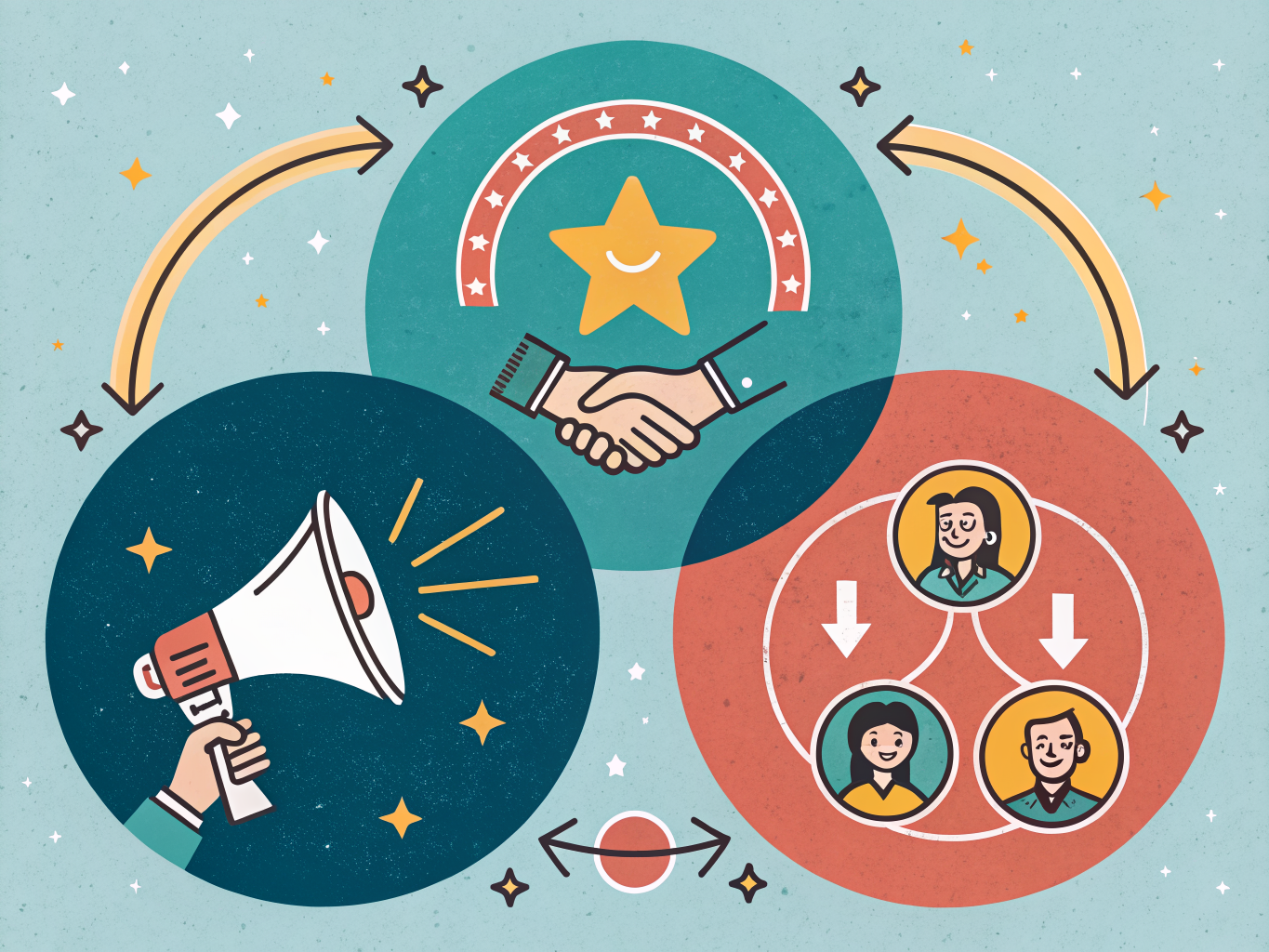
Employee advocacy transforms your entire organization, but each department experiences distinct advantages. Here's what actually matters to your team.
Marketing Gets Exponential Reach
When employees share content, your message travels far beyond your company page. A survey of companies found that 79% reported greater online visibility after establishing formal advocacy programs. That's not vanity; it's qualified eyeballs. Your content reaches the networks of hundreds or thousands of employees, each with their own credibility. Add in the 65% boost in brand recognition, and you're looking at earned media that no ad budget can replicate. The math is simple: more voices mean more impressions, more engagement, and stronger brand recall among decision-makers.
Sales Closes Faster
Your sales team needs qualified conversations, not generic leads. According to LinkedIn research, salespeople who regularly share content are 45% more likely to exceed their quota. Here's why: when prospects see your company's story through an employee's authentic perspective, trust builds faster. Prospects who engage with employee-shared content arrive at your sales team pre-warmed, already familiar with your narrative. Combine this with a strategic approach to LinkedIn engagement, and you've created a lead generation machine that feels organic, not pushy.
Recruitment Attracts Better Talent
HR departments win when employees become brand ambassadors. LinkedIn research shows that job openings shared by employees yield 30% more applicants. Better still, research indicates businesses with effective employee advocacy programs are 58% more likely to attract top talent. Candidates see real employees talking about culture, growth, and purpose. They're not reading marketing copy; they're hearing authentic voices. This dramatically improves both quality and quantity of applications.
The Cross-Functional Bonus
Beyond department-specific wins, you're building something bigger: employee engagement and retention. Your team members become invested in company success. They're not just executing tasks; they're shaping perception and driving growth. That ownership matters for career development and long-term loyalty.
How to Build and Launch Your Employee Advocacy Program
Building an employee advocacy program doesn't require reinventing the wheel. It requires a structured approach that removes barriers and builds momentum. Here's your roadmap.
Start with leadership alignment. Leadership buy-in is critical; the best programs have executives who lead by example. Schedule a conversation with your C-suite or department heads. Present the business case: more authentic reach, higher engagement rates, and stronger employer branding. Get them to commit to participating themselves. When leaders share content first, everyone else follows.
Recruit your first wave of advocates. You don't need everyone on day one. Target 20 to 30 enthusiastic employees from marketing, sales, and HR. These teams already understand your value proposition and have LinkedIn presence. They'll become your proof points and internal champions.
Select tools that eliminate friction. Your team won't sustain a program that's clunky. Look for platforms that integrate with LinkedIn, offer content curation, and make sharing a one-click experience. The easier you make participation, the higher your adoption rates.
Curate and pre-approve content strategically. Employees are more likely to participate when content is easy to access, pre-approved, and adaptable. Build a content library of company articles, industry insights, and thought leadership pieces. Content that educates or reflects expertise is more likely to be shared and trusted. Include multiple formats: articles, infographics, videos, and short-form posts. Crucially, allow employees to add their own commentary. Personalization drives authenticity.
Train your advocates. Host a 30-minute session covering LinkedIn best practices, what to share, and how to engage authentically. Share examples of posts that perform well. Show them how to use LinkedIn's native features like tagging and hashtags effectively. Keep it practical, not theoretical.
Launch small and iterate. Roll out with your initial group for two weeks. Measure engagement, gather feedback, and refine your approach. Celebrate early wins publicly. This builds momentum and shows skeptics that the program delivers results.
Your first 100 days will establish whether this becomes a sustainable competitive advantage or fades away. Prioritize ease of use, authentic content, and leadership visibility.
Best Practices for Maximizing Engagement and Participation
The difference between a thriving employee advocacy program and one that fizzles comes down to one thing: sustainable habits. Here's how to build them.
Start with authenticity. Your employees aren't brand robots. Let them personalize company content with their own commentary, voice, and perspective. Someone sharing a customer success story with their genuine take will outperform a corporate-approved post every time. Content strategists find that industry insights, customer stories, and practical learnings outperform promotional updates. Give people the freedom to make content their own, and engagement naturally follows.
Vary your content mix. Don't ask employees to post the same type of content week after week. Blend thought leadership pieces with behind-the-scenes culture moments, industry insights, customer wins, and personal professional reflections. This keeps their feeds fresh and gives them options based on their comfort level and interests.
Make recognition visible. Gamification and recognition boost participation and motivation. Public shout-outs matter. Feature top contributors in company newsletters, celebrate milestones on your company page, or create simple leaderboards. People want to know their effort creates impact. When they see peers recognized, participation increases naturally.
Prioritize video and visual content. LinkedIn's algorithm favors video posts and LinkedIn Stories, which garner higher engagement rates. Encourage employees to record quick takes, share screen recordings of industry news, or post short-form video reactions. The barrier to entry is lower than you'd think, and the payoff is significant.
Build consistency into routine. Set a realistic posting cadence, whether weekly or biweekly. Provide a content calendar so employees know what's coming. Make participation frictionless by pre-approving content and offering templates. Consistency beats intensity every time.
Close the loop. Share results back to your team regularly. Show impressions, engagement metrics, and tangible outcomes from their advocacy. When employees see the connection between their posts and business results, motivation sustains itself.

Measuring Success and Optimizing Your Program
You can't improve what you don't measure. Yet many organizations launch employee advocacy programs and then treat metrics like an afterthought. That's a missed opportunity to prove ROI and keep your team motivated.
Start by tracking what actually matters. Research on high-performing teams shows that real-time metrics and regular reports drive success. Focus on impressions and engagement first, but don't stop there. Monitor clicks and conversions to understand which content moves prospects closer to a sale. The real magic happens when you connect shares to pipeline, not just vanity metrics.
Measure at three levels simultaneously. Individual posts show which topics resonate. Employee performance reveals your most consistent advocates and where coaching helps. Business impact ties advocacy directly to revenue, which is what leadership cares about.
One powerful metric many overlook: earned media value. When employees share your content, calculate what you'd spend on paid ads to reach that same audience. 23% of organizations running structured programs achieve cost-per-click under $1, significantly beating typical LinkedIn ad costs. This number converts skeptics into believers.
Run quarterly reviews with your team. Share results openly. Show employees which posts they shared drove actual business outcomes. Celebrate wins publicly. This transparency sustains momentum and proves the program delivers value beyond engagement metrics.
Use your data to iterate continuously. Which industries respond best to your content? What posting times maximize clicks? Does video outperform articles? Each quarter brings new insights that sharpen your strategy. The teams winning at employee advocacy treat measurement as ongoing improvement, not a compliance box.
Common Challenges and How to Overcome Them
Let's be honest: launching an employee advocacy program sounds great in theory. In practice, you'll hit real obstacles. Here's how to navigate them.
The Participation Problem
Your employees are already juggling emails, meetings, and deadlines. Asking them to share content feels like one more task. The fix isn't motivation; research shows participation depends less on drive and more on confidence, clarity, and ease. Make sharing frictionless by integrating advocacy into existing workflows. Use a content library so people don't hunt for what to post. Advocacy experts recommend gamification and executive modeling to build momentum organically.
Authenticity vs. Brand Voice
Employees worry about sounding like marketing robots. You worry they'll say the wrong thing. The solution isn't scripts; it's guidelines. Give them clear brand values and talking points, then let them write naturally. When your CFO shares a company win in her own words, that's infinitely more credible than polished corporate copy.
The Confidence Gap
Not everyone's comfortable on LinkedIn. Some employees haven't posted in years or feel their network is too small. Start with low-pressure options: resharing company content, commenting on posts, or updating profiles. Offer optional training on LinkedIn engagement tactics and profile optimization. Recognize early participants publicly; advocacy best practices indicate voluntary, celebrated participation builds momentum.
Scaling Beyond the Enthusiasts
Your first 10% will jump in immediately. Getting to 50% requires removing friction and addressing real concerns. Compliance and privacy worries are legitimate. Document clear policies on what's shareable, who owns data, and how you'll protect employee information.
Proving ROI
Track metrics that matter: reach, engagement, leads generated, and hiring impact. Tie advocacy activity directly to business outcomes. When leadership sees that employee-shared content generates qualified leads, skepticism disappears.
Key Takeaways and Next Steps
Employee advocacy isn't a nice-to-have; it's how B2B companies win on LinkedIn. The data is clear: employees sharing company content generates significantly more engagement and reach than branded posts alone. But here's what separates successful programs from failed ones: systems beat intentions every single time.
Start small. Identify three to five early adopters in your organization who already engage on LinkedIn naturally. Give them simple, pre-approved content to share. Track what happens. Once you see traction and can point to real results, you'll have proof points that convince skeptics and attract more participants.
Build the right infrastructure. Make sharing effortless through a content calendar or curation tool. Remove friction. If employees need to hunt for content or jump through approval hoops, participation dies fast. Clear processes and authentic, relevant content keep people engaged long-term.
Measure everything. Monitor shares, impressions, clicks, and conversations. Share these wins with your team monthly. Celebrating progress builds momentum and shows participants their effort matters.
Here's the critical piece: leadership must model the behavior. When executives actively share and engage on LinkedIn, employees follow. Authenticity matters more than perfection; real voices resonate.
Ready to launch? Start by optimizing your team's LinkedIn profiles for consistency, then establish your content strategy. Use LinkedIn engagement tips and profile optimization best practices to build a strong foundation.
Your employees are your most credible marketers. Give them the tools, permission, and encouragement to become your brand's voice. The results will follow.
Conclusion: Transform Your Team Into Your Greatest Marketing Asset
Your employees possess something no marketing budget can buy: authentic credibility. When they share insights, celebrate wins, or discuss industry trends on LinkedIn, people listen. LinkedIn's algorithm heavily favors personal profiles over company pages, which means your team's voices reach further than any corporate post ever could.

The difference between companies that win and those that stagnate isn't luck. It's systems. Right now, your competitors are building employee advocacy programs while you're still thinking about it. The time isn't next quarter; it's today.
This playbook gives you everything needed to transform silence into amplification. Start small, measure results, iterate, and scale. Your greatest competitive advantage isn't hiding in your product roadmap; it's sitting in your Slack channels and email inboxes.
Ready to activate your team? Explore how strategic LinkedIn growth pairs perfectly with employee advocacy to create exponential results.