LinkedIn for B2B Lead Generation Guide
Master LinkedIn for B2B lead generation with this guide. Learn proven strategies to optimize profiles, create content, and convert connections into revenue.
Wilmer KarlssonTarstad
Using LinkedIn for B2B lead generation isn't just about sending connection requests. It’s a complete system for connecting with the right decision-makers, sharing content that actually matters to them, and building relationships that turn into a predictable inbound pipeline. Done right, it transforms your professional network from a digital rolodex into your primary growth engine.
This isn't about random acts of outreach; it's a systematic approach to attracting high-quality prospects who are already looking for a solution like yours.
Why LinkedIn Is Your B2B Growth Engine
Let's get straight to the point. LinkedIn is more than just a place for professionals to hang out—it's the core operating system for modern B2B growth. While other platforms are built for broad consumer engagement (and endless scrolling), LinkedIn is purpose-built for professional interaction. That makes it uniquely fertile ground for generating high-value leads.
Its user base isn't just large; it's a concentrated pool of the exact people you need to reach.
The real magic is in its targeting capabilities and professional context. Every user profile is a goldmine of data: job titles, company history, industry expertise, and professional interests. This allows for a level of precision in finding your ideal customer that you simply can't get anywhere else. You're not just shouting into the void; you're connecting with qualified decision-makers who are actively thinking about their business challenges right now.
The Undeniable Data Behind LinkedIn's Dominance
The numbers don't lie. LinkedIn dominates the B2B lead generation landscape with an efficiency that leaves its competitors in the dust.
A staggering 80% of all B2B social media leads originate from LinkedIn. That alone makes it the undisputed leader.
But it gets better. LinkedIn generates 277% more leads than Facebook and X (formerly Twitter) combined. This isn't just about volume; it's about quality. Leads from LinkedIn are known to convert at a rate 3x higher than those from other platforms, proving its power from the first touchpoint all the way to a closed deal. You can find more data on LinkedIn's performance at thunderbit.com.
A quick look at the data shows just how wide the gap is between LinkedIn and other channels for B2B marketers.
LinkedIn Lead Generation Performance vs Other Platforms
| Metric | Facebook & X (Combined) | |
|---|---|---|
| B2B Social Media Leads | 80% of all leads | Less than 20% |
| Lead Generation Effectiveness | 277% more effective | Baseline |
| Lead-to-Close Conversion | 3x higher conversion rates | Lower conversion quality |
| Primary Use Case | Professional Networking & B2B Sales | Consumer Engagement & Brand Awareness |
The takeaway is clear: while other platforms can be useful for top-of-funnel brand awareness, LinkedIn is where actual business gets done. It's the only platform designed from the ground up to facilitate the conversations that lead to high-value deals.
This is exactly why top-performing B2B leaders pour their resources into this channel. They know it's not just another marketing tactic, but a fundamental strategy for building authority and driving predictable revenue.
"Your LinkedIn activity is either building your brand or hurting it. There is no middle ground. Every post, comment, and connection is a signal to your market about who you are and what you stand for."
The rest of this guide is your playbook for making this opportunity work for you. We'll break down the exact steps to turn your LinkedIn presence from a passive profile into an active, lead-generating machine. For anyone serious about building a predictable inbound pipeline, mastering these tactics is non-negotiable.
Optimize Your Profile for Conversion
Before you even think about posting content or sending a single connection request, you need to treat your LinkedIn profile like a high-performance landing page. It's the first place a prospect looks after seeing your name, and you have about three seconds to answer their only question: "What's in it for me?"
A weak profile is a leaky bucket. A great one is a silent, 24/7 salesperson.
Think of it this way—every comment you leave and every piece of content you share is a breadcrumb leading back to your profile. If that destination isn't built to turn curiosity into a conversation, you're just wasting your time on the platform. This isn't about just filling out boxes; it's about telling a strategic story that frames you as the answer to your ideal client's biggest headache.
Craft Your Headline for Maximum Impact
Your headline is the most valuable piece of real estate on your entire profile. It follows you everywhere—in connection requests, comments, and search results. Most people waste it by just listing their job title, like "CEO at [Company Name]." That tells people what you do, but not what you can do for them.
A powerful headline is benefit-driven and speaks directly to your Ideal Customer Profile (ICP). It needs to be about the outcome you deliver.
- Weak Headline: Founder & CEO at SaaS Innovations
- Strong Headline: Helping B2B Founders Scale Revenue with Predictable Inbound Pipeline | Ex-Head of Growth
The second one immediately signals value and establishes credibility. It's a hook that makes them want to click and learn more.
Tell a Story in Your About Section
Your "About" section is your chance to drop the corporate jargon and make a real human connection. Stop writing it like a resume. Instead, think of it as a mini-sales page that tells a story and guides the reader to a clear next step.
Here’s a simple framework that just works:
- The Hook: Kick things off with a bold statement that hits on your ICP's main pain point.
- The Problem: Briefly dig into the challenge they're facing, using their own language.
- The Solution: Explain how you solve it and what makes your way different or better.
- The Proof: Drop in a key stat (89% of B2B marketers use LinkedIn for lead generation), a short client quote, or a quick win you delivered.
- The Call-to-Action: End with a clear, low-friction ask. Invite them to connect, grab a free resource, or book a quick chat.
This whole process—from finding the right people to converting them with a killer profile and content—is the engine of LinkedIn lead gen.
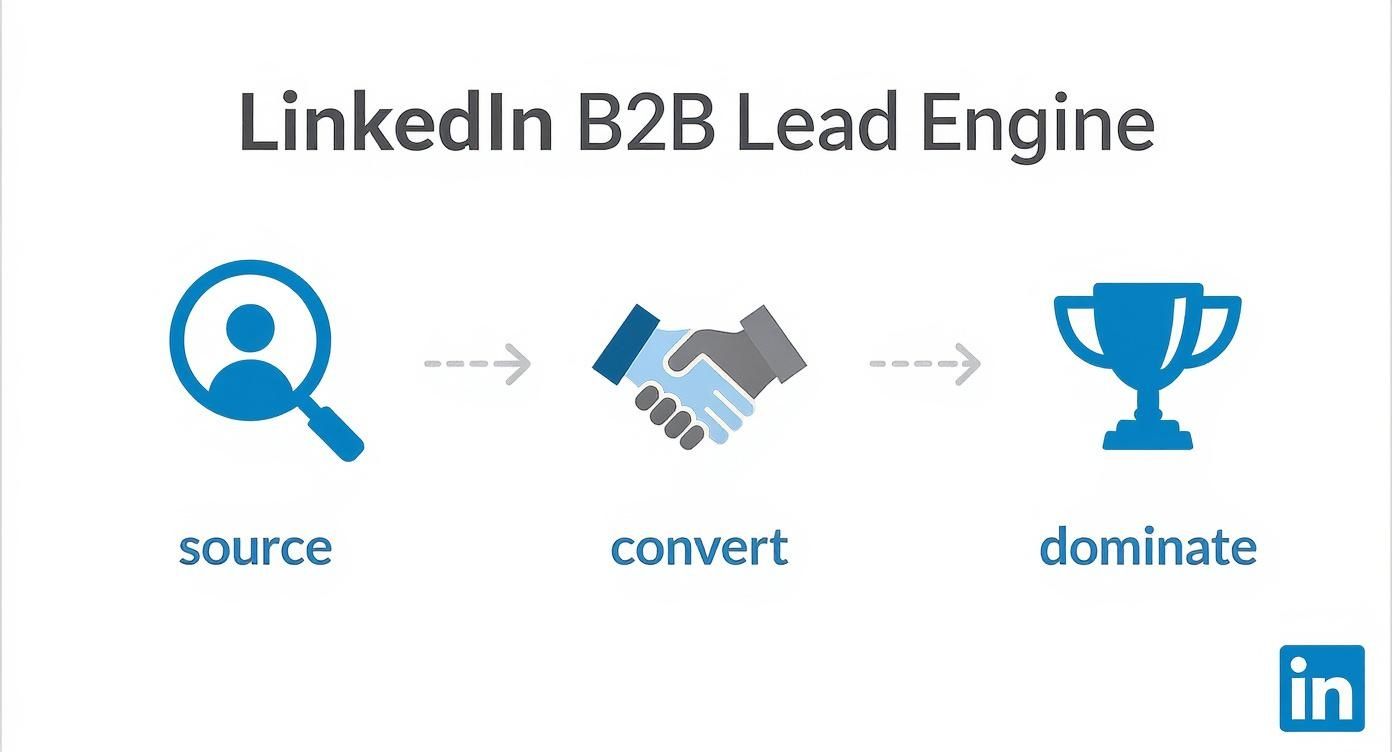
As you can see, a strong profile isn't just a "nice-to-have." It’s the critical bridge between finding prospects and actually turning them into pipeline. It's the conversion point.
Showcase Your Wins in the Featured Section
The "Featured" section is your visual portfolio. It’s the perfect spot to pin your best stuff—the assets that prove you know what you’re talking about and build immediate trust. Generic company updates have no place here.
Instead, feature content that directly serves your lead generation goals:
- Case Studies: Nothing sells better than showing real results for real clients.
- Testimonials: A quick video or quote from a happy customer adds massive credibility.
- Lead Magnets: Offer a valuable checklist, guide, or template to capture interest.
- Top-Performing Posts: Pin a post that sparked a ton of conversation to show you're an authority.
If you want to go deeper on this, check out our complete guide on how to optimise your LinkedIn profile. It’s packed with more tactical steps and examples you can steal.
Your profile isn't a static document; it's a dynamic conversion tool. Every element, from your banner image to your skills endorsements, should be aligned with the single goal of encouraging your ideal client to take the next step.
Finally, make sure your Company Page isn't an afterthought. The tagline should echo the value proposition in your personal headline, and the "Services" section needs to clearly list what you offer. Use that custom call-to-action button to send people right to your demo or contact page, creating a smooth path from discovery to conversation.
Develop Content That Attracts Your Ideal Client
Okay, your profile is now a conversion machine. But a great profile with no traffic is like a billboard in the desert. Now, we build the engine that drives your ideal clients directly to you, day in and day out.
This is the shift from a static, passive presence to actively building authority. The goal? Create content so sharp, so relevant, that your prospects see you as the only logical expert to solve their problem. Every DM you send later on will be exponentially warmer because they already know who you are.
This isn't about chasing viral trends or posting fluff. Real LinkedIn for B2B lead generation is a system. It's a calculated process designed to educate, resonate with, and convert a very specific type of person. And it all starts by getting ruthlessly specific about who that person is.
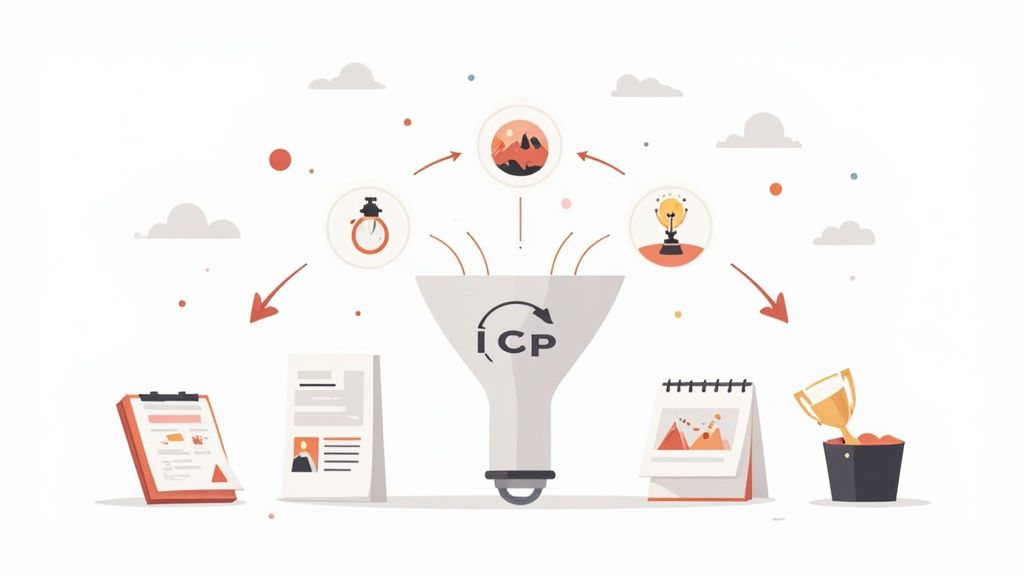
From Broad Targeting to a Laser-Focused ICP
Before you even think about writing, you need absolute clarity on who you're talking to. Don't just guess. Fire up LinkedIn Sales Navigator and get granular. Filter by industry, company size, seniority, even keywords they use in their profiles.
This process transforms your thinking from generic to personal. You’re no longer writing for "B2B leaders." You’re writing for a "Series A SaaS Founder struggling to build a predictable sales pipeline without a huge marketing budget."
That's the kind of specificity that cuts through the noise and makes someone stop scrolling.
The Four Pillars of a Sustainable Content System
Consistency is everything on LinkedIn, but burnout is real. To avoid it, I run my entire content strategy on a simple four-pillar framework. It ensures you always have something valuable to say and your content mix hits all the right notes—from building trust to proving results.
- Pillar 1: Address Client Pain Points. This is your bread and butter. Create posts that dive straight into the problems keeping your ICP up at night. A title like "The 3 Bottlenecks Killing Your Inbound Lead Flow" speaks directly to their world and immediately positions you as a problem-solver.
- Pillar 2: Share Industry Insights. This is how you build authority. Comment on new trends, analyze recent data, or make a bold prediction about the future. It shows you’re not just a participant in your industry—you’re helping to shape it.
- Pillar 3: Tell Personal Stories. People buy from people, not logos. Share a story about a mistake you made, a tough lesson you learned, or a behind-the-scenes look at the grind. This is what builds real human connection and trust.
- Pillar 4: Showcase Wins and Client Success. Nothing sells like proof. Share company milestones, team achievements, and most importantly, client case studies. A post detailing how you helped a client achieve a specific result makes your value tangible. It’s the ultimate social proof.
Building a strong content engine isn't just about what you post; it's about the consistency and relevance of those posts. Research shows that companies posting weekly on LinkedIn see twice as much engagement, proving that regular, valuable content is the key to staying top-of-mind.
Structuring Posts for Maximum Engagement
How you say it is just as important as what you say. The LinkedIn algorithm (and your busy reader) rewards content that's easy to scan and encourages interaction.
I’ve found that every winning post has three core components:
- The Hook: Your first one or two lines have one job: stop the scroll and earn the "see more" click. Make a bold claim. Ask a provocative question. State a counterintuitive fact. Make it impossible to ignore.
- The Value-Packed Body: This is where you deliver the goods. Forget long, dense paragraphs. Use short sentences, bullet points, and even emojis to break up the text. The goal is to give your reader a quick, actionable insight they can use immediately.
- The Clear Call-to-Action (CTA): Never leave your reader hanging. Every post needs to tell them what to do next. Ask a question to spark comments, invite them to share an opinion, or point them toward a deeper resource.
Here’s a simple example of how it all comes together:
Hook: Cold outreach is dead. Here’s what top-performing sales teams are doing instead.
Body:
- They build authority with content first.
- They engage in relevant conversations before ever sending a DM.
- They use tools like GetViews.AI to automate content that attracts inbound leads.
CTA: What’s one inbound strategy that's crushing it for you right now? Share it in the comments!
This system turns your profile into a magnet for your ideal clients, establishing the authority you need to generate consistent inbound interest. For a deeper dive into content frameworks, check out our complete guide to building a powerful LinkedIn content strategy. When you get this right, every outreach effort that follows becomes a warm conversation, not a cold pitch.
Engage Intentionally to Build Real Connections
Putting out killer content is only half the battle. A perfectly written post that nobody sees generates exactly zero leads. This is where you shift from being a content creator to a community builder, turning those passive views into active conversations that actually fill your pipeline.
This isn't about just blasting your content into the void. It’s about strategically showing up inside the conversations your ideal clients are already having. You build trust and familiarity long before you ever think about sliding into their DMs.
When you do this right, your outreach goes from cold to warm. That connection request isn't coming from a stranger anymore—it's from someone they recognize from the smart comments and shared discussions in their feed.
The Power of the Comment-to-Connect Workflow
Honestly, the most underrated lead gen strategy on LinkedIn isn't sending messages. It's leaving thoughtful comments. The whole game is to find posts from your target prospects or the influencers they follow and add genuine, value-driven insights.
Whatever you do, avoid the generic replies. "Great post!" or "Thanks for sharing!" is a complete waste of time. They add zero value and make you invisible. Your goal should be to extend the conversation.
Here's how:
- Ask a clarifying question. It proves you actually read the post and gave it some thought.
- Share a related experience. A quick personal story that backs up their point builds instant rapport.
- Offer a different perspective. Do it respectfully, and you can spark a healthy, memorable debate.
When you make this a daily habit, you start popping up in your prospect’s notifications for all the right reasons. After a few of these meaningful interactions, sending a connection request just feels like the natural next step. The acceptance rate on this kind of warm outreach blows any cold approach out of the water.
The visitor-to-lead conversion rate on LinkedIn is a solid 2.74%, which is nearly three times higher than other big social platforms. This just proves people are on LinkedIn with a business mindset, ready to connect over valuable content. You can dig into more of these powerful LinkedIn statistics if you're curious.
This high-intent environment is exactly why the Comment-to-Connect workflow is so ridiculously effective. You’re meeting qualified decision-makers right where they’re looking for professional insights.
Mastering Targeted, Personalized Messaging
Once they accept your connection, you can move the conversation to DMs. But be careful—this is the most critical stage and where most people completely fumble the ball. A generic sales pitch right now will instantly erase all the goodwill you just built.
The secret is personalization at scale. Your first message shouldn't feel like a sudden shift into sales mode; it should be a seamless continuation of your public chat.
Reference your last interaction directly.
Let's walk through an example: You just connected with a prospect after you commented on their post about the headaches of scaling a sales team.
- Weak Message: "Thanks for connecting! I help companies like yours scale their sales teams. Are you free for a demo next week?" (Yikes.)
- Strong Message: "Great connecting, [Name]. I was really thinking about your point on the difficulty of hiring senior AEs right now. We ran into a similar bottleneck last year. Have you found that the talent pool is shrinking, or is it more of an issue with finding the right cultural fit?"
See the difference? The strong message nails three things:
- It’s contextual. It directly calls back to a shared conversation, proving you were paying attention.
- It asks a thoughtful question. This invites them to talk more about their problems, putting the focus on them, not you.
- It’s not a pitch. It's a peer-to-peer chat. You're building rapport and trying to understand their world first.
This method is the bedrock of effective LinkedIn for B2B lead generation. It’s a consultative approach that puts the relationship way ahead of the transaction. When you lead with genuine curiosity and value, you create a space where the prospect wants to learn more about how you can help. The "ask" for a meeting then becomes a logical solution to their problem, not a forced sales tactic.
Turn Conversations into Pipeline Opportunities
Great content gets you to the one-yard line. This is where you score.
All the authority you've built, the comments you've left, and the connections you've made are just table stakes. They don’t mean a thing if they don’t translate into actual business opportunities. This is the critical moment where you pivot from building relationships to generating revenue.
The move from a public comment to a private DM—and finally, to a sales call—is an art. It takes finesse and good timing. Most importantly, it requires a genuine focus on your prospect's problems, not your quota. Rush this, and you’ll undo all your hard work and sound like every other generic salesperson flooding their inbox.
The goal isn't to trick someone into a demo. It’s to guide a warm, relevant conversation toward a logical next step where you can deliver even more value. When you do it right, asking for a meeting feels less like a pitch and more like a helpful suggestion.
From Comments to Consultative DMs
The initial DM is where most people completely fumble the ball. After a great back-and-forth in the comments, they immediately send a message that screams, "I want to sell you something."
Instead, your first DM should feel like a natural extension of the conversation you were already having. The key is to lead with curiosity, not a call to action. Ask smart, open-ended questions that get your prospect talking about their world and their challenges.
A winning LinkedIn DM strategy isn’t about pushing your solution. It’s about pulling out their problem. Ask questions that make them think, and you'll become a trusted advisor, not just another vendor.
Let's say you just connected with someone who engaged with your content about scaling sales teams.
- The Weak DM: "Thanks for the comment on my post! My company helps with sales scaling. Can I show you a demo?" (This is an instant turn-off).
- The Strong DM: "Appreciate you adding to the conversation on my post, [Name]. It got me thinking—you mentioned the challenge of training new SDRs. Is the bigger hurdle getting them ramped up on product knowledge or mastering the soft skills for outreach?"
See the difference? The second option is consultative. It opens a dialogue, proves you were actually listening, and positions you as an expert who is trying to understand their situation. This is the core of effective LinkedIn for B2B lead generation.
Identifying Buying Signals and Making the Ask
As the conversation flows, your job is to listen for buying signals. These are little tells—phrases or pain points—that signal a real, urgent need for a solution like yours.
They might sound like:
- "We're really struggling to get consistent results from our current process."
- "My team is completely swamped, we just don't have the bandwidth for this."
- "I'm actually exploring new tools to help us solve [specific problem]."
When you hear one of these, that's your green light. The prospect just opened the door for you. Now you can gently propose taking the conversation offline without it feeling abrupt or pushy.
Here’s a simple, effective script to make the ask:
"Based on what you're describing with [the specific pain point], it sounds very similar to the challenge we helped [Similar Company] solve. It might be helpful to walk you through how they tackled it. Would you be open to a brief 15-minute call next week to explore if a similar approach could work for you?"
This works because it's not about your product; it's about a solution to their stated problem, backed by a bit of social proof. For more frameworks on this, our guide on how to build a sales pipeline offers more strategies for moving prospects through the funnel.
Scaling Your Outreach with Smart Automation
Trying to manage dozens of these conversations manually is a recipe for burnout and missed opportunities. This is where smart automation becomes a game-changer, letting you scale your outreach without sacrificing that personal touch.
Tools like GetViews.AI can automate the initial touchpoint with users who engage with your posts. For example, you can build a workflow that automatically sends a personalized DM to everyone who comments on a specific piece of content.
This doesn't replace the human element; it enhances it. The automation handles the first step, freeing you up to focus on the high-value, consultative part of the conversation once a prospect responds. It ensures no opportunity slips through the cracks and helps you build a predictable system for turning engagement into qualified sales calls.
You Can't Improve What You Don't Measure
Let’s be honest. A LinkedIn strategy without tracking is just a hobby. You're throwing content at the wall and hoping something sticks, wasting time on tactics that feel productive but don't actually generate a single dollar of pipeline.
This isn't a "set it and forget it" channel. It's a living, breathing system that needs constant feedback. Tracking your performance is what turns random activity into a predictable revenue engine. It gives you the hard data to double down on what’s working and mercilessly cut what isn’t.
The Only Metrics That Actually Matter
Forget about vanity metrics like your follower count. Likes don't pay the bills. The pros focus on a handful of numbers that directly correlate to pipeline growth. You can track them on a simple spreadsheet or dashboard.
Here's what to watch like a hawk:
- Profile Views: Are people curious enough to click your name? A steady increase in profile views means your content and comments are hitting the mark. If this number is flat, your activity isn't compelling enough to stop the scroll and make someone investigate who you are.
- Connection Request Acceptance Rate: This is a direct gut-check on your profile and outreach. A low rate (anything below 20-30%) is a blaring alarm. It usually means your headline is weak and self-serving, or your connection message is a generic, copy-paste job.
- Content Engagement Rate: This goes beyond just likes. Look at the comments and shares. Low engagement is a clear signal of a disconnect. Either your topics are off-base for your audience, or your hooks are too weak to grab their attention in a crowded feed.
- Meetings Booked: This is the bottom line. The ultimate KPI. How many of your LinkedIn conversations are turning into actual calendar invites? This number tells you if all your relationship-building efforts are translating into real business opportunities.
Consistently tracking these few metrics is what separates the amateurs from the pros on LinkedIn. Data tells the story of your strategy. It shows you exactly where the friction is, so you can make targeted fixes instead of just guessing.
By keeping an eye on these indicators every single week, you can spot problems before they kill your momentum. For instance, high engagement but zero meetings booked? Your DMs are probably too salesy or your offer isn't resonating. High connection acceptance but no one engaging with your content? It's a sign your posts aren't providing enough value to your new network.
This constant loop of measuring, learning, and tweaking is the secret to building a pipeline machine that actually works.
Got Questions? We've Got Answers.
Even with the perfect playbook, you're going to have questions. Everyone does. Here are some of the most common ones I hear from B2B leaders trying to crack the LinkedIn code, along with my straight-up, no-fluff answers.
How Much Time Do I Really Need to Spend on LinkedIn Every Day?
Look, consistency is everything. You don't need to live on the platform, but you can't just drop in once a week and expect results.
The sweet spot is 30-60 minutes a day. Break it down like this:
- 15 minutes: Jump into your feed and leave thoughtful comments on posts from your ideal clients. Be a human, add value.
- 15 minutes: Focus on your own content. Publish today's post or, just as importantly, reply to every single comment you've received.
- 30 minutes: This is your pipeline time. Send personalized connection requests and manage your DMs.
This isn't about burning out; it's about building a sustainable habit that moves the needle every single day.
Is LinkedIn Sales Navigator Actually Worth the Money?
You can absolutely get started without it. But once you're serious about scaling, Sales Navigator is a non-negotiable. Think of it as upgrading from a regular car to a high-performance engine for your lead generation.
The advanced filters, lead lists, and real-time alerts let you zero in on your ideal customers with a level of precision the free version can't touch. It's not just a tool; it's a massive time-saver that pays for itself by filling your pipeline with better prospects, faster. The ROI is a no-brainer.
What's the Single Biggest Mistake People Make in Their Outreach?
Easy. Sending a generic, self-serving connection request. It’s the fastest way to get your request ignored and maybe even flagged as spam. The biggest mistake is making it all about you instead of them.
Your outreach has to be rooted in personalization and value. Full stop. You have to give something before you ever ask for anything. Find a shared interest, reference a post they wrote, or mention a mutual connection. Offer a nugget of insight first—and never, ever lead with your sales pitch. The goal is to start a conversation, not to force a transaction.
Ready to stop guessing and start building a predictable revenue machine on LinkedIn? GetViews.AI uses AI to help you create content that converts, automate your engagement, and turn those conversations into qualified pipeline. Start generating inbound leads on autopilot today.