How to build sales pipeline: A proven path to conversions
Discover how to build sales pipeline steps that convert. Our practical guide covers ICP, content strategy, and turning engagement into conversations.
Wilmer KarlssonTarstad
A sales pipeline isn't just a fancy spreadsheet. It’s a predictable, repeatable system for turning strangers on LinkedIn into paying customers. The whole thing is built on a simple idea: moving potential clients from "Who are you?" to "Here's my money" through a series of defined steps. This involves knowing exactly who you're selling to, mapping out their journey, and then consistently feeding the top of that funnel with the right people.
Build a Foundation for Predictable Sales
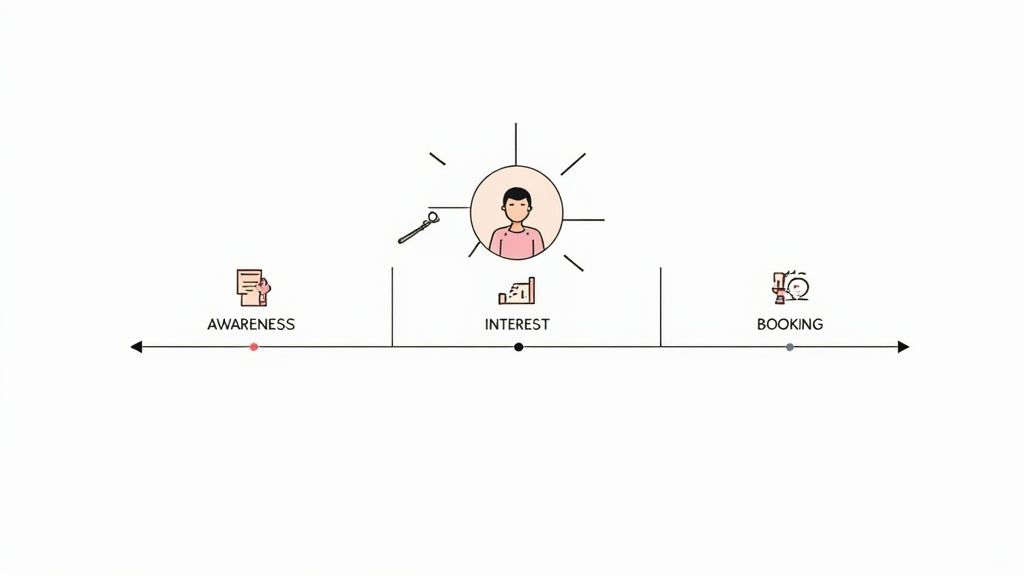
Before you write a single post or send a connection request, you need a blueprint. Winging it on LinkedIn is like trying to build a house without architectural plans—it’s messy, wildly inefficient, and pretty much guaranteed to fail.
The foundation of a killer sales pipeline isn't a long list of names. It’s an almost obsessive understanding of who you’re selling to and the journey they take to solve their problems.
This is the work that separates the one-off, lucky sales from consistent, predictable revenue. It’s about being strategic from the get-go, so every single person who enters your pipeline has a high chance of becoming a customer. Quality over quantity isn’t just a nice-to-have; it’s everything.
The pressure on sales pros is higher than ever. The 2025 State of Pipeline Generation survey found that 86.1% of sellers have a higher pipeline quota this year than last. At the same time, 55.4% say their biggest hurdle is buyers being reluctant to engage, and 46.5% blame excessive manual work for slowing them down. These numbers scream one thing: you need an efficient, well-defined process.
Define Your Ideal Customer Profile
A fuzzy idea of your audience leads to a weak pipeline. You can't just target "marketing managers." You need a hyper-specific Ideal Customer Profile (ICP) that reads like you’re describing a real person you know. A strong ICP moves beyond job titles and company size and gets into the human stuff—the psychographics that actually drive buying decisions.
To nail down your ICP, start asking better questions:
- What specific pain points keep them up at night? Not just "needs better SEO," but "is struggling to prove content marketing ROI to their VP and fears their budget will get cut."
- What are their real goals? Are they trying to land a promotion? Secure a bigger budget for their team? Or just make their day-to-day work less of a headache?
- What's the trigger event? What just happened in their business that made them start actively looking for a solution like yours?
- How do they talk on LinkedIn? Are they formal and data-heavy, or do they respond to casual, story-driven posts?
Key Takeaway: Your ICP isn't a "set it and forget it" document. It’s a living thing. As you talk to more prospects on LinkedIn, listen to the exact words they use and feed that language back into your profile. This is how you stay sharp and relevant.
Map Your LinkedIn Sales Pipeline Stages
Once you know who you're after, you need to map out the journey they'll take with you on LinkedIn. This isn't just a contact list; it's a series of clear stages that show a prospect's progress. Each stage needs a goal and clear criteria for moving someone to the next step.
Here’s a simple but powerful way to structure your pipeline stages on LinkedIn, along with their objectives and key activities.
Key Sales Pipeline Stages and Objectives
| Pipeline Stage | Primary Objective | Key LinkedIn Activities |
|---|---|---|
| Awareness & Engagement | Get on their radar and establish initial credibility. | Liking/commenting on their posts, creating content they engage with. |
| Connection | Move them from a follower to a first-degree connection. | Sending a personalized connection request referencing a shared interest or engagement. |
| Conversation Started | Transition from public engagement to a private DM chat. | Sending a value-first DM (no pitch!) after they connect or engage. |
| Qualified Lead | Confirm they have a real need, budget, and authority. | Asking smart questions in DMs to uncover pain points and buying intent. |
| Meeting Booked | Move the conversation from LinkedIn to a formal sales call. | Successfully transitioning the DM chat to a scheduled discovery call or demo. |
Mapping these stages turns a chaotic mess of DMs, likes, and comments into a structured, manageable process. It’s how you stop guessing and start building a predictable system for generating sales opportunities.
Create Content That Fuels Your Pipeline
If your pipeline stages are the skeleton of your sales process, content is the muscle that moves prospects through it. On LinkedIn, you can't just connect and pitch. You have to earn the right to have a conversation.
High-value content is how you do that. Think of it as your silent salesperson, working 24/7 to educate your ideal buyers, build trust, and filter for the right people. When someone consistently engages with your posts, they're raising their hand and showing interest. You're creating a magnetic presence that pulls the right people toward you.
The goal isn't to go viral. The goal is to start conversations. A post that gets 10 likes from your ideal customers is infinitely more valuable than one that gets 1,000 likes from everyone else.
Develop Your Core Content Pillars
To stay consistent without burning out, you need a simple framework. Don't try to be an expert on everything. Instead, focus on three core content pillars that map directly to your buyer's journey and your ultimate sales goal.
Each pillar has a specific job to do in moving someone from a stranger to a qualified lead.
- Educate (Top of Funnel): This is your "what" and "why" content. It tackles the big-picture problems your ideal client profile (ICP) faces, often before they even know a solution like yours exists. The goal here is pure value and establishing your authority.
- Solve (Middle of Funnel): Here, you get into the "how." This content offers actionable advice, frameworks, and quick wins that help your audience solve a piece of their problem. You're showing your expertise in a practical, tangible way.
- Prove (Bottom of Funnel): This is all about social proof and building confidence. It’s where you share case studies, client stories, and results that show your solution in action. It's built for someone who is already considering a purchase and just needs that final nudge.
This structured approach turns random posting into a strategic asset for your pipeline, ensuring you have a balanced mix of content for prospects at every stage.
Establish a Sustainable Content Rhythm
Consistency is the secret weapon on LinkedIn. Showing up 3-5 times a week keeps you top-of-mind and signals to the algorithm that you're an active, valuable voice. But trying to create that much content from scratch is a recipe for burnout.
The key is to work smarter, not harder.
Pro Tip: Don't feel pressured to write a masterpiece every day. A simple, insightful text-only post that sparks a single meaningful conversation is a huge win. Your rhythm should be sustainable for you, not dictated by what the gurus preach.
One of the most effective ways to maintain a steady flow is by reusing and adapting your best material. You can learn more about how to do this by exploring content repurposing strategies, which can turn one great idea into a week's worth of posts.
Here’s a practical weekly cadence you can adapt:
- Monday: An "Educate" post sharing an industry trend or a common mistake you see people making.
- Wednesday: A "Solve" post offering a quick tactical tip, a short framework, or a checklist.
- Friday: A "Prove" post sharing a client win (with their permission, of course) or a personal story tied to your work.
Generate Ideas That Resonate Deeply
The best content ideas don't come from staring at a blank screen. They come from listening intently to your target audience. Your prospects are telling you exactly what they want to see every single day—you just need to know where to look.
Here are a few goldmines for endless content inspiration:
- Your Sent Items: Go through your emails and DMs. What questions do prospects ask most often? Each one is a potential post.
- Competitor Comments: Look at the comments on your competitors' popular posts. What are people asking? What are they debating? This is a direct line into the topics your audience is fired up about.
- Customer Onboarding Calls: What are the first few things you teach a new client? These foundational concepts make for perfect "Educate" and "Solve" content.
By focusing on these three pillars—Educate, Solve, and Prove—you transform your LinkedIn profile from a simple online resume into a powerful, automated system for filling your sales pipeline. Every post becomes a strategic move to attract, nurture, and qualify your next best customer.
Turn Engagement Into Sales Conversations
Likes and comments feel good, but they don't pay the bills. Think of them as signals—invitations to start a real conversation. The single most important skill for building a pipeline on LinkedIn is mastering the art of turning that passive engagement into an active dialogue in the DMs.
This is where most people drop the ball. They either ignore the engagement and let warm leads go cold, or they jump straight into a hard pitch and scare prospects away. The real goal is to build genuine rapport and show your value. When you do that, the transition to a sales call feels like a natural, helpful next step.
From Public Comments to Private Conversations
Every comment on your post is an open door. Your first move is simple: reply publicly. Acknowledge their input, add to the discussion, and show other readers you’re paying attention. It’s a small step that boosts your post’s visibility and makes you look good.
Immediately after that public reply, it’s time to slide into the DMs. But this transition has to be smooth and value-driven, not a jarring sales pitch.
Key Insight: Your first DM should have zero to do with your product or service. Frame it as a simple, human "thank you" for their engagement or a follow-up on their comment. That’s it.
Let's say someone comments, "Great point about tracking pipeline velocity."
- Weak Approach: "Thanks for the comment! I saw you're a sales director. My company helps teams like yours improve pipeline velocity. Can we chat next week?"
- Strong Approach: "Hey [Name], really appreciate you adding to the conversation on my post about pipeline velocity. It's a metric not enough teams focus on. Glad it resonated!"
The second approach is completely disarming. You've given them nothing to object to and everything to feel good about, opening the door for a natural back-and-forth.
Designing Your DM Playbooks
Once the conversation is flowing, you need a playbook to gently guide it toward a discovery call. A good playbook isn't a rigid script; it’s a flexible framework built on providing value and asking smart questions. Your content pillars—Educate, Solve, and Prove—give you the perfect roadmap.
This visual shows exactly how those pillars guide a prospect from just being aware of a problem to seeing you as the solution.
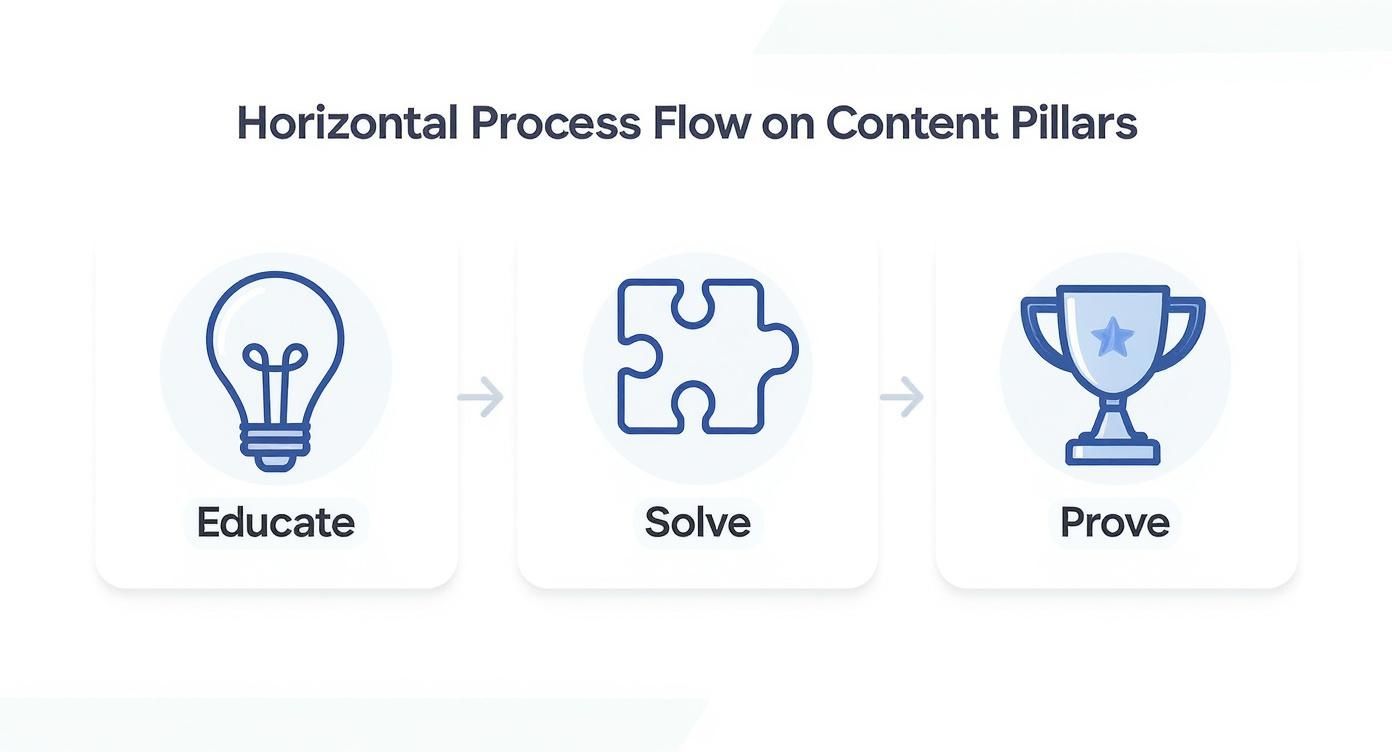
It all starts with education, moves into practical problem-solving, and finishes with proof. Trust gets built at every single step.
Here’s a simple structure for your DM follow-ups:
- The Acknowledgment: Your initial message. No ask, just a thank you for their engagement.
- The Value-Add: A day or two later, circle back with a relevant resource. It could be a blog post, a short video, or a helpful framework that expands on your original post. A solid LinkedIn content strategy is your best friend here, giving you an endless supply of value-add ideas.
- The Question: After you’ve given value, ask an open-ended question to understand their world. Something like, "Out of curiosity, how is your team currently tracking pipeline conversion rates?"
- The Pivot: Based on their answer, you can gently pivot to your solution. "That's a common challenge. We actually built a feature to help with that exact problem. Would a quick 15-minute demo be helpful to see if it could save you some time?"
This methodical approach builds trust and positions you as an expert, not just another salesperson clogging their inbox.
The Power of Persistent Follow-Up
Look, building a pipeline takes grit. So many promising conversations die simply because the salesperson gives up too soon. Don't be that person.
Recent sales stats show that 80% of sales require between 5 and 12 contact attempts. That number should tell you everything you need to know about the importance of consistent, polite follow-up. It's not pushy; it's professional.
Of course, persistence needs to be balanced with a personal touch. This is where simple automation becomes a game-changer. For example, a tool like GetViews.AI can automate those initial DMs to people who engage with your content, making sure no opportunity slips through the cracks.
This kind of automation handles the first touchpoint, which frees you up to focus on the real, human-led conversations that actually close deals. It ensures every engaged prospect gets a timely acknowledgment, dramatically increasing the number of conversations you can start—and the number of meetings you ultimately book.
Measure and Optimize Your Pipeline Performance
Trying to build a sales pipeline without measuring its performance is like flying a plane blind. You might be moving, but you have no idea if you're headed for the mountains or the runway. If you want to turn random LinkedIn activity into a predictable revenue engine, you have to track the right data.
This isn’t about chasing vanity metrics like profile views or follower counts. Let's be honest, those numbers feel good but don’t pay the bills. Instead, we need to zero in on a handful of Key Performance Indicators (KPIs) that tell you the real story about the health of your pipeline and show you exactly where things are breaking down.
By consistently watching these numbers, you can spot bottlenecks before they crater your quarter, double down on what’s actually working, and make decisions based on data, not just gut feelings. This is what separates the pros from the amateurs.
Key Metrics That Truly Matter
To build a pipeline you can count on, you have to look past the surface. A flood of new connections feels productive, but it’s a complete waste of time if none of them ever turn into a real conversation.
The goal is to track the metrics that measure the flow and efficiency of your entire process, from that first "like" to a booked meeting.
Here are the essentials you should be watching like a hawk:
- Lead-to-Opportunity Conversion Rate: What percentage of your engaged prospects or new connections become qualified opportunities? This is where you confirm they have a real need and are a good fit. If this number is low, it’s a huge red flag that your ICP targeting is off or your initial DMs are falling flat.
- Sales Cycle Duration: On average, how long does it take for a lead to get from the "Conversation Started" stage to "Meeting Booked"? Knowing this helps you forecast with some degree of accuracy and lets you see which deals are getting stuck in the mud.
- Pipeline Velocity: This is a big one. It calculates how quickly deals are moving through your pipeline and generating cash. A high velocity means your process is humming along efficiently. A low velocity means you're leaving money on the table.
Focusing on these core numbers gives you a clear, honest picture of your pipeline's health. You'll finally be able to move from guesswork to a structured system for growth.
Understanding Your Pipeline Numbers
Data is just noise until you interpret it. For example, knowing your average sales cycle duration is more important than ever. A recent data report from Outreach found that for 34% of revenue teams, the average sales cycle now stretches across one to two full quarters. The same report shows the average B2B win rate hovers around 21%—meaning you need to generate roughly five qualified opportunities to land one single deal.
You can dig into the specifics in the full sales data analysis from Outreach.
This context is everything. If your sales cycle is dragging on longer than the industry average, something in your process is causing friction. Maybe your follow-up game isn’t persistent enough, or your content isn’t hitting the mark to overcome objections at critical stages.
A low conversion rate between stages is another major warning sign. If you're getting tons of engagement but very few DMs, your content is probably too generic. If conversations are fizzling out before they become meetings, your DM playbook needs a serious overhaul to better qualify—and intrigue—your leads.
Essential Pipeline KPIs and What They Tell You
You don’t need a complex business intelligence platform to get started. A simple dashboard can give you an at-a-glance view of your pipeline's health and tell you where to focus your energy.
Here’s a quick breakdown of the critical KPIs and what they actually signal about your process.
| Metric (KPI) | How to Calculate It | What It Indicates |
|---|---|---|
| Engagement Rate | (Likes + Comments) / Followers | The relevance and quality of your content for your target audience. |
| Connection-to-Conversation Rate | (Conversations Started / New Connections) * 100 | The effectiveness of your initial outreach and DM strategy. |
| Conversation-to-Meeting Rate | (Meetings Booked / Conversations Started) * 100 | Your ability to qualify leads and create value during DM exchanges. |
When you analyze these KPIs, you can systematically diagnose and fix the weak spots. For instance, if your Engagement Rate is high but your Connection-to-Conversation Rate is in the gutter, you know your content is resonating but your initial DMs are terrible.
This data-driven approach allows you to make small, targeted tweaks that lead to massive improvements over time.
Automate and Scale With Smart Tools
Let's be honest. The single biggest thing holding you back from a full sales pipeline is time.
Manually brainstorming content, scheduling posts, and sending initial follow-ups will eat your entire day. It leaves zero room for the high-value conversations that actually close deals. This is where smart automation stops being a "nice-to-have" and becomes a core part of your growth engine.
By using technology the right way, you build a semi-automated system that handles the grunt work without killing the personal touch that makes LinkedIn so effective. This isn't about replacing you; it's about amplifying your efforts at scale.
The goal is to build an efficient machine that frees you from the tedious tasks so you can focus on what you do best: building key relationships and having real sales conversations.
Streamline Your Content Creation Engine
Consistently putting out high-quality content feels like a full-time job because, frankly, it can be. The grind of coming up with ideas, drafting posts, and getting them scheduled is a massive time-suck. This is where AI-powered tools give you an almost unfair advantage, turning hours of work into minutes.
Platforms like GetViews.AI are built for this. They can help you:
- Generate endless ideas: Stop staring at a blank cursor. AI can look at trending topics and your own past performance to suggest post ideas that actually resonate with your target buyers.
- Draft content in your voice: Modern tools can learn your unique style and tone, helping you draft posts that sound like you, just way faster.
- Schedule for optimal reach: Post consistently without being chained to your laptop. You can schedule your content to drop at the exact times your audience is most active.
This kind of automation turns a frustrating, manual process into a smooth, predictable workflow. You keep full creative control but get rid of all the friction that makes most people quit their content strategy.
Key Takeaway: Automation is your leverage. Sales teams that use automation effectively boost their productivity by 14% and cut overhead by 12%. It’s the straightest line to doing more with less.
Amplify Your Reach and Engagement
Just posting content is only half the battle. To actually fuel your pipeline, you need to get that content in front of the right eyeballs. Post-amplification is the critical step most people skip, but it’s what separates a post that gets 50 views from one that gets 5,000.
This goes beyond just hitting "publish." Smart tools can automate the process of amplifying your posts across relevant networks or inside your own team, giving your content the initial push it needs to get picked up by the LinkedIn algorithm.
Even better, these platforms collect crucial data on who is engaging with your content. This intelligence is gold. It hands you a pre-qualified list of people who have already raised their hands and shown interest in what you do. For a deeper look, our guide on automated lead generation breaks down how to build these systems from scratch.
Personalize Follow-Ups at Scale
Following up with every single person who likes or comments on your posts is the gold standard for building a pipeline. It’s also incredibly time-consuming. Once your engagement starts to grow, it becomes literally impossible to manage by hand.
This is the perfect job for intelligent DM automation.
Instead of blasting out generic, spammy messages, you can set up personalized sequences that trigger based on how someone engages. For example, a tool can automatically send a warm, non-salesy DM to everyone who liked your latest post. It acknowledges their interest and opens the door for a real conversation.
This ensures no lead ever slips through the cracks. The automation handles the first touchpoint, filtering for people who are genuinely interested and ready to talk. From there, you jump in and have a real, human-to-human conversation, turning a high-volume chore into a series of high-quality interactions.
Quick Answers to Common Pipeline Questions
Even with the best blueprint, you'll hit a few speed bumps when you're in the trenches building your pipeline. Let's tackle the most common questions that pop up.
Think of this as your go-to reference for those nagging "am I doing this right?" moments. Getting these details ironed out makes a world of difference.
How Many Stages Should a Sales Pipeline Have?
Forget complex, multi-layered funnels. Simplicity is your best friend here. For a LinkedIn-based pipeline, 4 to 6 key stages is the sweet spot. Anything more just creates confusion and makes tracking a nightmare.
A clean, effective structure usually looks something like this:
- Awareness: They've engaged with your content (a like, comment, etc.).
- Connection: You’re now a first-degree connection.
- Conversation: A real back-and-forth has started in the DMs.
- Meeting Booked: The conversation has officially moved off LinkedIn.
The goal is for each stage to mark a real step forward. Keep it actionable and easy to manage.
What's the Single Biggest Pipeline Building Mistake?
It’s focusing 100% on generating new leads and completely dropping the ball on follow-up and nurturing. So many people are great at making connections but have zero system for actually moving those relationships forward.
This creates a classic "leaky bucket." You pour tons of high-potential leads in the top, but they all fall through the cracks from neglect.
A pipeline isn't a list of names; it's a process of movement. Without a consistent follow-up cadence, you're just collecting contacts, not building a revenue engine.
A strong system needs a balanced effort across every stage, with clear playbooks for turning that first like or comment into a qualified sales call.
How Often Should I Be Posting on LinkedIn?
Consistency will always crush frequency. You don't need to post multiple times a day.
Aiming for 3 to 5 high-quality posts per week is the ideal rhythm. It’s often enough to stay top-of-mind with your audience (and the algorithm) but not so demanding that you burn out trying to create content.
Remember, one thoughtful post that sparks a handful of conversations with your ideal buyers is worth more than five generic posts that get ignored. Use a scheduler to plan ahead and keep your rhythm steady without the daily pressure. It's the quality of the engagement—not the quantity of posts—that fuels your pipeline.
Ready to stop the manual grind and build your pipeline on autopilot? GetViews.AI transforms your expertise into consistent, high-quality LinkedIn content that attracts your ideal buyers and starts sales conversations for you. Start building your predictable inbound pipeline today.