Impressions on linkedin: Mastering LinkedIn Strategies to Grow Your Reach
Discover how to boost impressions on linkedin with proven tactics, expert tips, and practical steps to expand your reach today.
Wilmer KarlssonTarstad
On LinkedIn, impressions are the total number of times your content gets shown to users. That’s it. Think of it like a billboard on a busy highway—every time a car drives by and the driver could see it, that's one impression. It’s the first, most basic measure of visibility.
Without impressions, nothing else matters. No clicks, no comments, no leads. They are the absolute foundation of getting noticed.
What LinkedIn Impressions Really Mean for You
Let's stick with the billboard analogy. If the same person drives past your billboard five times in one day, that counts as five impressions. LinkedIn works the same way. Every single time your post appears in someone's feed, it’s an impression. It doesn't matter if they scroll right past it or if they've seen it before.
This simple count is the top of your personal marketing funnel. Before anyone can like, comment, or share your content, they first have to see it. High impressions mean the LinkedIn algorithm is actively pushing your content out, giving you a shot at earning engagement. Low impressions mean your content is essentially invisible.
The Foundation of Your Visibility
Understanding this metric is critical because it's a direct signal of your content's initial reach. It tells you if the algorithm is giving your post a chance to perform.
And on a platform like LinkedIn, that potential audience is massive.
As of early 2025, LinkedIn has ballooned to over 1.2 billion members across more than 200 countries. With about 75% of users living outside the United States, your content has a serious shot at global visibility if you can just get those initial impressions.
This simple diagram breaks down the hierarchy: impressions are the starting point, leading to the unique people who see your content (reach) and the actions they take (engagement).
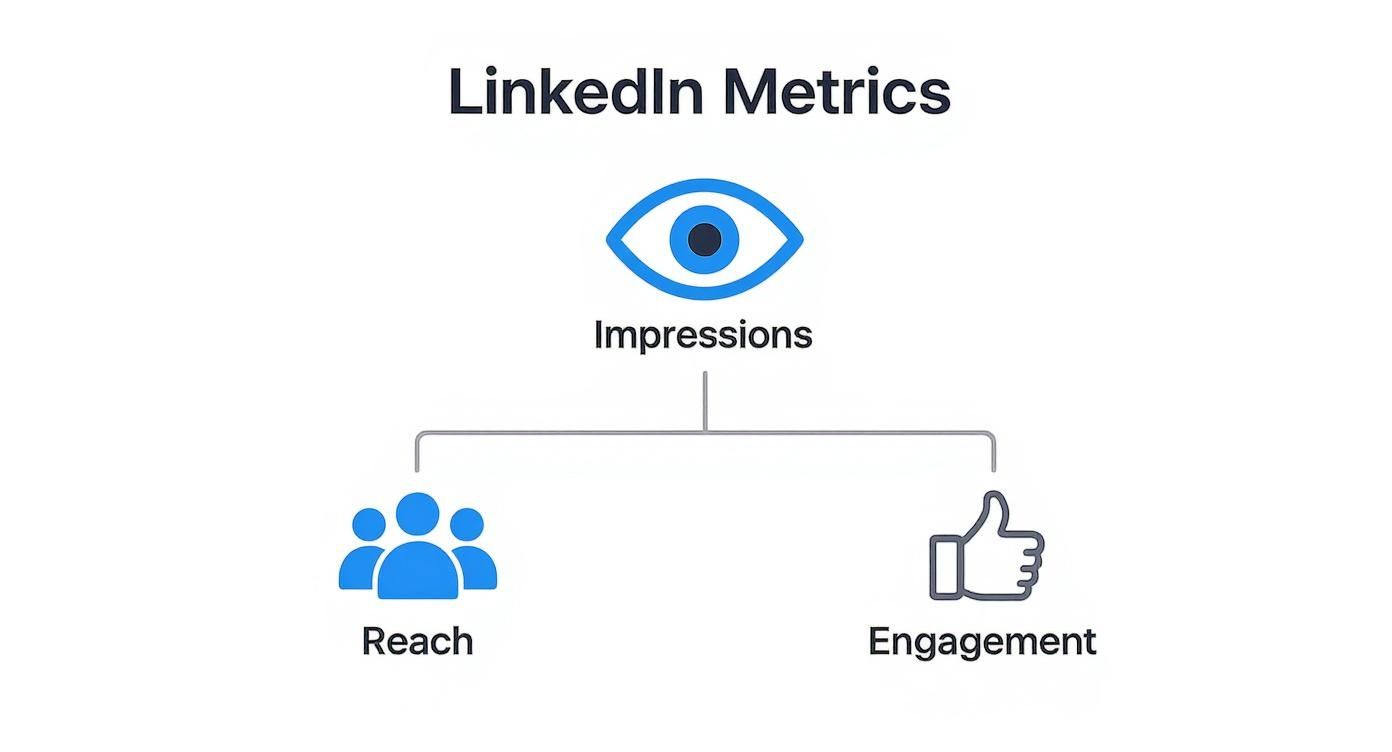
As the visual shows, impressions are the broadest measure. It's the total number of views, which is always bigger than your reach (unique viewers). If you want to dig deeper into how this works across different platforms, this a comprehensive guide to understanding social media impressions is a great read.
Finding and Understanding Your Impression Data
So, you’re sold on the idea of impressions. Great. But to really make them work for you, you need to know where to find the data and, more importantly, how to read the story it’s telling.
Thankfully, LinkedIn gives you a pretty powerful analytics dashboard, whether you're on a personal profile or a company page. Think of it like the dashboard in your car—it gives you the critical readouts you need to see how you're performing and when to make adjustments.
For any post you share from your personal profile, the feedback is immediate. Just look right below the post itself, and you'll see a direct count of impressions. This is your quickest gut check on how a specific piece of content is landing.
Locating Your Analytics Dashboard
For the bigger picture, you'll want to head to your main analytics section.
On a personal profile, you can get there by going to your "Posts & Activity" area. This is where you’ll find aggregated data over time. Company Pages have an even beefier "Analytics" tab, which is your central command for tracking all content performance.
Once you’re in, you'll see a chart breaking down your impressions over whatever time period you select.
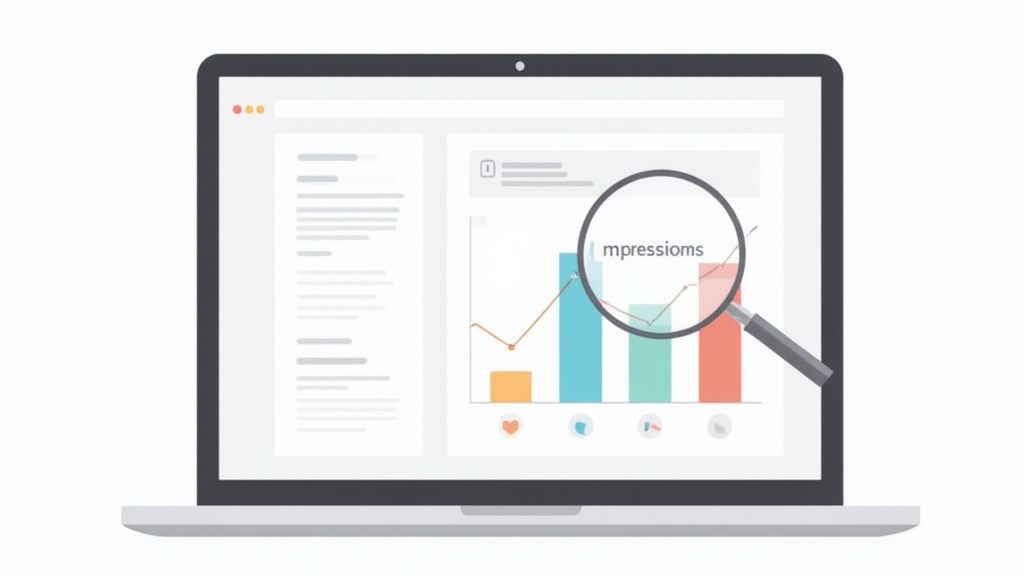
This simple visual is huge. It lets you spot trends at a glance. Are your impressions growing? Tanking? Staying flat? Figuring this out is the first real step toward building a smarter content strategy. And if you need a hand making sense of the numbers, a good LinkedIn Post Analyzer can give you much deeper insights into what’s really going on.
Differentiating Impression Types
Here’s a key detail: not all impressions are created equal. Your analytics will break them down into a few different types, and each one tells a different part of your content's story.
- Organic Impressions: These are the views you get from your immediate network—your followers and connections. High organic numbers mean your content is hitting the mark with the audience you've already built.
- Viral Impressions: This is where the magic really happens. These views come from people outside your network when someone shares, comments on, or likes your post. Viral impressions are the ultimate sign that you've created something truly shareable.
- Paid Impressions: If you're running ads, these are the views generated from your sponsored campaigns. This tells you the raw reach you’re getting for your ad spend.
Understanding the mix of organic versus viral impressions is crucial. It tells you if you're primarily talking to your existing circle or if your ideas are breaking out and reaching new, untapped audiences.
This distinction matters, especially on a platform with the sheer scale of LinkedIn. The growth has been absolutely staggering. Since 2019, the member base has exploded from 644 million to over 1.15 billion by early 2025.
That’s a nearly 79% increase, which just shows the incredible potential for your content to catch fire and reach a massive chunk of the world's professionals. By digging into your impression data, you can position your content to be seen by this ever-expanding audience.
Why Impressions Are Your Secret Weapon for Growth
It’s easy to look at LinkedIn impressions and wave them off as a “vanity metric.” A number that feels good but doesn’t actually move the needle.
That’s a huge mistake.
Ignoring impressions is like trying to close a deal without ever shaking someone’s hand. They’re the first step, the top-of-funnel fuel that makes every other meaningful action possible.
Think of your LinkedIn activity like a basic sales funnel. Before you get a single click, comment, lead, or connection, you have to earn awareness. Impressions are that awareness—the digital equivalent of someone noticing your brand in a crowded room.
You can't convert an audience you haven't reached. Each impression is a small deposit in your brand's recognition bank.
From Visibility to Opportunity
So how does this visibility actually turn into real-world results? It’s all about staying top-of-mind.
When your content consistently shows up in your network's feed, you slowly transform from a stranger into a familiar, credible voice. That subtle shift is where opportunity is born.
Think about these scenarios:
- The Unexpected Job Offer: A hiring manager in your network has been seeing your posts on industry trends for weeks. When a senior role opens up, your name is the first one that pops into their head—not because you applied, but because your consistent impressions built a perception of expertise.
- The Inbound Client Lead: A potential client has been quietly watching your content. They see you answer questions, share wins, and talk through challenges. When they finally have a need, you’re the obvious person to call because you've already built trust through sheer visibility.
- The Strategic Partnership: Another founder sees your high-quality content popping up all the time. Your high impression count signals you have an active audience, making you an attractive partner for a joint webinar or collaboration.
Each of these outcomes starts with the humble impression. They are the seeds of future engagement and business growth, proving that visibility isn't just for show—it's a strategic asset for long-term success.
Ultimately, a high volume of impressions on LinkedIn means you are consistently part of the conversation in your industry. This sustained presence ensures that when opportunities arise, you aren’t just an option; you’re the first one they think of.
Actionable Strategies to Boost Your LinkedIn Impressions
Knowing what impressions on LinkedIn are is one thing. Actually getting more of them is a whole different ball game. To boost your visibility, you need to shift from random posting to a deliberate content strategy—one that grabs attention and earns you some love from the algorithm. This isn't about cheating the system. It's about understanding how real people consume content and giving them something they actually find valuable.
The fight for attention is fierce. Every single minute, LinkedIn users view around 1.8 million feed updates. That's a ton of noise. With nearly half of all members logging in at least once a month, your content has to earn its spot in the feed.
Master the Art of the Hook
Let's be real: the first two lines of your post are the most important piece of real estate you have on LinkedIn. As people scroll at lightning speed, that "hook" is what decides if they stop and click "...see more" or just keep on flying by. A killer hook is your ticket to an impression that a human actually sees and processes.
How do you write one? Your goal is to spark curiosity or drop a bold, counterintuitive opinion that makes someone pause.
- Ask a provocative question: "Is the 9-to-5 workday officially dead?"
- Share a startling statistic: "90% of startups fail, but not for the reason you think."
- Start with a personal story: "I got rejected from 15 jobs in a row. Here's the one thing I changed."
That initial click signals to the algorithm that your post is interesting. In response, it starts showing it to more people, and boom—your LinkedIn impressions climb.
Your primary goal isn’t to tell the whole story in the first sentence. It’s to convince the reader that the rest of your story is worth their time.
Diversify Your Content Formats
If you’re only posting text, you’re leaving impressions on the table. The LinkedIn algorithm favors variety, and frankly, so does your audience. Mixing up your content formats keeps your feed from getting stale and appeals to the different ways people like to consume information.
Of course, a fundamental part of boosting your reach is implementing effective strategies to grow your LinkedIn followers. A bigger audience naturally means more initial impressions, and different content types are great for attracting new people.
Try working these formats into your weekly content plan:
- Carousels (PDFs): These are absolute gold for breaking down complex topics into simple, swipeable slides. They keep users on your post longer, which is a massive positive signal to the algorithm.
- Polls: Polls are a super low-effort way for your audience to engage, and they can kick off some fantastic debates in the comments. All that quick engagement often gives your post a fast spike in impressions.
- Video: Short, native videos (meaning you upload them directly to LinkedIn) are perfect for showing off your personality and building a much stronger connection than plain text ever could.
By mixing things up, you give the algorithm more reasons to push your content while appealing to a much wider slice of your audience. For a deeper dive into what types of content really move the needle, our guide on how to get more views on LinkedIn has even more tactical advice.
And if you want to skip the guesswork, a platform like GetViews.AI can help automate this entire process. It helps you brainstorm ideas, optimize a varied content mix, and consistently drive impressions without all the manual effort.
Stop Guessing, Start Strategizing: How to Use Your Data to Build a Winning Content Plan
Great content isn’t a lottery. It’s a science. The best creators aren't just guessing; they're making smart bets based on cold, hard data. Your LinkedIn analytics are a goldmine of clues telling you exactly what to create next.
Think of yourself as a detective combing a crime scene. Every post is a piece of evidence. Your job is to find the hidden patterns, understand what worked (and what flopped), and use those insights to build a content plan that gets more predictable results over time. This creates a powerful feedback loop: post, analyze, learn, and repeat.
Spotting Your Winning Content Formulas
First things first, pull up your best-performing posts from the last 30 to 90 days. Which ones pulled in the most impressions on LinkedIn? Don’t just admire the big numbers. Dig deeper and ask why they worked.
To uncover your unique patterns, ask a few simple questions:
- Format: Are carousels crushing it? Do native videos consistently get more eyeballs than simple text posts?
- Topic: Is industry news the clear winner, or do your personal stories and career tips get more traction?
- Timing: Do your Tuesday morning posts always seem to fly, while Friday afternoon posts fall flat?
Once you spot these trends, you can start doubling down on what your audience—and the LinkedIn algorithm—clearly wants to see. This is the first step in moving from random content acts to a repeatable, strategic system.
Your past performance is the best crystal ball you have. Forget generic "best practices" for a minute. Your own data is a personalized roadmap to success, tailored specifically to your niche and your audience.
Looking Beyond Impressions to Gauge Real Quality
Impressions tell you how many people saw your content, but they don't tell you how many people cared. A post can get thousands of views and still be a ghost town in the comments. That's a sign of low-quality content.
To get the full picture, you need to look at the relationship between views and action. This is where the impression-to-engagement ratio comes in.
It's a simple but powerful calculation: just divide your total engagements (likes, comments, shares) by your total impressions. A higher ratio means your content was compelling enough to stop the scroll and make someone do something.
For example, a post with 10,000 impressions and 500 engagements has a solid 5% ratio. That's a signal of high-quality, resonant content. This single metric helps you understand not just who saw your post, but who was truly captivated by it. Knowing how to measure content performance properly is what separates the pros from the amateurs, turning your content from a creative outlet into a real business driver.
Got Questions About LinkedIn Impressions?
Even with a solid plan, a few common questions always seem to trip people up when they start paying attention to their impressions on LinkedIn. Let's clear the air on a couple of the big ones so you can move forward with confidence.
What’s the Difference Between Impressions and Profile Views?
This is probably the most common point of confusion, and the distinction is critical.
An impression is just a "sighting." It means your content—a post, an article, even a comment you left on someone else's post—appeared on someone's screen as they scrolled. That's it. One scroll-by, one impression.
A profile view, on the other hand, is a much bigger deal. That's when someone was interested enough by what they saw to click your name and land directly on your profile page.
Think of it this way: impressions are the people who walk past your shop window. Profile views are the ones who open the door and come inside. Both matter, but they measure completely different levels of intent.
Why Do My Impressions Fluctuate So Much?
Welcome to the club. One post gets 10,000 impressions, the next gets 800. It feels random, but it's not. Seeing your numbers swing wildly is completely normal. The LinkedIn algorithm is a beast, juggling hundreds of signals to decide who sees what.
A few key things can cause those rollercoaster numbers:
- Early Engagement: A post that gets likes and comments in the first hour or two gets shown to more people. A slow start can kill its reach.
- Content Fit: The algorithm is trying to play matchmaker between your post and users' interests. Sometimes it nails it, other times it gets it wrong.
- Platform Noise: Your content is competing against millions of other posts. On super busy days, it's just harder to get seen.
Here's the key: don't get obsessed with the performance of a single post. Instead, track your average impression count over a few weeks. That's where you'll see the real trends. True growth isn't about one viral hit; it's about a steady upward climb over time.
Ready to stop guessing and start growing? GetViews.AI turns your expertise into a consistent pipeline of high-performing content, putting your LinkedIn growth on autopilot. Turn your professional stories into revenue opportunities at https://getviews.ai.