What is sales pipeline management: Key Steps to Predictable Revenue
Explore what is sales pipeline management and learn how to define stages, track metrics, and optimize your sales process for predictable revenue.
Wilmer KarlssonTarstad
Sales pipeline management is the hands-on process of guiding every potential sale through a clear set of stages, from that first "hello" all the way to a signed contract.
Think of it like building the riverbanks that guide opportunities from a wide lake of leads toward a specific destination. You’re not just watching the water flow; you're actively shaping its path. It’s the art of creating a predictable, repeatable system for generating revenue.
What Is Sales Pipeline Management Exactly
Imagine your sales process is an assembly line. Raw materials (leads) go in one end, and a finished product (a happy, paying customer) comes out the other. Sales pipeline management is the system you put in place to make sure that assembly line runs smoothly and efficiently, without breaking down.
It’s a visual, trackable map of every single opportunity your team is working on. This isn't about just watching from the sidelines; it’s about knowing exactly when and where to step in. Good pipeline management gives sales leaders the clarity to see which deals are on track, which ones are about to stall, and where the team should really be focusing its energy.
From Chaos to Clarity
Without a managed pipeline, sales feels chaotic. Reps end up chasing low-value deals, follow-ups are all over the place, and forecasting is basically just a hopeful guess. The numbers back this up—research shows that companies with a formal sales process see 18% more revenue growth than those that don't.
Putting a solid pipeline management process in place brings order to the chaos by giving you:
- Clear Visibility: A real-time snapshot of every deal, its value, and exactly where it stands.
- Actionable Insights: Hard data on where deals are slowing down, helping you pinpoint and fix the bottlenecks.
- Improved Forecasting: A much more accurate way to predict future revenue based on what's actually happening, not just wishful thinking.
At its core, sales pipeline management is about turning the unpredictable art of selling into a measurable science. It gives you the structure you need to scale your team, coach reps effectively, and build a consistent revenue engine.
Pipeline vs. Funnel: A Quick Clarification
People throw the terms "sales pipeline" and "sales funnel" around like they’re the same thing, but they actually show you two different views of the world. A funnel is all about the customer's journey and measures how a large number of leads gets narrowed down. A pipeline, on the other hand, is all about the sales team's actions—the specific stages a rep moves a deal through to get it closed.
Here’s a quick breakdown to make it crystal clear.
Sales Pipeline vs Sales Funnel Key Differences
| Aspect | Sales Pipeline | Sales Funnel |
|---|---|---|
| Perspective | Seller-centric (focuses on the actions your sales team takes) | Buyer-centric (focuses on the customer's journey from awareness to purchase) |
| Purpose | To manage and track the health and progress of active deals | To measure conversion rates and see how many leads you have at the top |
| Structure | A series of linear stages representing your sales process (e.g., Qualify, Demo, Proposal) | A top-down view of lead volume as it narrows (e.g., Awareness, Interest, Consideration) |
In short, the funnel tells you how many potential customers you have, while the pipeline tells you what your team is doing to turn them into actual customers. Both are important, but they serve very different purposes.
Building The Essential Stages Of Your Sales Pipeline
A sales pipeline isn't some rigid, one-size-fits-all template. It's a living blueprint of your customer's actual buying journey. Building one is all about defining the key milestones a deal has to clear to get from a qualified lead to a paying customer. Each stage represents a specific set of moves your reps need to make to push an opportunity forward.
Defining these stages is step one in taking control of your sales process. Without them, you're just winging it, treating sales as a series of random activities. With them, you have a clear, repeatable roadmap that guides your team and starts making revenue feel predictable. The best sales teams don't just have stages; they have crystal-clear "exit criteria" for each one—specific, non-negotiable conditions that have to be met before a deal can advance.
Think of it as a funnel, where you pour in a bunch of leads at the top and, through a series of filters (your pipeline stages), end up with pure gold—closed-won deals—at the bottom.
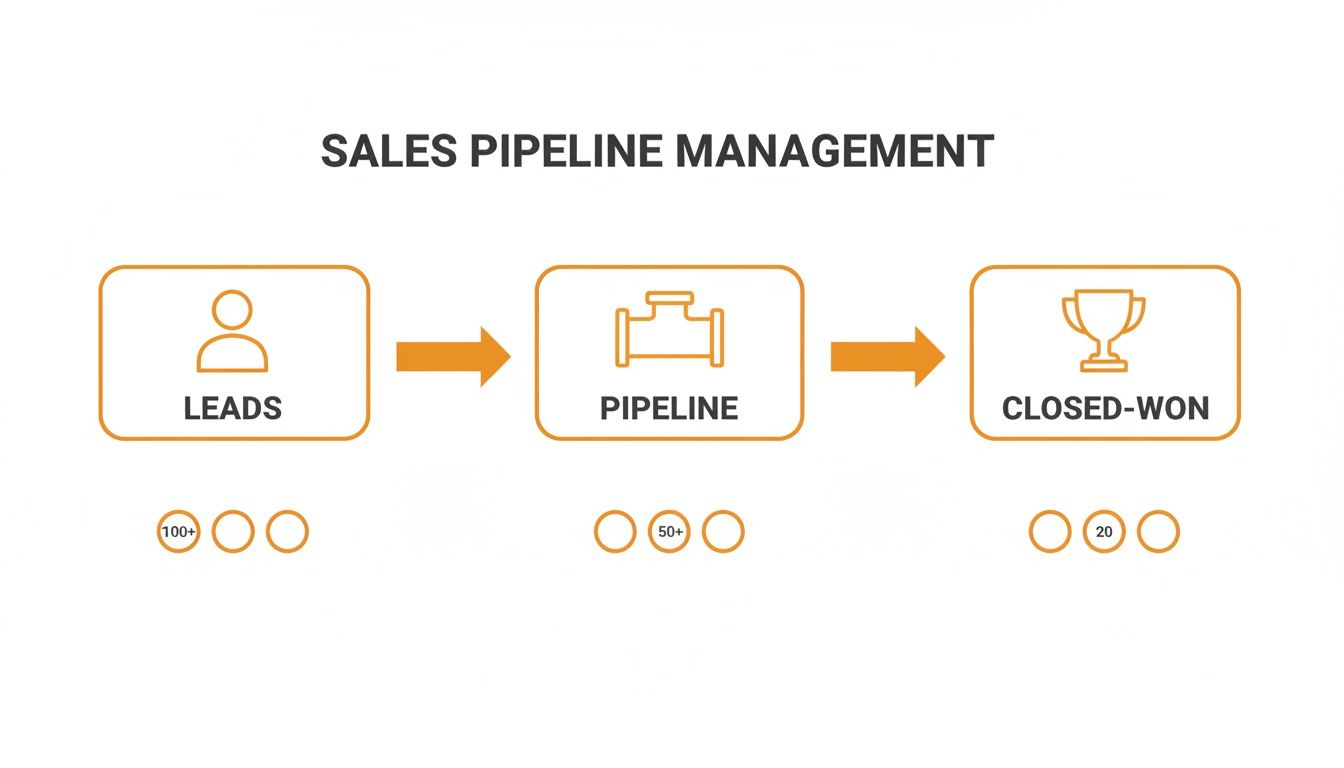
This process shows how a large number of initial leads get refined and qualified, ultimately resulting in a smaller, but much more valuable, set of successful deals.
Stage 1: Lead Qualification
This is the gatekeeper stage, the bouncer at the club. A lead—whether it came from marketing or an inbound inquiry—isn't an "opportunity" yet. The whole point here is to figure out if this person has a real need and if they actually fit your ideal customer profile (ICP).
Your reps are asking the tough questions to make sure the lead has a problem you can actually solve. This is all about that initial conversation designed to weed out the tire-kickers and focus your team's energy where it counts.
Exit Criteria: The lead is confirmed to have a relevant business pain, a potential budget, and the authority (or a clear path to the authority) to make a buying decision.
Stage 2: Discovery Call
Once a lead is qualified, it officially becomes an opportunity and moves into discovery. This is where the real work—and the real selling—begins. The mission is to go deep, to understand the full scope of the prospect’s challenges, their goals, and the actual business impact of not solving their problem.
This is absolutely not a product demo. It’s a strategic consultation. Your reps should be asking smart, open-ended questions to uncover the details and position themselves as trusted advisors. With sales cycles having stretched by 32% in recent years, building that trust and value early on is more critical than ever.
- Key Activities: Asking probing questions, actively listening, and connecting their pain points directly to what your solution does.
- Common Hurdles: Reps who talk more than they listen or jump straight into a generic pitch without understanding the context.
For a more detailed walkthrough, check out our guide on how to build a sales pipeline that actually converts.
Stage 3: Solution Presentation or Demo
Okay, you've done your homework and deeply understand the prospect's needs. Now it's time to show them the solution. This stage is all about demonstrating tangible value. The presentation or demo must be tailored specifically to the pain points you uncovered during discovery.
A generic, feature-dump demo is a waste of everyone's time. A killer presentation connects every feature you show back to a specific problem the prospect is trying to solve, making your value proposition feel real and urgent.
Exit Criteria: The prospect verbally agrees that what you've shown them effectively solves their core problems and asks about next steps, like getting a proposal.
Stage 4: Proposal and Negotiation
Now that the prospect sees the light, it's time to talk commercials. This stage involves sending over a formal proposal that clearly outlines the scope of work, pricing, and all the terms of the agreement.
Negotiation is a natural part of this phase, where both sides work to find common ground. This could mean tweaking the price, adjusting contract length, or clarifying implementation details. The key here is to be transparent and clear to keep the momentum going and solidify that trust you've been building.
Stage 5: Closing The Deal
This is it—the final hurdle. The opportunity is marked either Closed-Won or Closed-Lost. If you win, contracts are signed, and the deal officially becomes revenue. This is also the critical moment for a smooth handoff to your customer success or onboarding team to ensure a great experience from day one.
But what if you lose? It's just as important to document why the deal was lost. That data is gold. It helps you refine your sales process, sharpen your product positioning, and get smarter about your competition. Every outcome, win or lose, is a lesson.
Measuring The Health Of Your Sales Pipeline
Your sales pipeline isn't just a list of deals. Think of it as a living, breathing system that needs regular check-ups to stay healthy. Relying on guesswork or gut feelings is like flying blind—you might get lucky, but you're more likely to crash.
To really understand what's working (and what's not), you have to measure your pipeline's vital signs. Specific, actionable metrics are the only way to go.
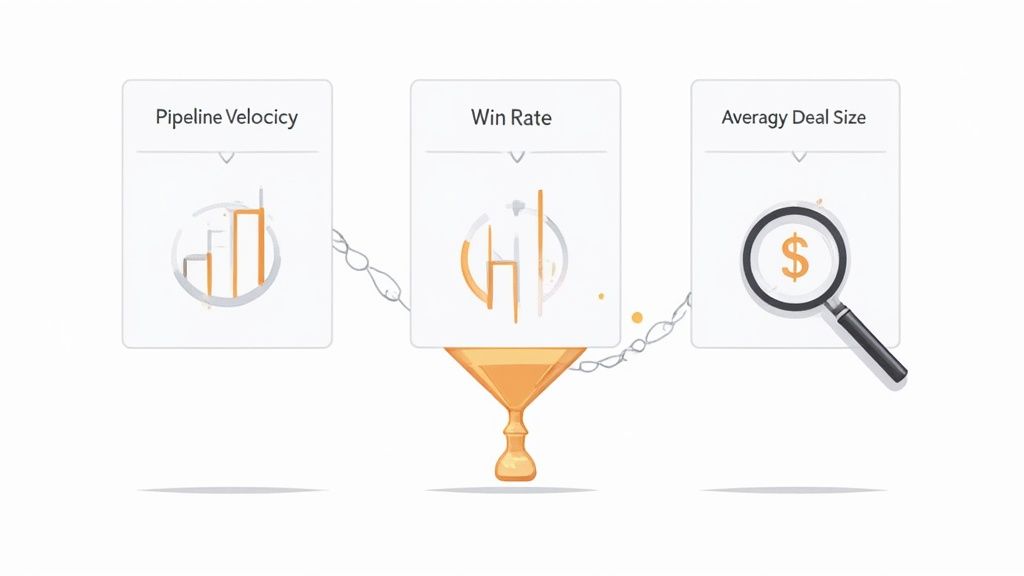
Tracking these key performance indicators (KPIs) is what turns raw data into a clear story. It shows you exactly where deals are getting stuck, how efficient your team really is, and whether you're actually on track to hit your revenue targets. This data-driven approach is the bedrock of predictable growth.
And the payoff is huge. Companies with a defined sales process see nearly 30% higher revenue growth than those without one. Even better, those who keep their pipeline data accurate are 10% more likely to see year-over-year growth. You can read the full research on sales pipeline coverage to see just how powerful this is.
Key Sales Pipeline Metrics To Track
To get a complete picture of your pipeline’s health, you don’t need dozens of vanity metrics. Just focus on a handful of high-impact ones. These four give you a balanced view of your team's efficiency, effectiveness, and overall value.
1. Win Rate
Your Win Rate (or close rate) is one of the simplest but most telling metrics you have. It tells you exactly what percentage of your qualified opportunities turn into actual, paying customers. It's a direct reflection of your sales team's effectiveness.
- Formula: (Number of Closed-Won Deals / Total Number of Opportunities) x 100
- What It Measures: How well your team converts genuine interest into revenue. A low win rate might point to problems with your qualification process, uninspiring product demos, or getting outmaneuvered by competitors.
- How to Use It: Don't just look at the overall number. Track win rates by individual rep, by team, or even by lead source. This helps you spot your top performers (who can then mentor others) and reveals which marketing channels are sending you the best-fit opportunities.
2. Average Deal Size
Closing deals is great, but the value of those deals is just as critical. Average Deal Size tracks the typical revenue you bring in from a single closed-won deal.
- Formula: Total Revenue from Closed-Won Deals / Number of Closed-Won Deals
- What It Measures: The financial impact of a typical sale. Keeping an eye on this helps with revenue forecasting and tells you if your team is successfully upselling or cross-selling.
- How to Use It: Is your average deal size shrinking? It could be a sign that reps are handing out discounts too freely or are focusing on smaller, less profitable clients. On the flip side, a rising deal size shows that your value proposition is hitting home with higher-value customers.
Key Takeaway: A high win rate on a bunch of tiny deals might look good on a dashboard, but a healthy average deal size ensures your team's effort is actually generating significant revenue. The magic is in balancing both.
Metrics That Measure Pipeline Efficiency
Winning deals is one thing, but how quickly and efficiently you do it is another. A clunky, inefficient process can bleed resources and put your revenue goals at risk, no matter how skilled your sales team is.
3. Sales Cycle Length
The Sales Cycle Length is the average time it takes for an opportunity to move all the way through your pipeline—from the moment it's qualified to the day it's closed. A shorter cycle means you generate revenue faster. It's that simple.
- Formula: Total Number of Days to Close All Deals / Number of Deals
- What It Measures: The speed of your sales process. If your sales cycle is long or, worse, getting longer, it's a huge red flag for bottlenecks. Maybe proposals are taking too long to get out the door, or negotiations are dragging on forever.
- How to Use It: By analyzing how long deals sit in each stage, you can pinpoint exactly where things are slowing down. This allows you to give targeted coaching to your team or streamline specific parts of your process. This metric is also a key piece of the puzzle for understanding your customer acquisition cost calculation.
4. Pipeline Velocity
Finally, we have Pipeline Velocity. Think of this as the ultimate health metric because it rolls the other three KPIs into a single, powerful number. It measures how much revenue is moving through your pipeline every single day, giving you a real-time pulse on your sales engine.
- Formula: (Number of Opportunities x Average Deal Size x Win Rate) / Sales Cycle Length in Days
- What It Measures: The speed at which you are making money.
- How to Use It: Because it combines multiple factors, even small improvements in your win rate, deal size, or sales cycle can have a massive impact on your velocity. This metric shows sales leaders exactly which levers to pull to speed up revenue growth most effectively.
Don't Let These Common Mistakes Sabotage Your Pipeline
A healthy sales pipeline is your engine for predictable revenue. But even the best-looking pipelines can spring leaks, letting deals vanish and turning your forecasts into fiction. Getting pipeline management right means understanding—and avoiding—the common traps.
These aren't big, dramatic failures. They're usually subtle habits that quietly kill your momentum. Things like letting stale deals hang around for months, working with messy CRM data, or just going through the motions in your pipeline reviews. The trick isn't just reacting to problems; it's building a process that stops them from ever taking root.
Letting Stale Deals Clog the Arteries
One of the biggest mistakes is treating your pipeline like a storage unit instead of a fast-moving river. Reps often cling to dead or stalled deals, maybe out of pure optimism or fear of an empty pipeline. This habit clutters the view, creates a false sense of security, and ultimately leads to wildly inaccurate forecasts. Even worse, it wastes precious time that could be spent on opportunities that are actually alive.
What's a "stalled" deal? Any opportunity that's been sitting in one stage for longer than your average. If deals usually move from "Demo" to "Proposal" in seven days, one that's been stuck in the "Demo" stage for a month is a red flag.
Rule of Thumb: Run a tight ship with a "use it or lose it" policy. If a deal shows no real forward momentum—like a next meeting locked in the calendar or a clear "yes" from the prospect—within a set timeframe (say, 14-21 days), it needs to go. Move it out of the active pipeline and into a long-term nurture sequence.
This kind of discipline keeps your pipeline clean, your data trustworthy, and your team focused on deals that actually have a chance of closing.
Giving Up on Follow-Ups Too Soon
Dropping leads too early is another massive, self-inflicted wound. The road to a signed contract is almost always longer than salespeople think, and it demands persistent, valuable communication to keep the conversation from going cold. When follow-ups are spotty, promising deals just fade away.
The numbers on this are staggering. It turns out persistence is everything. An incredible 80% of sales require 5 to 12 follow-up attempts to close. Yet, 92% of salespeople throw in the towel after four "no's" or fewer. With sales cycles stretching 32% longer since 2021, that gap is costing companies a fortune. You can dig into more of these sales stats on flowlu.com.
The fix is to standardize your follow-up cadence so every qualified lead gets the attention it deserves.
- Build a Multi-Touch Cadence: Map out a clear sequence of emails, calls, and LinkedIn touches over a specific period.
- Automate Your Reminders: Your CRM should be your best friend here. Set up automatic tasks for every follow-up so nothing ever slips through the cracks.
- Lead with Value, Not "Just Checking In": Every single touchpoint should offer something new—an insightful article, a relevant case study, or a helpful tip. Never send another generic "just checking in" email again.
Running Pipeline Reviews That Are a Waste of Time
Too many teams treat pipeline reviews as a simple status update where reps just list off their deals. This is a huge missed opportunity. A real pipeline review is a strategic coaching session, not an interrogation. The goal is to spot risks, brainstorm next steps, and figure out how to keep deals moving.
A great pipeline review is all about strategy, not status. Instead of asking, "What's the update?" managers should be asking questions that force reps to think critically:
- "What's changed since the last time we talked to this prospect?" This homes in on actual progress, not a generic summary.
- "What's the very next step, and is it confirmed on the calendar?" This demands clear, scheduled actions, not vague hopes.
- "What's the single biggest risk to this deal, and what's our plan to get ahead of it?" This pushes everyone to solve problems before they happen.
When you shift the focus from reporting to strategy, your pipeline review transforms from a weekly chore into one of your most powerful tools for hitting your number.
Using Modern Tools To Supercharge Your Pipeline
A well-defined sales process is the engine that drives predictable revenue. But in today's world, technology is the high-octane fuel that makes the engine scream.
Modern tools, especially Customer Relationship Management (CRM) platforms, act as the central nervous system for your entire sales operation. They bring order to the chaos, standardizing your pipeline stages and making sure every rep is running the same playbook.
For sales leaders, this is game-changing. Instead of wrestling with messy spreadsheets and inconsistent data, you get a clear, real-time picture of every deal's health. It turns guesswork into an actionable strategy.
The Rise of AI in Sales Pipeline Management
Beyond a foundational CRM, Artificial Intelligence (AI) is completely reshaping the sales landscape. This isn't just a buzzword; AI delivers real, measurable results by automating soul-crushing repetitive tasks and pulling powerful insights out of your data.
Just look at the numbers. In 2023, a mere 24% of sales teams were using AI. By 2024, that figure shot up to 43%, and it’s still climbing fast. This isn’t just a trend—it’s a performance gap. Teams using AI are seeing massive gains, with 83% reporting revenue growth, compared to just 66% for those who haven't adopted it.
This tech doesn't replace solid sales fundamentals. It amplifies them, letting your team work smarter, not just harder.
By automating administrative work and providing data-driven recommendations, technology frees up your sales team to do what they do best: build relationships and close deals. It empowers them with the information they need to be more strategic in their approach.
Practical Applications of Modern Sales Tools
So, how does this technology actually supercharge your pipeline in the real world? It turns abstract data into tangible advantages that directly boost your bottom line, helping reps prioritize their time and giving managers the intel they need to coach effectively.
Here are a few high-impact examples:
- Predictive Lead Scoring: Instead of treating every lead the same, AI algorithms analyze your historical data to spot the characteristics of your best customers. New leads get scored in real-time, letting your team instantly focus on the opportunities most likely to close.
- Sales Forecasting: Gut feelings don't cut it. AI-powered forecasting looks at deal progression, rep activity, and historical win rates to produce far more accurate revenue predictions. This gives leadership a trustworthy view of what's coming down the pike.
- Task Automation: Think about all the time wasted on manual data entry. Modern platforms can automatically log calls and emails, set follow-up reminders, and even draft initial outreach messages. This gives your reps back hours of their day for actual selling.
To see just how deep this integration can go, consider the impact of adding an AI sales assistant to your workflow.
Ultimately, the right tech stack transforms your sales pipeline from a simple tracking document into a dynamic, intelligent system that actively helps you grow your business.
Weaving LinkedIn Leads Into Your Sales Pipeline
Let's be honest: LinkedIn is an absolute goldmine for high-quality B2B leads. But a connection request or a clever comment on your post isn't a sales opportunity. Not yet, anyway.
For those leads to mean anything, you need to pull them out of the chaotic world of DMs and notifications and plug them into a structured, repeatable sales process. This is the critical handoff point where solid sales pipeline management turns a simple online interaction into actual, measurable revenue.
Think of it as building a bridge. On one side, you have a casual LinkedIn chat. On the other, the first formal stage of your pipeline. Without that bridge, promising prospects fall into the abyss of overflowing inboxes and forgotten alerts. A smart, systematic approach makes sure every high-intent signal from a prospect gets the timely, personal follow-up it deserves.
The whole point is to create a predictable flow. By deciding exactly what makes a LinkedIn prospect a Sales Qualified Lead (SQL), you give your team the green light to focus their energy on conversations that have a real shot at converting.
Defining Your LinkedIn SQL Criteria
Not every like, comment, or connection is ready for a sales conversation. Your first move is to set up clear, non-negotiable criteria for when a prospect officially graduates from "LinkedIn contact" to "pipeline opportunity." This is how you stop your team from chasing ghosts and keep the top of your pipeline clean.
An effective handoff needs clear rules of engagement. For instance, a lead only becomes an SQL after they meet a few specific conditions.
- They engaged meaningfully: They didn’t just like your post; they replied to your DM, asked a thoughtful question in the comments, or accepted your connection request and immediately checked out your profile.
- They fit your ICP: Their company size, industry, and job title are a perfect match for your ideal customer profile. No exceptions.
- They showed real intent: They flat-out asked for more information, brought up a pain point your product solves, or downloaded a guide you shared.
Only when a prospect checks these boxes do they get moved from a simple "LinkedIn Prospect" into the "Qualification" stage of your CRM.
The Ideal Follow-Up Cadence
Once a lead is qualified, speed and relevance are everything. Your follow-up shouldn't feel like a generic pitch dropped from the sky—it needs to be thoughtful and add real value. A multi-touch approach designed specifically for LinkedIn prospects is incredibly effective.
The goal isn't to sell right away. It's to move the conversation from the public feed to a private, value-driven dialogue. That shift is where real pipeline building happens, turning a flicker of passive interest into an active opportunity.
Here’s a simple but powerful cadence you can start with:
- Initial DM (Within 24 Hours): Reference the exact interaction (e.g., "Hey, thanks for your comment on my post about pipeline velocity..."). Ask an open-ended question that relates to their comment or their role.
- Value-Add Follow-Up (Day 3): Send them a relevant article, case study, or resource that speaks directly to a common pain point for someone in their position. Keep it short, sweet, and genuinely helpful.
- Connection to a Problem (Day 5): Gently pivot the conversation toward a business challenge. "You know, a lot of leaders in your space tell me they struggle with X. Is that something on your radar at all?"
- The Ask (Day 7): If the engagement has been positive and they're responding, it's time to propose a brief call to dig into their challenges and share a few ideas.
Platforms like GetViews.AI can automate this entire top-of-funnel dance. By setting up automated DM sequences that trigger when someone engages with your posts, you create a steady, consistent flow of new conversations. This ensures no high-intent lead ever slips through the cracks. It’s how you turn your LinkedIn activity into a predictable source of qualified opportunities, keeping your sales pipeline full and your reps focused on what they do best: closing deals.
For a deeper dive into making this happen, check out our complete guide on prospecting with LinkedIn to really dial in your strategy.
Got Questions? Let's Talk Specifics.
Even when you've got the basics down, a few questions always pop up when you're in the trenches. Here are some of the most common ones I hear, with straight-to-the-point answers.
What Is The Difference Between A Sales Forecast And A Sales Pipeline?
Think of it like this: your sales pipeline is the roadmap of every single deal your team is currently working on. It’s a real-time, visual map showing who's where—from the first "hello" to the final signature.
A sales forecast, on the other hand, is your prediction based on that map. It’s an educated guess, backed by pipeline data, of how much revenue you'll actually close in a given month or quarter. The pipeline shows the journey; the forecast predicts the destination.
How Often Should I Review My Sales Pipeline?
The gold standard here is a weekly pipeline review. Any less, and deals start to go stale. Any more, and you're just micromanaging.
This weekly rhythm is non-negotiable for a few reasons:
- It keeps the momentum going: Regular check-ins force action and keep deals moving forward.
- It sharpens your forecast: You get a much more accurate picture of reality when deal stages and close dates are constantly being refined.
- It keeps things clean: Dead or stalled deals get pruned out fast, so your team stays focused on what can actually close.
A weekly review isn't just a status update. It's a strategic coaching session. Done right, it's one of the most powerful tools a sales leader has for hitting their numbers, quarter after quarter.
Can A Small Business Benefit From Pipeline Management?
Absolutely. I'd argue it’s more critical for a small business. When you have a smaller team and every dollar counts, you can't afford to let a single opportunity slip through the cracks.
For a small business, a structured pipeline is an instant advantage. It forces a consistent follow-up process, making sure you get the most out of every lead. More importantly, it gives you the data to see which activities are actually making you money, so you can pour your limited resources into what works. It’s how you build a predictable path to growth.
Ready to turn your LinkedIn activity into a predictable source of qualified leads? GetViews.AI automates your top-of-funnel engagement, filling your pipeline with high-intent prospects so your team can focus on closing deals. Transform your LinkedIn presence into a revenue machine.