Automated Lead Generation A Complete Guide
Discover how automated lead generation can transform your sales pipeline. Our guide covers strategies, AI tools, and workflows to convert leads on autopilot.
Wilmer KarlssonTarstad
Automated lead generation is a fancy term for a simple idea: using technology to find, qualify, and nurture potential customers around the clock, without you having to lift a finger for every single step. Think of it as building an intelligent, self-operating factory for your business that keeps your sales pipeline humming. This lets your team stop hunting for leads and start focusing on what they do best—closing deals.
What Is Automated Lead Generation

Imagine a tireless expert working 24/7, sifting through the noise to spot your ideal customers and gently guide them toward making a purchase. That's the real magic behind automated lead generation. It’s much more than just plugging in a new piece of software; it's a strategic system you build to move potential buyers through your sales funnel without friction.
This system is always on, capturing interest from all your different channels, sorting prospects by how likely they are to buy, and delivering the right information at the right time to build trust. It’s the engine that powers scalable, consistent growth.
Solving Key Business Challenges
Let's be honest, manual lead generation is a grind. Sales teams burn countless hours on repetitive tasks, which means missed opportunities and pipelines that feel perpetually stuck. An automated system is designed to fix these exact headaches.
- Eliminates Repetitive Tasks: It takes over the soul-crushing work of data entry, initial follow-ups, and sorting through leads, freeing up your team's time for high-value conversations.
- Ensures Consistency: Every single lead gets a prompt, relevant touchpoint. No one falls through the cracks, whether they show interest at 2 PM on a Tuesday or 2 AM on a Sunday.
- Improves Lead Quality: By using rules and lead scoring, the system automatically surfaces the prospects who are actually ready to talk, pushing the tire-kickers to the back of the line.
The payoff here is huge. It’s a top priority for about 50% of marketers across the globe for a reason. Companies using these methods generate an average of 1,877 leads a month. But with the average cost per lead floating around $198, you absolutely need an efficient system to make sure you're not just burning cash. You can dig into more lead generation statistics and trends to see the full picture.
By automating the top of your funnel, you create a predictable flow of opportunities. This allows your sales team to stop prospecting and start focusing exclusively on high-intent conversations that lead to revenue.
Ultimately, this whole strategy is about letting your sales experts be experts. When you hand off the messy, initial stages of the customer journey to a reliable, automated process, you build a far more effective and profitable sales machine.
Understanding The Core Components Of Automation
A killer automated lead generation system isn't just one piece of software. It’s a machine, with a few distinct parts working in sync to churn out predictable results. To really get how this works, you have to break it down into the four essential components that form the backbone of any real automation engine.
Think of it like an assembly line for your sales pipeline. Each station has a specific job, and when you connect them correctly, the whole thing runs on its own, turning raw interest into actual customers.
Lead Capture: The Front Door
First up, and most importantly, is Lead Capture. This is the entry point—the moment an anonymous website visitor or social media lurker raises their hand and identifies themself. Your only job here is to make it dead simple and compelling for them to give you their contact info.
This whole stage is about creating an inviting "front door." Instead of a single, boring contact form, a modern automation strategy uses a bunch of different hooks to engage different kinds of visitors.
You’ll typically see things like:
- Smart Forms and Pop-ups: Not the annoying kind. These are triggered by specific actions, like when someone is about to leave your site, offering a relevant guide in exchange for an email.
- Interactive Quizzes and Assessments: Fun tools that give the user immediate value while you collect super-valuable data on their needs.
- Chatbots and Live Chat: These bots can field questions 24/7, qualify visitors on the spot, and grab contact details without a human ever getting involved.
- High-Value Lead Magnets: The classic for a reason. Offering juicy downloadable content like eBooks, webinars, or checklists in exchange for an email is still one of the most effective tactics out there.
Lead Qualification: The Sorting System
Once you've captured a lead, the next stop is Lead Qualification. This is the brain of your whole operation, figuring out how valuable each new contact is and how ready they are to talk to sales. If you skip this, your sales team will burn countless hours chasing people who are just kicking tires.
The goal is simple: separate the hot prospects from the curious onlookers. This is usually done with two automated processes working together.
Lead qualification is where automation delivers its biggest ROI, hands down. By automatically flagging the most engaged and relevant prospects, you ensure your sales team only spends time on conversations that actually turn into money.
This sorting system is all about using data to make smart calls.
- Lead Scoring: This process assigns points to leads based on who they are (demographics, company size, job title) and what they do (pages they visit, emails they open, content they download). A lead who hits your pricing page gets way more points than someone who just reads a blog post.
- Segmentation: Based on their score and other info, leads get automatically sorted into different buckets, like "Hot," "Warm," or "Cold." This lets you hit them with much more targeted and relevant messages in the next stage.
Lead Nurturing: The Relationship Builder
After a lead is qualified and segmented, the Lead Nurturing phase kicks in. This is where you build a real relationship and gently guide prospects along their buying journey using automated, personalized messages. A lead who just downloaded an introductory eBook isn't ready for a demo, but they’re definitely ready to learn more.
Nurturing campaigns are all about delivering the right message at the right time, building trust and keeping your brand at the top of their mind. This is usually done through automated email sequences or social media DMs that are triggered by a lead's score or segment. For example, a "Warm" lead might get a case study, while a "Hot" lead gets an invite to book a demo.
Lead Routing: The Final Hand-Off
The last piece of the puzzle is Lead Routing. As soon as a lead hits a certain score or takes a high-intent action (like requesting that demo), this system instantly assigns them to the right salesperson. Speed is everything here—studies show that responding to a hot lead within five minutes massively increases your odds of closing the deal.
Automated routing gets rid of clumsy manual hand-offs and makes sure no hot lead gets left hanging. You can set up rules to assign leads based on territory, industry, or even which salesperson is available right now. It creates a seamless transition from marketing to sales and tees them up for an easy close.
How To Design Your Automated Workflow
Turning a great idea into a high-performing lead machine starts with a solid blueprint. A killer automated workflow isn't just a random sequence of actions. It’s a carefully planned journey designed to guide potential customers from their first flicker of curiosity all the way to conversion. This is what ensures your automation feels helpful and genuinely relevant, not just robotic.
Everything kicks off with a deep, almost obsessive, understanding of your Ideal Customer Profile (ICP). I'm not talking about basic demographics. You need to know their deepest pain points, their day-to-day challenges, and what a "win" actually looks like for them. You have to know who you're talking to before you can even think about automating the conversation.
Start With The Customer Journey
Once you've nailed down your ICP, it's time to map their journey. Think of it like drawing a treasure map where "X" marks a sales-ready lead. The goal is to identify every single touchpoint and decision a prospect makes on their path to becoming a customer.
This map helps you pinpoint the perfect moments for automation to step in and do its thing. A visitor downloading their first ebook is in a completely different headspace than someone who just watched a full product demo or hit your pricing page three times in one week.
An automated workflow is essentially a series of 'if/then' statements that mirror your customer's decision-making process. If a lead does X, then the system automatically triggers Y. This logic is the engine that drives personalized engagement at scale.
Understanding these critical moments allows you to build pathways that feel natural and responsive, building trust with every single interaction.
Crafting The Essential Components
With your customer journey mapped out, you can start building the individual pieces of your workflow. These are the practical assets that will actually capture, educate, and persuade your leads.
- Irresistible Lead Magnets: Create genuinely high-value content—think detailed guides, exclusive webinars, or handy interactive tools that solve a very specific problem for your ICP. This is the bait that gets the whole automated sequence started.
- High-Converting Landing Pages: Design clean, focused landing pages for each lead magnet. A landing page should have one job and one job only: to clearly spell out the value of your offer and make it dead simple for someone to hand over their information.
- Personalized Nurture Sequences: This is where the magic really happens. Develop automated email or messaging sequences that are tailored to the specific lead magnet they downloaded. Someone who grabbed a beginner's guide should get educational content, while someone who requested a case study is ready for more bottom-of-the-funnel material.
This simple infographic gives you a bird's-eye view of how a core automated system flows, from the initial capture all the way to routing a hot lead to sales.
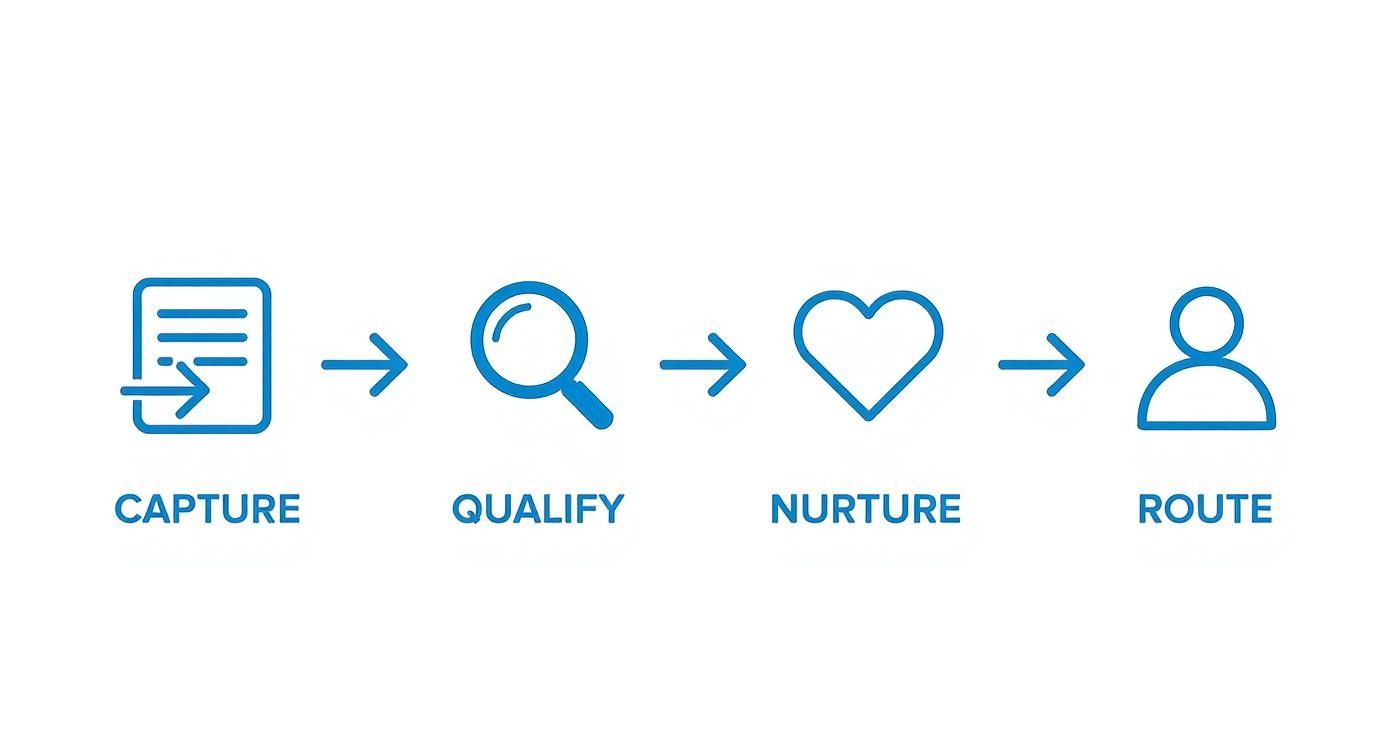
As you can see, each stage logically connects to the next, ensuring a smooth and efficient transition for every single prospect.
Implementing Logic and Segmentation
The final layer is the "if/then" logic that makes your workflow smart. This means setting up rules and triggers in your automation software that guide leads down different paths based on what they actually do.
For example:
- If a lead downloads an ebook, then add them to the "Early Stage Nurture" email sequence.
- If that same lead later visits the pricing page, then crank up their lead score by 20 points and send them a targeted case study.
- If their lead score shoots past 100 points, then automatically assign them to a sales rep for immediate follow-up.
This kind of rules-based approach ensures your marketing efforts are hyper-relevant and incredibly efficient. And it's a proven strategy—marketing automation has a huge impact on lead generation, with 80% of users reporting a significant increase in the number of leads they acquire. What's more, 34% of marketers directly credit these platforms for supercharging their nurturing capabilities, allowing them to scale activities that would otherwise completely overwhelm their teams. You can find more marketing automation insights and statistics on EmailVendorSelection.
By taking the time to design a thoughtful, customer-centric workflow, you create an automated machine that doesn't just save time—it delivers a superior experience that builds trust and, ultimately, drives revenue.
Using AI To Supercharge Your Automation
Think of your standard lead generation automation as a factory assembly line. It’s efficient, it follows the rules you set, and it gets the job done. Now, think of Artificial Intelligence as the brilliant factory manager who walks the floor, spots tiny inefficiencies no one else sees, and constantly tweaks the process to get more out of the same machinery.
Traditional automation is built on hard-coded "if this, then that" logic. It’s powerful, but rigid. AI is different. It doesn't just follow rules; it learns from data to make its own, smarter decisions. This elevates your entire system from a simple, rules-based machine to a predictive and adaptive growth engine.
AI acts as the ‘brain’ for your automation's ‘body.’ It spots complex patterns in prospect behavior that a human—or a simple script—would completely miss. This allows you to anticipate what a buyer needs and personalize every interaction at a scale that was previously unimaginable. The result is a system that isn't just fast, but is genuinely intelligent about turning prospects into paying customers.
From Rules To Predictions
The real game-changer with AI is the move from reactive rules to proactive predictions.
A traditional system might bump up a lead’s score after they visit your pricing page three times. That's a good start. But an AI-powered system analyzes thousands of subtle data points all at once—website behavior, email engagement, company firmographics, social signals—to predict a prospect's likelihood to buy before they even hit the pricing page.
This predictive power transforms every piece of your automated workflow:
- Intelligent Lead Scoring: Forget simply counting clicks. AI weighs behavioral patterns, company data, and social signals to calculate a true "propensity to buy" score, telling you exactly who to focus on.
- Hyper-Personalized Content: AI can dynamically swap out the emails, case studies, or ads a lead sees based on their real-time engagement. They read a blog post about feature X? The next email they get is a case study about a similar company using feature X.
- Optimized Cadences: What's the best time to send an email to a VP of Sales in the SaaS industry? AI can figure that out. It can also determine the perfect number of follow-ups for different segments to get the highest response rates.
AI doesn't just make your existing automation faster; it makes it smarter. It learns from every single interaction, constantly refining its approach to get better and better results over time—all without you having to manually tweak a thing.
This intelligent layer is what turns automated lead generation into a self-improving system.
AI In Action: Practical Applications
So, what does this look like in the real world?
Generative AI can now write incredibly personalized outreach emails by the thousand. It can reference a prospect's recent LinkedIn post, a new company funding announcement, or a quote from a podcast they were on. Pulling this off manually would take a team of researchers weeks. For a detailed breakdown of how this is being done, check out the cold email playbook used by Instantly.ai.
Another killer example is the AI-powered chatbot. Instead of a clunky, scripted bot that constantly says "I don't understand," these tools can have genuinely nuanced conversations. They understand intent, answer complex questions, and can book qualified meetings directly onto your sales team's calendar, 24/7.
This isn't just theory; it's delivering real numbers. Companies putting these AI tools to work are reporting more than a 50% increase in sales-ready leads, often while cutting their lead generation costs by as much as 60%. The team at Outreach.io has a great piece on how AI is reshaping these strategies.
Here’s a look at how we’ve built AI directly into the GetViews.AI platform to help our users create content that pulls in leads.
The platform uses AI to generate content ideas and drafts, turning a founder's raw expertise into a consistent stream of high-performing LinkedIn posts that naturally attract inbound interest.
By weaving AI into your automation, you’re not just speeding up tasks—you're building a dynamic growth engine. It’s the key to hitting that next level of performance, turning your lead generation from a simple workflow into an intelligent, revenue-driving machine.
Automating Lead Generation on LinkedIn with GetViewsAI
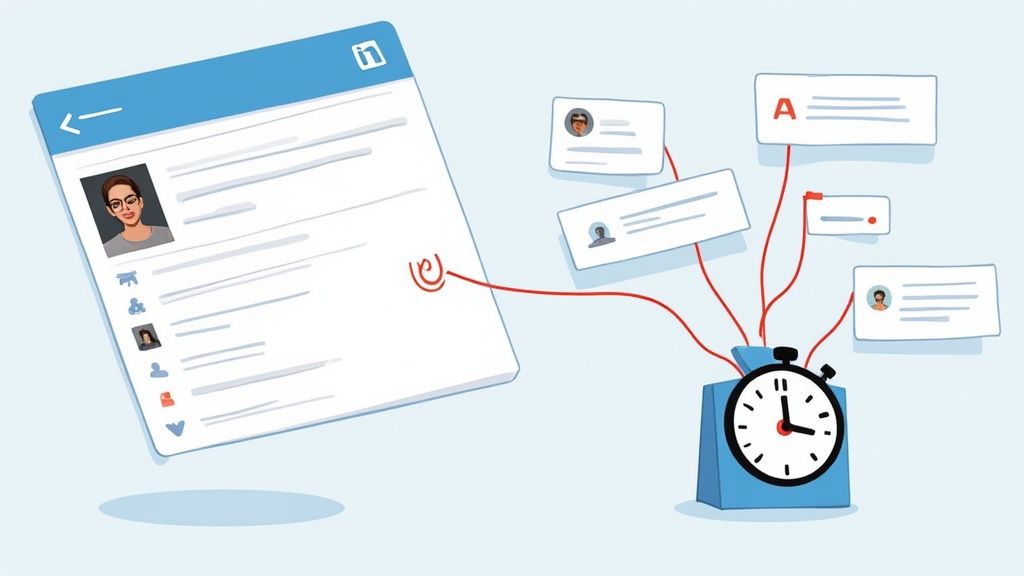
Theory is one thing, but seeing how the gears of a real lead generation machine turn is where it all clicks. So, let’s get practical and walk through a real-world example of automated lead generation that combines the world’s biggest B2B playground, LinkedIn, with a smart automation tool like GetViewsAI.
This is how you stop the manual, soul-crushing grind of prospecting and start building a predictable, scalable pipeline. We're about to connect the dots between finding prospects, qualifying them, and nurturing relationships into a single, cohesive system built for how people actually buy today.
Finding Your Ideal Audience On LinkedIn
Every killer campaign starts with knowing exactly who you're talking to. Spraying and praying with connection requests is just a fast track to getting ignored. LinkedIn’s Sales Navigator is your secret weapon here, letting you slice and dice the entire network to build hyper-specific lead lists.
Imagine you sell marketing software to VPs of Marketing at North American SaaS companies with 50-200 employees. With Sales Navigator, you can pull a list of thousands of those exact professionals in minutes. This list isn't just data; it's high-octane fuel for your automation engine.
Once you have this list, you’re no longer guessing. You're building your campaign on a solid foundation, ready to speak directly to an audience with a shared language of professional goals and headaches.
Automating The Initial Outreach
Now for the fun part: letting technology do the heavy lifting. Manually sending personalized connection requests and follow-ups to a list of 1,000 prospects could take you weeks of tedious work. An automation platform built for LinkedIn can execute this flawlessly while you sleep.
Here’s a look under the hood:
- Campaign Setup: You start by importing your laser-focused lead list from Sales Navigator right into the automation tool.
- Connection Request: The system gets to work sending connection requests on your behalf. A good tool will let you add a personalized note referencing a shared industry or interest, which massively boosts acceptance rates.
- Intelligent Follow-Ups: As soon as a prospect hits "Accept," the system triggers a pre-written sequence of direct messages that feel personal and timely.
This isn't about spam. It’s about starting a relevant conversation at scale, making sure every single new connection gets a valuable touchpoint without you having to lift a finger.
The goal of automated outreach isn't to close a deal in the first message. It’s to start a meaningful conversation by providing value upfront, positioning you as a helpful expert rather than just another salesperson.
This approach respects your prospect's inbox while ensuring your message lands consistently, every time.
Crafting Messages That Actually Work
Great automated messaging is an art. You need it to be scalable, but it absolutely has to feel personal. This is where AI-assisted templates become invaluable. Instead of a robotic, one-size-fits-all script, you create dynamic templates that pull in personalization details.
A simple, effective template might look something like this:
"Hi [FirstName], thanks for connecting. I saw you’re the [JobTitle] at [CompanyName] and noticed your team's recent focus on [Industry Trend]. We actually just published a guide on that very topic for B2B leaders. Would that be helpful for you?"
This little message does a lot of work. It’s personalized, it shows you did your homework, and most importantly, it leads with value instead of a pushy sales pitch. That’s how you build trust and actually get a response.
Nurturing Engagement Into Opportunities
The final, and most critical, piece of the puzzle is turning that initial engagement into a qualified lead. A truly advanced platform does more than just send messages; it watches who's engaging with your content and DMs. The most powerful tools, like GetViews.AI, take it a step further by integrating content creation with your outreach, creating a full-circle inbound and outbound system.
Here's how that powerful synergy plays out:
- Content as a Magnet: You use the platform's AI to consistently publish high-value LinkedIn posts that speak directly to your target audience's biggest challenges.
- Engagement Tracking: The system keeps an eye on who likes and comments on these posts, automatically flagging warm prospects from your target list who are raising their hands.
- Automated DMs: For those who engage, the tool can trigger a specific, relevant DM sequence. For example, if someone comments on your post about lead scoring, they could get an automated message with a link to your latest case study on the topic.
This blend of proactive outreach and reactive, content-driven nurturing creates a powerful, self-sustaining loop. You're out there building authority with your content, while your automation engine works 24/7 in the background to turn that authority into real sales conversations. That's a true automated lead generation machine.
How To Measure And Optimize Your System
An automated lead generation system isn’t a crockpot you can just set and forget. That’s a common misconception. Think of it more like a high-performance engine; it needs regular tuning to deliver peak power and efficiency. Without consistent measurement, you’re just flying blind, completely unable to spot leaks in your funnel or jump on hidden opportunities.
This whole process kicks off by tracking the key performance indicators (KPIs) that actually matter. Vanity metrics like follower counts might feel good, but you need to focus on data that directly impacts your bottom line. These are the real gauges on your engine's dashboard that tell you if you're winning or losing.
Defining Your Core Metrics
To get a crystal-clear picture of your system's health, you need to concentrate on a handful of critical KPIs. These numbers don't just show you what is happening; they reveal why it's happening, letting you diagnose problems with precision.
- Cost Per Lead (CPL): This is the most direct measure of your campaign's financial efficiency. If your CPL is climbing, it could be a sign of ad fatigue or a serious disconnect between your messaging and your target audience.
- Lead-to-Customer Conversion Rate: This metric tells you the ultimate effectiveness of your entire funnel. It answers one simple question: "Of all the leads we generate, what percentage actually become paying customers?"
- MQL-to-SQL Ratio: This one is a crucial diagnostic tool. It measures how many of your marketing-qualified leads (MQLs) successfully become sales-qualified leads (SQLs). A low ratio is a massive red flag.
If you're generating thousands of MQLs but very few ever become SQLs, your automation isn't broken—your lead scoring criteria probably is. This data is screaming that your definition of a "good lead" doesn't align with what your sales team actually needs to close deals.
To make this easier, here’s a quick-reference table of the metrics you should have on your dashboard.
Key Metrics for Automated Lead Generation
This table breaks down the most important KPIs to track, what they measure, and the industry benchmarks you should be aiming for.
| Metric (KPI) | What It Measures | Formula | Industry Benchmark |
|---|---|---|---|
| Cost Per Lead (CPL) | The cost-effectiveness of your lead generation activities. | Total Campaign Spend / Total New Leads | $50 - $200 (Varies by industry) |
| Lead-to-Customer Conversion Rate | The overall efficiency of your funnel from initial lead to paying customer. | (New Customers / Total Leads) * 100 | 2% - 5% for B2B |
| MQL-to-SQL Ratio | The quality of your marketing leads and the alignment between marketing and sales. | (Total SQLs / Total MQLs) * 100 | 10% - 30% |
| Click-Through Rate (CTR) | The effectiveness of your ad creative and copy in grabbing attention. | (Total Clicks / Total Impressions) * 100 | 1% - 2% for LinkedIn ads |
| Landing Page Conversion Rate | How well your landing page persuades visitors to take action. | (Form Submissions / Total Visitors) * 100 | 5% - 15% |
| Customer Lifetime Value (CLV) | The total revenue a business can expect from a single customer account. | (Avg. Purchase Value * Avg. Purchase Frequency) * Avg. Customer Lifespan | 3x your Customer Acquisition Cost (CAC) |
Tracking these numbers isn't just about reporting; it's about finding the friction in your funnel and smoothing it out.
Turning Insights Into Action
Once you have this data, the real work begins: optimization. It's a continuous cycle of testing, learning, and iterating to make your system more efficient and profitable over time. A great place to start is A/B testing different elements of your campaigns.
Experiment with:
- Email Subject Lines: Test direct, benefit-driven lines against more curiosity-driven ones to see what actually boosts your open rates.
- Landing Page Copy: Tweak your headlines and calls-to-action (CTAs). Even small changes can have a huge impact on form submissions.
- Ad Creatives: Run different images or videos to identify what visuals best capture your audience's attention and stop their scroll.
By methodically testing just one variable at a time, you can systematically improve each stage of your automated funnel. Of course, properly measuring these efforts is essential for proving value. You can learn more about calculating ROI with LinkedIn attribution to connect your optimization efforts directly to revenue.
This kind of disciplined approach ensures your automated lead generation machine gets smarter, faster, and more profitable with every single cycle.
Frequently Asked Questions
Even with a solid game plan, diving into lead generation automation for the first time usually brings up a few last-minute questions. It's totally normal to wonder about the little details, from keeping that human connection to wrestling with the initial setup. Let's tackle the most common ones head-on.
The goal here is to clear up any final doubts so you feel confident enough to start building. We'll get straight to the point on these practical questions, making sure you're ready to go.
Can Automation Still Feel Personal?
Absolutely. In fact, when you do it right, automated lead generation often feels more personal than a lot of manual outreach. The whole point is to use the data your system is gathering to send hyper-relevant messages. This isn't about blasting generic emails to a giant, faceless list.
It's about using behavioral triggers and smart segmentation to get the right message to the right person at precisely the right moment. For example, if a prospect spends time on a specific case study page, your system can automatically ping them with an email that offers more detail on that exact industry. Trying to pull that off manually for hundreds of leads is nearly impossible.
The real magic happens when you pair smart automation with a personal follow-up. Automated emails and personalized content warm up the conversation, making prospects feel seen and understood—not spammed. This tees up the perfect moment for a human to step in.
Think of automation as your scout. It pinpoints the perfect time and place for a meaningful conversation, letting your team jump in with a perfectly timed human touch when it counts the most.
Is The Initial Setup Difficult and Time-Consuming?
It requires a thoughtful investment of time upfront, but it’s far from impossible. Honestly, the hardest part—and the most important—is the strategy phase. You have to really nail down your ideal customer profile, map out their journey, and create the first batch of content and lead magnets. Get this foundation right, and it will pay you back for years.
Once your strategy is locked in, modern automation tools are built to be pretty user-friendly. Most platforms have drag-and-drop workflow builders and ready-made templates that take the sting out of the technical side. Sure, there’s a learning curve in the first few weeks, but the time you put in upfront is returned tenfold. You'll end up saving hundreds of hours of manual work down the line, all while your system generates leads for you 24/7.
Ready to turn your LinkedIn presence into a predictable revenue machine? GetViews.AI uses AI to transform your expertise into high-performing content that attracts a steady stream of inbound leads, putting your growth on autopilot. Start building your pipeline today at https://getviews.ai.