Content Marketing for Consultants A Proven Playbook
Discover a proven content marketing for consultants playbook. Attract high-value clients, build authority, and generate qualified inbound leads with this guide.
Wilmer KarlssonTarstad
Content marketing for consultants isn't about chasing clients; it's about building a foundation that brings them to you. It all starts with defining your hyper-specific niche, getting crystal clear on your ideal client, and establishing core content pillars that scream "expert."
Get this right, and you turn your knowledge into a predictable system for generating high-value leads.
Building Your Strategic Content Foundation

Before you even think about writing a single post, you need to lay the groundwork. This is what separates the consultants who thrive from those who just create noise online. Too many people jump straight into creation mode, posting generic advice and hoping a client magically appears. It rarely works.
The highest-earning consultants I know are ruthless strategists. They make smart choices upfront to ensure every single piece of content has a clear purpose and speaks directly to the right person.
This isn't just a "nice-to-have" step; it's a financial one. Companies that actually document their content strategy see a 33% higher return on investment (ROI). And considering that 67% of B2B buyers look at five or more pieces of content before they even talk to a sales rep, your strategy better be intentional.
Define a Hyper-Specific Niche
The single biggest mistake a consultant can make is trying to be everything to everyone.
Being a general "business coach" or "marketing consultant" means you're competing with thousands of others, which quickly becomes a race to the bottom on price. The goal is to carve out a niche so specific that you become the only logical choice for a very specific group of clients.
Think about it this way: are you a general family doctor, or are you the leading pediatric heart surgeon for a rare condition? The specialist commands higher fees, faces almost no competition, and has clients actively seeking them out.
To dial in your niche, ask yourself these questions:
- Who do I get the absolute best results for? Get specific—think industry, company size, and the role of the person you help.
- What's the one high-value, painful problem I solve better than anyone else?
- Do I have a unique methodology or framework that gets results?
Niching down is how you go from being an option to being the solution.
Here’s a look at how this transformation plays out in the real world:
From Generalist to Specialist Niche Definition
| Generalist Service | Specialist Niche | Ideal Client Profile (ICP) | Primary Pain Point Addressed |
|---|---|---|---|
| Marketing Consulting | LinkedIn Content Strategy for B2B SaaS | Founder or VP of Marketing at a Series A SaaS company ($5M-$15M ARR) | Inconsistent lead flow and low-quality demos from their current marketing efforts. |
| Business Coaching | Scaling Operations for E-commerce Brands | Founder of a 7-figure DTC brand using Shopify | Hitting a revenue ceiling due to inefficient fulfillment and supply chain processes. |
| Financial Consulting | M&A Advisory for Family-Owned Manufacturing | Second-generation owner of a manufacturing firm with $20M+ in revenue | Navigating the complex process of selling the family business without losing its legacy. |
See the difference? The specialist speaks directly to a specific person with a specific, expensive problem.
Create Your Ideal Client Profile
Once your niche is set, you need to go deeper than a generic persona. You need a detailed Ideal Client Profile (ICP). This isn't just about demographics; it's about understanding their world. Their pains, their goals, what triggers their decisions, and what their day-to-day work life actually looks like.
Your ICP should be so vivid you can almost predict their thoughts. What kind of internal politics are they dealing with? What specific metrics does their boss obsess over? What podcasts do they listen to on their commute?
The real magic happens here: A great ICP lets you create content that feels like you're reading your client's mind. It's the difference between shouting into a crowd and having a quiet, persuasive conversation with the one person who can actually hire you.
Establish Signature Content Pillars
With a sharp niche and a clear ICP, the final foundational piece is to lock in three to five "Signature Content Pillars."
Think of these as the main themes of your expertise—the big-picture topics you want to own in your industry. These pillars become the guardrails for all your content, ensuring everything you publish reinforces your authority in a consistent, focused way.
For instance, a consultant who helps SaaS companies reduce customer churn might have these pillars:
- Proactive Customer Onboarding Frameworks
- Product Adoption & Engagement Analytics
- Negative Churn & Expansion Revenue Strategies
Every single LinkedIn post, video, or guide you create should tie directly back to one of these pillars. This approach builds a cohesive library of work that screams deep expertise, not just surface-level tips. It’s an essential part of building a powerful personal brand that attracts the clients you actually want to work with.
Building Your LinkedIn-First Content Engine
For a consultant today, LinkedIn isn't just an online resume or a place to find old coworkers. Think of it as your digital office. It's your speaking stage. It’s the most important networking event you attend, and you're there every single day.
This is where your dream clients are actively scrolling, looking for answers to the very problems you solve. That makes it the perfect—and I mean, the perfect—place to build your content engine.
Your entire content marketing strategy should be built around LinkedIn first. Everything else is secondary. This is where you establish yourself as the go-to expert, start real business conversations, and get qualified leads coming to you. The key is to stop posting randomly and start building a real system.
Choosing Your Core Content Formats
Not all content formats are created equal, especially when you're trying to showcase deep consulting expertise. Forget trying to do everything at once. That's a recipe for burnout.
Instead, get really good at a few formats that fit your personality and, more importantly, how your ideal clients like to learn.
These are the formats I see delivering the best results for consultants right now:
- Text + Image Posts: This is your bread and butter. Use this format to share client "war stories" (anonymized, of course), offer a contrarian take on a popular industry trend, or share a personal reflection from your own business journey. A strong, relevant image—even a simple headshot or a clean graphic—can make people stop scrolling long enough to actually read what you wrote.
- Carousels (PDFs): I love carousels. They're basically mini-presentations that are perfect for breaking down a complex framework or a step-by-step process. They immediately position you as a teacher and an expert, letting you guide your audience through a solution one swipe at a time. Think of it as a micro-guide that packs a ton of value into a single post.
- Short-Form Video: Nothing builds trust faster than letting people see your face and hear your voice. These short clips, usually under 90 seconds, are fantastic for sharing a quick tip, answering a common client question, or just putting a human face to your expertise. It feels personal and forges a connection that text alone just can't match.
The data absolutely backs this up. Video is exploding, with 45% of marketers calling it their best-performing content type. Even more telling for consultants, a massive 58% of consumers trust brands that create educational content far more than those who just promote themselves. These formats are built for teaching. You can dive deeper into these content marketing statistics and trends if you're curious.
The Pillar and Spoke Content Model
The biggest hurdle for any busy consultant is consistency. You have client work piling up, business development to handle, and a million other things pulling at your attention. The "Pillar and Spoke" model is your way out of the content hamster wheel.
The idea is brilliantly simple. Instead of trying to come up with something new and profound every single day, you create one big, high-value "Pillar" asset each month. Then, you systematically slice and dice it into smaller "Spoke" pieces for your daily LinkedIn posts.
This is the ultimate leverage for your ideas. One pillar asset doesn't just create one piece of content; it fuels your entire content calendar for weeks, ensuring every post is rooted in a deep, valuable insight.
Let’s say a marketing consultant's pillar is a 45-minute webinar on "Building a Predictable Lead Gen System for B2B SaaS."
Here’s how that one webinar becomes an entire month's worth of high-quality LinkedIn content:
- A Carousel Post: You could easily summarize the 5 key steps from the webinar into a sharp, 10-slide carousel.
- Multiple Text + Image Posts: Each of those 5 steps then becomes its own detailed text post, where you can go deeper into the nuances.
- Short Video Clips: Pull a few powerful quotes or critical insights from the webinar recording and edit them into several 60-second video clips.
- A "War Story" Post: Share a quick story about a client who used one of the strategies from the webinar and got a specific, measurable result.
This structured approach transforms content creation from a daily chore into a strategic, efficient system. Here is a great example of what a consultant's feed can look like when they consistently mix formats like this.
You can see a mix of video, text, and articles—all designed to grab attention and deliver value. That's the heart of a winning LinkedIn-first strategy.
Building Your Practical Content Calendar
The final piece is mapping this all out in a simple content calendar. This doesn't need to be some fancy, over-engineered software—a basic spreadsheet is all you need. The goal is to create a rhythm, balancing different types of content to keep your audience engaged and moving them closer to a conversation.
A balanced calendar makes sure you're not just educating, but also building a personal connection and proving your authority.
Here’s a sample weekly schedule, built entirely from our webinar pillar:
- Monday (Authority): Post that 10-slide carousel breaking down the webinar's core framework.
- Tuesday (Personality): Share a short video of you talking about the single biggest mistake people make with this topic.
- Wednesday (Value): Write a detailed text post that dives deep into "Step 1" of your framework.
- Thursday (Engagement): Ask a pointed question related to the webinar's theme to get a conversation started in the comments.
- Friday (Social Proof): Share a text post telling a client story that demonstrates the outcome of your webinar's framework.
This system gives you structure and eliminates that daily "what on earth do I post today?" panic. By committing to a LinkedIn-first approach, mastering a few key formats, and using the Pillar and Spoke model, you build a powerful content engine that works for you, consistently attracting the clients you actually want to work with.
Streamlining Your Content Production Workflow
Consistency is the engine that drives content marketing. We all know this. But for consultants, it’s usually the first ball to drop when client work gets busy.
The answer isn't to work more hours or grind yourself into the ground. It's to build a smart, efficient workflow that lets you create high-impact content without burning out. A good system turns your sporadic content efforts into a predictable machine for generating leads.
The goal is simple: move from a raw idea to a polished piece of content without the guesswork. This means using simple templates, batching your tasks, and knowing exactly what you’re creating each week. When you have a clear process, you remove all the friction that stops most consultants from staying consistent.
The Power of Repurposing One Idea
The single most effective way to stay consistent without sacrificing billable hours is to stop creating content from scratch every day. It's a fool's errand.
Instead, you need to adopt the “create once, distribute forever” mindset. This whole approach is built on a powerful repurposing model where one solid piece of work can fuel your entire content calendar for weeks.
Think about a high-value client case study you just finished, a webinar you hosted, or even a detailed solution you mapped out on a client call. That single core idea—your "pillar"—can be systematically broken down into dozens of smaller "spoke" pieces of micro-content.
This is how you get off the content hamster wheel.

As you can see, the heavy lifting happens upfront when you create the pillar. After that, creating daily content becomes almost effortless.
A Practical Repurposing Workflow in Action
Let’s make this real. Imagine you're a consultant who helps e-commerce brands optimize their supply chains. Your pillar content is a detailed case study about how you helped a client slash their shipping costs by 15%.
Here’s how you can spin that single case study into a month's worth of high-value content:
- The LinkedIn Article (Pillar): Write the full story as a detailed, 1,000-word article on LinkedIn. Lay out the client's problem, your specific methodology, and the measurable results.
- The Carousel (Spoke 1): Distill the five key steps you took into a visually slick 10-slide carousel. Each slide can highlight one part of your process.
- Video Clips (Spokes 2-4): Fire up your webcam and record three separate 90-second videos. In each one, talk through a single, critical insight from the case study. For example, one video could focus entirely on how you renegotiated with carriers.
- Quote Graphics (Spokes 5-7): Pull three powerful sentences from the case study—maybe a killer client testimonial or a surprising statistic—and turn them into simple, shareable quote graphics.
- Text Posts (Spokes 8-10): Write three text-only posts, each one zeroing in on a different challenge the client faced before they hired you. This speaks directly to the pain points of your dream clients.
- Newsletter Insight (Spoke 11): Feature the case study as the main story in your weekly email newsletter, linking back to the full LinkedIn article for anyone who wants to go deeper.
Just like that, you've created nearly a dozen high-quality content pieces from a single effort. This is how you make your expertise work smarter, not harder.
Building Your Efficiency Toolkit
To make this workflow even smoother, you don't need a bunch of complicated or expensive software. A few simple tools and templates are all it takes to keep your content engine humming.
- Content Calendar: A simple Google Sheets spreadsheet is perfect for planning your pillar and spoke content for the month.
- Idea Repository: Use a note-taking app like Notion or Evernote to capture every question a client asks and every random idea you have. This becomes your goldmine.
- Design Templates: A tool like Canva is a lifesaver. Create pre-branded templates for your carousels and quote graphics so you’re not reinventing the wheel every time.
This systematic approach is critical because content frequency has a direct impact on your results. Data shows that 24% of high-performing websites publish new content daily. While that might be overkill for a solo consultant, the principle holds: consistency gets you seen.
And since 71% of consumers read at least one blog post during their buying journey, having a steady stream of valuable content is non-negotiable for nurturing leads.
By building a workflow around repurposing, you can achieve this level of consistency without ever sacrificing your client work. To see this strategy in even greater detail, check out our guide on how to master content repurposing on LinkedIn.
Turning Content Views Into Client Conversations
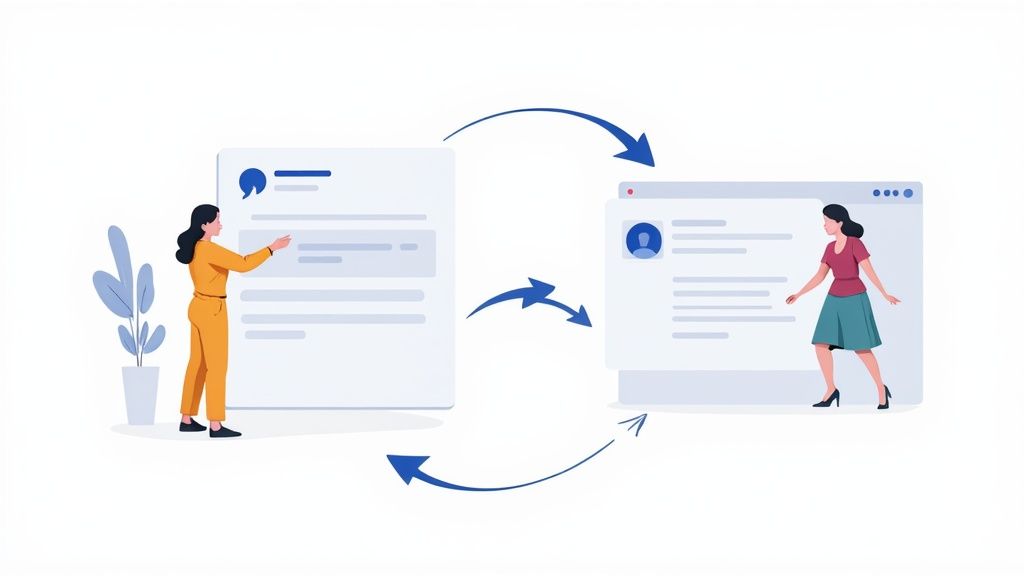
Let’s be honest. Creating high-value content is only half the job. If your brilliant posts don't lead to actual business, you've just got a time-consuming hobby. This is where we get down to brass tacks—turning your expertise into the one-on-one conversations that lead to signed contracts.
The goal isn't just more views or likes. The real point of this whole content marketing thing for consultants is to generate revenue. That requires a smart, tactical approach to distribution and engagement, turning passive readers into active, qualified leads. It’s about building a system where your content warms up prospects, so your outreach feels less like a cold pitch and more like a welcome discussion they were already expecting.
Get Your Posts Seen and Shared
Before you can start a conversation, people actually need to see your content. The LinkedIn algorithm loves posts that spark meaningful engagement right out of the gate. That first hour after you hit "post" is everything.
A classic mistake is to "post and pray"—just tossing your content into the void and hoping for the best. That’s not a strategy. You need an intentional distribution plan.
Here are a few tactics to give your content an immediate kick:
- Warm Up the Algorithm First: Spend 15 minutes engaging with other people's content right before you publish your own. This tells LinkedIn you're an active community member, not just a broadcaster shouting into the wind.
- Ask a Better Question: Don't end your posts with a lazy "What do you think?" Ask a pointed, easy-to-answer question. Instead of asking about "leadership," ask "What's one leadership book that actually changed how you manage your team?" See the difference?
- Tag People Who Actually Care: If you mention someone's work or a company, tag them. But do it sparingly and make it genuine. Over-tagging looks spammy and will absolutely backfire.
The Art of the Strategic Comment
Your own posts are only half the equation. The other, and often more powerful, half is how you show up on your prospects' content. This is how you get on their radar long before you ever think about sending a connection request.
The key is to add genuine value, not just drop a generic "Great post!" comment and move on. You want to leave a comment so insightful that the original poster has to respond and other readers see you as an expert.
Think of each comment as a mini-piece of content. It’s a chance to showcase your expertise, demonstrate your unique point of view, and build rapport in a public forum where their entire network can see your contribution.
Here’s a simple framework for a comment that actually gets noticed:
- Acknowledge: Start by agreeing with or highlighting a specific point they made. "I love your point about X..."
- Add: Build on their idea with a unique insight, a relevant stat, or a personal experience. "...it reminds me of a time when..."
- Ask: End with a thoughtful question that invites them (and others) to keep the conversation going. "...how have you seen this play out with larger teams?"
This simple shift elevates you from a passive scroller to a valuable contributor in their professional world.
From Public Comments to Private DMs
After you've built some rapport through public comments, the next logical step is moving the conversation to a more personal setting—the Direct Message (DM). This transition needs to feel natural, not salesy. If you pounce with a sales pitch right after a couple of comments, you'll destroy all the trust you just built.
Instead, look for a natural reason to take it private.
- Offer a Resource: "Loved your post on supply chain challenges. I have a case study on how we helped a similar company cut shipping costs that you might find interesting. Happy to send it over if you'd like."
- Reference a Shared Interest: "I saw from your comment you're also a fan of [Industry Podcast]. I just listened to their latest episode on [Topic] and had a thought I wanted to share."
- Ask a Deeper Question: "Your point about team burnout is something I'm seeing a lot. I have a question about that I'd love to get your take on, mind if I send you a quick DM?"
The goal here is simply to continue the conversation, not to book a meeting. The sales part comes later, once you’ve established that there's genuine mutual interest.
This strategic approach is what separates high-earning consultants from the crowd. In the US, the average salary for content marketers is $112,000, but top freelancers and consultants command significantly higher rates by building a powerful personal brand. With 68% of marketers finding it harder to secure roles than five years ago, standing out is non-negotiable. You can find more insights about these content marketing statistics and see why this approach is more critical than ever.
To stay on track, a weekly checklist can make all the difference. It ensures you’re not just creating content but actively distributing it and engaging where it counts.
Weekly Content Distribution Checklist
| Day | Action Item | Objective | Time Commitment |
|---|---|---|---|
| Monday | Publish new pillar content. Engage with 10 ICPs' posts. | Maximize initial reach and get on prospects' radar. | 45 minutes |
| Tuesday | Reply to all comments. Send 5 value-first DMs to engagers. | Nurture initial engagement into conversations. | 30 minutes |
| Wednesday | Repurpose pillar content into a new format (e.g., carousel). | Extend the life and reach of your core message. | 30 minutes |
| Thursday | Share repurposed content. Engage with 10 different ICPs. | Maintain visibility and build new connections. | 45 minutes |
| Friday | Review weekly analytics. Follow up on open DM conversations. | Optimize future content and move leads forward. | 20 minutes |
Following a simple routine like this turns your content from a passive asset into an active client-generation machine. It’s the system that ensures your hard work actually pays off.
Measuring The Metrics That Actually Matter
Likes and shares feel good, but they don’t pay your invoices. As a consultant, you can't measure your content marketing with vanity metrics. They stroke the ego, but they don't build your business.
The entire point of this system is to generate predictable, qualified inbound leads. That means you have to track the numbers that actually reflect that outcome. Forget obsessing over the engagement rate on a single post. Instead, let's shift your focus to the key performance indicators (KPIs) that directly translate to client conversations and revenue. This is how you turn a creative exercise into a reliable lead generation engine.
Moving Beyond Vanity Metrics
First things first: we need to redefine what "success" looks like. It’s not about going viral. It’s about attracting the right handful of people who can and will hire you. Your measurement system should be simple, sustainable, and laser-focused on business impact.
Here are the core metrics you should be tracking every single week:
- Profile Views From Target Companies: LinkedIn literally tells you which companies are viewing your profile. Are these your ideal clients? This is a direct signal that your content is landing in the right offices.
- Inbound Connection Requests Mentioning Content: When someone sends you a request and says, "Loved your post on X," that’s a warm lead. How many of these are you getting per week?
- Qualified DMs From Content: How many direct messages did you get from your ideal client profiles (ICPs) asking a question related to a post? This is a crucial leading indicator of future business.
- Discovery Calls Booked: This is the ultimate metric. How many actual meetings were set that started from a piece of content or a DM conversation?
The key takeaway is this: You're measuring the journey from a passive view to an active conversation. Everything else is secondary. A single discovery call is worth more than a thousand likes from the wrong audience.
Building a Simple Tracking System
You don’t need complex software for this. A simple spreadsheet is all it takes to hold yourself accountable.
Just create a sheet with columns for each of the KPIs listed above. At the end of every week, update it. This simple act does two powerful things: it forces you to be honest about what's working, and it reveals patterns over time that you can use to make smarter decisions.
This strategic approach is a hallmark of successful businesses. Among top-performing companies, 79% of those classified as “very successful” dedicate over 10% of their marketing budgets just to content. Even more telling, 80% of these leaders have a fully developed content strategy in place, proving that strategic management is key to getting measurable results. You can find more stats on how top companies approach content marketing here.
Analyzing Your Data for Growth
Once you have a few weeks of data, you can start asking the right questions. Which content pillar is generating the most inbound DMs? Are carousels or video posts leading to more profile views from my target accounts?
This analysis is where the magic happens. You're no longer guessing; you're making data-informed adjustments to your strategy.
For instance, if you notice that posts about your "Proactive Onboarding Frameworks" consistently lead to more booked calls, that’s a clear signal. Double down on that topic. Create more carousels, videos, and stories around that pillar, confident that it resonates with your ideal clients.
This process is what separates consultants who treat content as a "nice-to-have" from those who build a predictable pipeline with it. It’s about understanding the real business impact of your work. You can dive deeper into this by learning more about LinkedIn attribution and ROI in 2025. By tying your content directly to business outcomes, you create a powerful feedback loop that makes your marketing more effective every single month.
Answering the Questions I Always Get
Whenever I talk about this content system with other consultants, a few key questions always pop up. They're the practical, "boots-on-the-ground" concerns that everyone has when they're starting out. Let's tackle them head-on.
How Much Time Does This Actually Take?
Look, your time is your money. I get it. The trick isn't to clear your calendar, but to be ruthlessly efficient with the time you do have.
Aim for 3-5 hours a week. That’s it.
Here’s how that breaks down in the real world:
- Creation (1-2 hours): This is your focused time to get one solid "pillar" piece of content out the door. Think one really thoughtful LinkedIn post, a short video breaking down a concept, or a well-designed carousel.
- Engagement & Distribution (2-3 hours): The rest of the time is spent in the trenches. You're slicing up that main piece for other posts, sharing it, and—most importantly—commenting and starting conversations on your ideal clients' posts.
Don't fall into the trap of thinking more is better. Consistency blows volume out of the water every single time. A focused 4-hour block each week is infinitely more powerful than a chaotic 10-hour sprint once a month.
What If I'm a Terrible Writer or Awkward on Camera?
Good. That means you're human. Most of us aren't natural-born writers or aspiring YouTubers, and that's perfectly okay.
The goal here isn't to win a Pulitzer or an Oscar. It's to communicate your expertise in a way that feels genuine to you.
So, play to your strengths. If you're a great talker but freeze up when you see a blinking cursor, just record yourself talking through a client problem on your phone. Use an AI transcription tool, clean it up a bit, and boom—you have a written post. If you'd rather write a novel than be on video, then stick to text and carousels.
Your authenticity is your biggest advantage. Clients hire you for your brain, not your broadcast-quality video setup. Pick the format that has the least amount of friction between your knowledge and your audience.
Seriously, How Long Until I See Real Results?
This is the big one, isn't it? While there's no magic formula, you should start seeing signs of life within 60-90 days of consistent, focused effort.
"Signs of life" aren't necessarily a flood of inbound leads just yet. It looks like:
- More profile views from people at your target companies.
- Connection requests that are actually relevant.
- People starting real conversations in your comments section.
The real inbound leads—the "Hey, can we talk?" messages—typically start trickling in around the 3-6 month mark. Building a reputation through content is a marathon, not a sprint. You're building trust and authority, and that investment pays off for years to come.
Can't I Just Hire Someone to Do All This for Me?
My advice? Not at the beginning. I strongly recommend against it.
As a consultant, your secret sauce is you. It's your unique point of view, your war stories from past projects, and your specific way of explaining complex ideas. That is almost impossible to outsource authentically from day one.
When you create the content yourself, you forge a much deeper connection with your audience. They're not just reading generic tips; they're learning from you.
Down the road, once you have a clear voice and a system that works, then absolutely you can bring in help. Hire a freelancer to edit your videos, design your carousels, or handle the repurposing. But you should always remain the chief strategist and the source of the core ideas.
Ready to turn your expertise into a predictable inbound pipeline? GetViews.AI is an AI-powered platform that helps you create high-performing LinkedIn content that builds authority and generates qualified leads, all without cold outreach. Learn more at https://getviews.ai.