Mastering Customer Acquisition Cost Calculation
Unlock business growth with our guide to customer acquisition cost calculation. Learn to gather data, analyze channels, and optimize your marketing spend.
Wilmer KarlssonTarstad
To get your customer acquisition cost calculation right, you have to start with one non-negotiable step: you must define every single expense that goes into winning a new customer. This goes way beyond your ad spend. A real-world CAC includes salaries, software, and a slice of your overhead to show you what growth truly costs.
Defining Your True Cost to Acquire a Customer
Before you even think about opening a spreadsheet, you need to get this foundation right. If you miss costs, you'll end up with a "vanity CAC"—a number that looks great on a slide but tells you absolutely nothing about the health of your business. The real goal here is a fully loaded CAC, which paints the complete, unvarnished picture of your investment.
This means you have to dig deeper than the obvious line items and account for every dollar that fuels your acquisition engine. Getting this right is the difference between making sharp, data-driven decisions and just flying blind.
Identifying Your Direct Acquisition Costs
Direct costs are the easy part. These are the expenses you can point to and tie directly to specific marketing and sales campaigns. They’re the frontline dollars you spend to get in front of prospects and close deals.
Most businesses are already tracking these, but it pays to be thorough. Common direct costs include:
- Advertising Spend: This is what you're paying platforms like Google Ads, LinkedIn Ads, Meta (Facebook/Instagram), and any other paid channel you're running.
- Campaign-Specific Production: Think about the costs to create the assets themselves—the video production for a YouTube ad or the design work for a high-converting landing page.
- Sponsorships and Events: This covers fees for sponsoring industry events, webinars, or newsletters, plus the cost of booths, travel, and materials.
For instance, if you spend $10,000 on a LinkedIn campaign and another $2,500 on the creative assets for those ads, your direct cost for that specific push is $12,500. These are the numbers that jump right out of your P&L.
Uncovering Your Indirect Acquisition Costs
This is where most CAC calculations go wrong. Indirect costs are all the supportive expenses that allow your marketing and sales teams to do their jobs but aren't tied to a single campaign. Forgetting them will dramatically understate your true CAC.
Think of it like building a house. The direct costs are the bricks and lumber. The indirect costs are the architect's plans, the construction permits, and the foreman’s salary—all absolutely essential to the project's success.
A common mistake is to only count ad spend in CAC. A fully loaded CAC must include the salaries of your marketing and sales teams, software costs, and other overhead. Forgetting these costs gives you a dangerously optimistic number that hides the real cost of customer acquisition.
To build an honest picture, you have to include:
- Salaries and Benefits: The gross salaries, commissions, bonuses, and benefits for every single person in your marketing and sales departments. This is almost always the biggest expense category.
- Software and Tools: All those monthly or annual fees for your martech and sales stack. This means your CRM (like Salesforce), marketing automation (like HubSpot), analytics tools, and social media schedulers.
- Freelancers and Agency Fees: Any payments to external contractors, content creators, SEO consultants, or marketing agencies that support your acquisition efforts.
- General Overhead: A proportional slice of office rent, utilities, and other administrative expenses that keep the lights on for your sales and marketing functions.
Capturing these "hidden" figures is absolutely essential for an accurate customer acquisition cost calculation.
Defining a New Customer and Timeframe
Finally, you need to lock down two last variables with total clarity: what actually counts as a "new customer" and the period you're measuring. A new customer might be someone making their first purchase, signing a contract, or upgrading from a free plan. Whatever it is, be specific and stick to it.
Just as important is the timeframe. Are you calculating CAC for a particular month, a quarter, or an entire year? This decision ensures your cost data lines up perfectly with the acquisition results from that same period, making your final number both accurate and meaningful.
An accurate CAC is only as good as the numbers you feed it. If you’re working with messy or incomplete data, your final number won’t just be a little off—it will be dangerously misleading. This is where the real work begins: rolling up your sleeves to gather every last dollar spent and every new customer won.
Think of it less like accounting and more like building the foundation for a reliable growth engine. It takes a bit of detective work, but getting this right is non-negotiable.
Tracking Down Every Dollar of Your Costs
Your acquisition costs are almost never sitting in one neat spreadsheet. They're scattered across different platforms, departments, and budgets. The goal here is to be exhaustive. Leave no stone unturned.
First, let's round up your direct ad spend. This is usually the easiest part. You'll need to export reports from every paid channel you're running.
- Social Platforms: Jump into your ad managers for Meta (Facebook/Instagram) and LinkedIn. Pull the total spend for the exact time period you're analyzing.
- Search Engines: Do the same for Google Ads and Microsoft Ads. Export the total cost data.
- Other Channels: Don’t forget the less obvious ones. Are you running campaigns on content discovery networks? Paying for sponsorships? Running an affiliate program? Add it all to the list.
Next up is the human element—your team. This is often the biggest line item. You'll need to connect with your finance or HR department to get the gross salary figures for everyone on your marketing and sales teams. And don't just stop at base salary. You have to include commissions, bonuses, and benefits to get the true cost of their time and effort.
Finally, pull together all your indirect costs by looking at your software stack and overhead. List out every martech and sales tool you pay for: your CRM, analytics platforms, email marketing software, you name it. Then, work with finance to figure out a reasonable percentage of general business overhead (like rent and utilities) that should be allocated to sales and marketing.
Nailing Down Your New Customer Count
With your costs tallied, it's time to get a precise count of the new customers you acquired in that same period. Your Customer Relationship Management (CRM) software is almost always the best place to start.
Export a list of every new customer whose "close date" or "signup date" falls within your timeframe. Now, here’s the most critical part: you have to clean that list meticulously. You must filter out anything that isn't a genuine, brand-new customer.
Garbage in, garbage out. This old saying has never been more true. A reliable CAC is built on clean data. Take the time to scrub your customer list, because a bloated denominator will give you a dangerously optimistic (and false) sense of your acquisition efficiency.
This means you’ll need to:
- Deduplicate the list to make sure you aren't counting the same person twice.
- Filter out any internal users. Get rid of employee test accounts or internal stakeholders.
- Remove existing customers. Someone making a repeat purchase isn't a new acquisition. Stick to the definition of a "new customer" you decided on earlier.
Before you can crunch the numbers, you need to know exactly what data to collect and where to find it. Here’s a quick checklist to guide your data-gathering process.
Essential Data Sources for CAC Calculation
| Data Point | Typical Source | Notes |
|---|---|---|
| Direct Ad Spend | Ad Managers (Google, Meta, LinkedIn) | Export reports for your specific date range. Include all platforms. |
| Marketing Team Salaries | HR / Payroll System | Include gross wages, benefits, and taxes. |
| Sales Team Salaries & Commissions | HR / Payroll & CRM/Sales Platform | Don't forget bonuses and commissions tied to new acquisitions. |
| Martech & Sales Tools | Accounting Software / Invoices | List all relevant software subscriptions (CRM, automation, analytics). |
| Creative & Content Costs | Invoices / Project Management Tools | Freelancer fees, agency retainers, stock photo subscriptions, etc. |
| Allocated Overhead | Finance Department Records | A percentage of office rent, utilities, and other general expenses. |
| Count of New Customers | CRM / Billing System | Filter by "close date" or "first purchase date" within your period. |
This checklist isn't exhaustive, but it covers the core components you'll need for a solid calculation. Having these numbers ready and verified is half the battle.
With your costs and customer count properly sourced and scrubbed, you finally have reliable inputs. Now you're ready to plug them into the formula and find out what it really costs you to win a new customer.
Alright, you've got your data cleaned up and ready to go. Now it's time to actually run the numbers. Calculating your customer acquisition cost isn't some dark art, but it does demand precision. We'll kick things off with the big-picture number to get our bearings, then dive into the channel-specific details where the real insights are hiding.
First up, you need to figure out your blended CAC. This gives you a single, business-wide average of what it costs to land a new customer. Think of it as a vital health metric for your entire go-to-market engine, even if it doesn't tell the whole story.
The formula itself is refreshingly simple:
Blended CAC = Total Sales & Marketing Costs / Number of New Customers Acquired
Let's put this into practice. Imagine a B2B SaaS company is looking back at its Q2 performance. After pulling all the data, their costs look something like this:
- Marketing & Sales Salaries: $150,000
- Total Ad Spend (LinkedIn, Google): $75,000
- Software & Tool Subscriptions: $15,000
- Freelance Content & Agency Fees: $10,000
Their Total Sales & Marketing Costs for the quarter add up to a clean $250,000. In that same timeframe, they brought on 250 new paying customers.
Pop those numbers into the formula: $250,000 / 250 = $1,000 blended CAC.
This number is your new benchmark. It tells you that, on average, every new customer set you back $1,000 in Q2. Now, the real work begins: picking that number apart.
Moving Beyond Blended CAC to Channel-Specific Insights
A blended CAC is a great starting point, but it hides as much as it reveals. That $1,000 average could be masking a highly efficient SEO strategy that brings in customers for $200 a pop, while a brand-new paid search campaign is bleeding cash at a $2,500 CAC. If you don't break it down, you can't make smart calls on where to double down and where to pull back.
This is where your customer acquisition cost calculation evolves from a simple metric into a strategic weapon. The whole point is to isolate the costs and the customers for each channel—Paid Search, Organic Search (SEO), Social Media, you name it.
This diagram shows you the basic flow for sourcing the data you'll need.
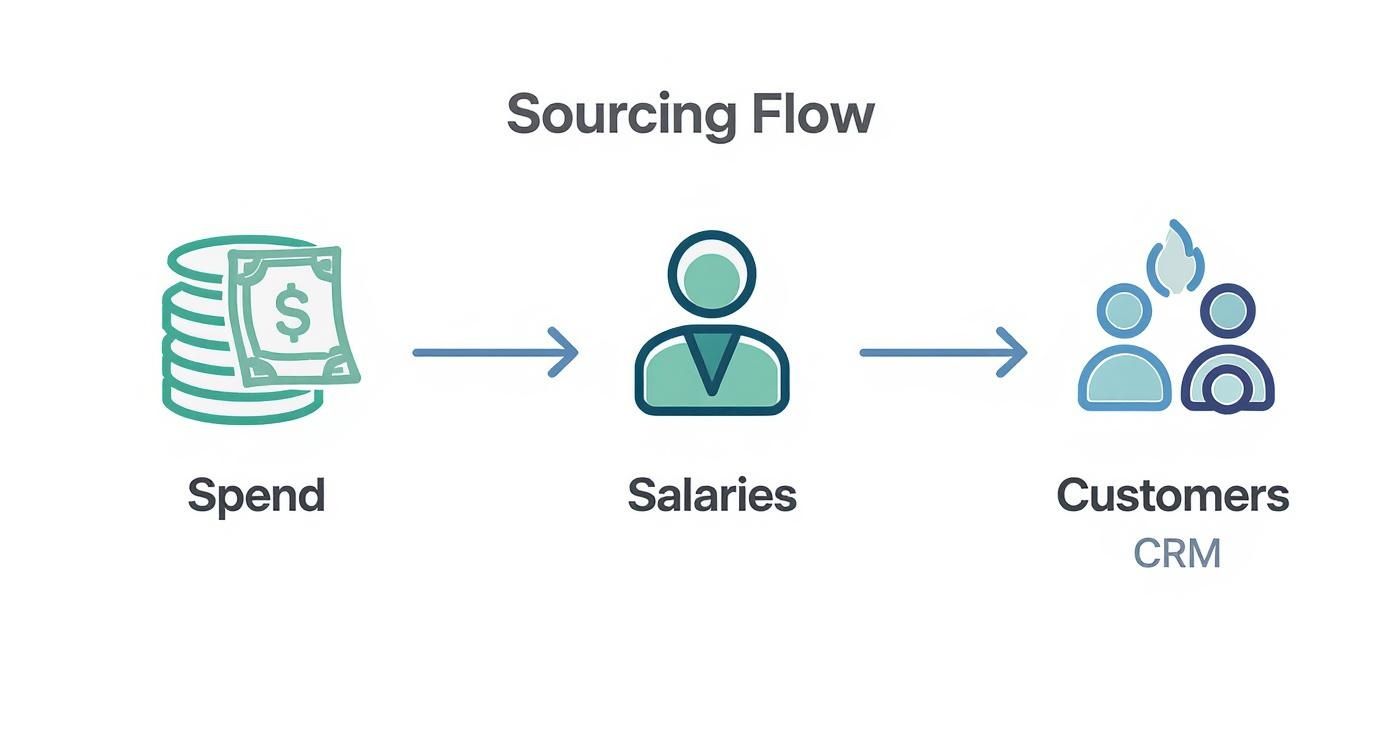
As you can see, a true CAC calculation means pulling numbers from your ad platforms, your payroll system, and your CRM to get the full picture.
Allocating Costs Fairly Across Channels
Getting a channel-specific CAC is a bit more involved than just looking at ad spend. You have to figure out how to attribute a fair slice of your indirect costs—like salaries and software—to each channel.
Honestly, this is part art, part science. A solid approach is to allocate these overhead costs based on how much time and resources are poured into each channel.
- Salaries: If your content marketer spends 50% of their time writing SEO-focused blog posts and the other 50% creating LinkedIn content, you’d split their salary cost right down the middle between your "Content/SEO" and "Social Media" channels.
- Tools: Maybe you have a pricey analytics tool that's used 80% for SEO analysis. In that case, you'd allocate 80% of its subscription cost to the SEO channel and the remaining 20% elsewhere.
Let’s walk through a quick example for a LinkedIn Ads campaign.
- Direct Ad Spend: $20,000
- Attributed Salary Cost (a portion of the marketing manager's time): $5,000
- Attributed Tool Cost (a slice of the analytics software license): $500
That gives you a total channel cost of $25,500. If your attribution model says this campaign brought in 25 new customers, the channel-specific CAC is $25,500 / 25 = $1,020. Nailing these numbers is critical, which is why a deep dive into LinkedIn attribution and ROI is a must for any serious B2B marketer.
This granular approach is the only way to see which channels are your true growth engines and which might be quietly draining your budget. It's an absolutely essential step for any business that wants to scale without lighting money on fire. The cost of acquiring customers just keeps climbing, especially in crowded markets.
Just look at e-commerce. In 2013, the average loss per new customer was only $9. Fast forward to today, and that number has skyrocketed to $29—a massive 222% jump. This trend just hammers home how urgent it is to get precise with your channel analysis to protect your profitability.
Turning Your CAC Numbers Into Actionable Insights
Calculating your customer acquisition cost is just the starting line. A raw number, whether it's $50 or $5,000, is completely meaningless by itself. The real power comes from putting that number into context and using it to make smarter decisions about your budget, marketing, and overall growth.
This is the point where you shift from just doing accounting to building a strategic advantage. When you know how to read your CAC, you can spot the expensive leaks in your funnel, double down on the channels that are actually working, and build a truly sustainable business.
The LTV to CAC Ratio: Your North Star for Profitability
Your CAC can't be judged in a vacuum. To really understand if a CAC is "good" or "bad," you have to weigh it against the total value a customer brings in over their entire relationship with you. This is their Customer Lifetime Value (LTV).
The relationship between these two metrics—the LTV to CAC ratio—is arguably the single most important number for the long-term health of your company. It answers a painfully simple question: Are you actually making money from the customers you're paying to acquire?
A healthy LTV:CAC ratio is the hallmark of a scalable business. For most industries, the magic number is 3:1. This means for every $1 you spend to get a customer, you get $3 back in lifetime value.
If your ratio is below 1:1, you're literally paying to lose money on every new customer. Not good. A ratio hovering between 1:1 and 3:1 means you're breaking even or making a tiny profit, which probably isn't enough to cover your overhead and reinvest in growth. To get this right, you first need a solid grip on your LTV; this guide on customer lifetime value calculation is a great place to start.
Benchmarking Your CAC Against the Rest of Your Industry
Context is everything. A $700 CAC would be a five-alarm fire for an e-commerce store selling t-shirts. But for a B2B SaaS company selling an enterprise solution? That might actually be pretty good. This is exactly why you need to see how your numbers stack up against industry averages.
It helps you set realistic targets and understand if you're playing the same game as your competitors.
Here's a quick look at how wildly different CAC can be depending on the market you're in.
Average CAC by Industry Comparison
| Industry | Average CAC (2025 Estimate) | Key Influencing Factors |
|---|---|---|
| B2B | $536 | Longer sales cycles, reliance on sales teams, higher deal values. |
| SaaS | $702 | High competition, need for education, focus on recurring revenue. |
| Insurance | $1,280 | Strict regulations, low customer trust, complex products. |
| Fintech | $1,450 | High compliance costs, intense competition for user trust and deposits. |
As you can see, a "high" CAC in one field is pocket change in another. Knowing where you stand helps ground your strategy in reality.
Using Channel-Level CAC to Optimize Your Spend
Okay, this is where your analysis gets truly powerful. A blended CAC is useful, but the real gold is in the channel-level breakdown. By calculating the CAC for each of your marketing channels, you can finally see what's efficient and what's just burning cash.
Let's say your overall blended CAC is $450. Not bad. But when you dig into the channels, you see a completely different story:
- Organic Search (SEO): CAC of $120
- LinkedIn Ads: CAC of $480
- Google Ads: CAC of $850
This data tells you exactly where to focus. Your SEO efforts are incredibly efficient, bringing in customers for a fraction of the average cost. LinkedIn Ads are a bit more expensive than your average, but probably still profitable.
But Google Ads? That channel is costing you nearly double your average.
This doesn't automatically mean you kill the Google Ads budget. Maybe those customers have a much higher LTV, which could justify the cost. But it’s a massive red flag telling you to either fix the campaigns or reallocate that budget to a channel that actually performs. A deep analysis like this often comes down to how well you understand your audience on each platform. Our guide on how to create buyer personas can help you sharpen your targeting and messaging to make every channel more efficient.
Proven Strategies to Lower Your Acquisition Costs
Alright, you've done the hard work of calculating your CAC. Now comes the fun part: actively driving that number down.
The goal isn't just about cutting costs for the sake of it. It's about building a more efficient growth engine. This means plugging the leaks in your funnel so you can convert prospects more effectively and get more value out of every single customer you bring in.
Lowering your CAC isn't a happy accident; it’s the outcome of a deliberate, multi-front strategy. Every tweak, from your landing page copy to the channels you invest in, adds up to a more profitable and sustainable business.
Double Down on Conversion Rate Optimization
The fastest way to slash your acquisition cost is to convert more of the traffic you’re already getting. Pouring more money into ads when your website is leaking visitors is like trying to fill a bucket with holes in it. It's a losing battle.
Instead, fix the bucket. This is where Conversion Rate Optimization (CRO) comes in.
Even a tiny lift in your conversion rate can have a seismic impact. Think about it: improving your conversion rate from 1% to 2% literally cuts your CAC in half. You just got twice the customers for the exact same ad spend. For most businesses, this is the highest-leverage activity you can focus on.
Here are a few high-impact areas to get you started:
- A/B Test Your Landing Pages: Don't guess. Continuously test your headlines, calls-to-action (CTAs), images, and layouts. Let the data tell you what your audience actually responds to.
- Simplify Your Checkout Process: Every unnecessary field and extra step is a reason for someone to abandon their cart. Make it ridiculously easy for people to give you their money.
- Improve Site Speed: Every second counts. A slow-loading page is a conversion killer and a direct hit to your bottom line.
By systematically improving these areas, you make every dollar you spend on acquisition work twice as hard. For a deeper dive, check out our guide on conversion rate optimization best practices.
Increase Customer Lifetime Value to Justify CAC
Sometimes, a high CAC is just the cost of doing business, especially in a crowded market. When that's the case, your best move is to make each customer more valuable over their lifetime.
When your Customer Lifetime Value (LTV) is high, you can afford to spend more to acquire a customer and still come out way ahead. This changes the game from a short-term transaction to a long-term relationship. A higher LTV builds resilience into your business model and gives you way more breathing room in your acquisition strategy.
Think of LTV as the "revenue ceiling" for your CAC. The higher you can push that ceiling, the more room you have to invest in growth without torching your margins. It's all about playing the long game.
Here are some smart ways to boost your LTV:
- Implement a Loyalty Program: Reward your repeat customers. Make them feel valued, and they'll stick around.
- Focus on Upselling and Cross-selling: Look for opportunities to offer existing customers higher-tier plans or complementary products that solve their next problem.
- Nail Your Customer Onboarding: A great onboarding experience gets customers to that "aha!" moment fast. This slashes churn and makes them much more likely to buy from you again.
If you really want to understand how variables like CAC and LTV impact your business outcomes, it's worth learning about performing sensitivity analysis.
Lean into High-Leverage Channels
Not all acquisition channels are created equal. Paid ads are fast and scalable, but they're almost always the most expensive route. To build a truly efficient acquisition engine, you need to invest in lower-cost, high-leverage channels that deliver sustainable growth over the long haul.
These channels often require more sweat equity upfront, but they pay dividends for years with a much lower ongoing CAC.
- Search Engine Optimization (SEO): Create genuinely helpful content that ranks on Google. You'll attract high-intent prospects for free, day in and day out.
- Referral Programs: Turn your happiest customers into your most effective sales team. A solid referral program can be one of the cheapest and best acquisition channels you have.
- Strategic Partnerships: Team up with non-competing businesses that serve the same audience. It’s a powerful way to tap into a fresh stream of qualified leads.
- Leverage AI: This is no longer a "nice-to-have." The impact of AI on acquisition is undeniable. In 2025, companies using AI for customer acquisition have seen CAC reductions of up to 50% in some industries by optimizing ad targeting, personalizing messages, and automating engagement at scale. You can find more on these AI findings on amraandelma.com.
Unpacking the Nuances: Your Top CAC Questions Answered
Once you start calculating Customer Acquisition Cost, a few questions always pop up. It's a simple formula on the surface, but the details are what make it a powerful tool instead of just another number on a spreadsheet.
Let's dig into the most common sticking points I see founders and marketers run into.
How Often Should I Be Calculating CAC?
The right cadence really depends on your sales cycle. A fast-moving e-commerce brand might even look at it weekly during peak season, while a B2B enterprise with a six-month sales cycle will get more value from a longer-term view.
For most businesses, though, a blended approach works best:
- Monthly calculations give you a near-real-time pulse. This is perfect for seeing how a new campaign or sales initiative is performing right away. It’s your go-to for making quick, tactical adjustments.
- Quarterly calculations smooth out the noise. A great month or a slow month won't throw off your entire analysis. This gives you a more stable, big-picture view for spotting broader trends and making strategic decisions.
Think of it this way: monthly is for tactics, quarterly is for strategy.
What's the Single Biggest Mistake People Make?
Easy. Calculating a "vanity CAC" by only including direct ad spend. It's a trap. It makes your marketing channels look incredibly efficient, but it’s completely divorced from reality.
You absolutely must calculate a "fully loaded" CAC. This is non-negotiable if you want an honest look at your business. It means accounting for every single cost that supports acquiring a customer. We're talking salaries for your marketing and sales teams, the cost of your CRM and other software, agency fees, and even a slice of overhead.
Forgetting to include indirect costs like salaries and software gives you a dangerously optimistic number. It hides the real cost of acquiring a customer and can lead you to overinvest in channels that are actually unprofitable.
An honest CAC might be a higher number than you'd like, but it’s the only number you can actually use to make smart decisions.
What’s the Difference Between CAC and CPA?
This one trips people up all the time, but the distinction is critical. They sound similar, but they measure two completely different things. Confusing them will lead to a messy, inaccurate analysis of your funnel.
CPA (Cost Per Acquisition) is a top-of-funnel metric. It measures the cost to get someone to take any action—download an e-book, sign up for a free trial, or register for a webinar. It's about actions, not customers.
CAC (Customer Acquisition Cost) is a bottom-of-funnel metric. It measures only one thing: the total cost to acquire a new paying customer.
Here’s a practical example: Say you run a webinar and your CPA for a qualified lead is $75. That’s great. But if you know it takes, on average, 10 of those webinar leads to close one paying customer, your actual CAC for that channel is $750 ($75 x 10).
Both numbers have their place, but CAC tells you the final, most important story about profitability.
Ready to turn your LinkedIn presence into a predictable pipeline? GetViews.AI uses AI to help you create high-performing content that attracts qualified inbound leads, so you can stop chasing prospects and start closing deals. Learn more and get started.