How to Create Buyer Personas That Drive Growth
Learn how to create buyer personas with this guide. Turn customer data into actionable insights for marketing strategies that actually boost revenue.
Wilmer KarlssonTarstad
Building a buyer persona is pretty straightforward at its core. You're essentially doing research to figure out who your audience is—their demographics, what they do, what drives them—and then using all that data to sketch out a semi-fictional "ideal customer." This whole exercise turns a pile of abstract data into a real, relatable character you can actually market to.
Why Buyer Personas Are Your Marketing Compass
Before we get into the nuts and bolts of how to build these things, let's talk about why they're an absolute must-have for any marketer who's serious about growth. A buyer persona is so much more than a dry demographic profile. It's a detailed, story-driven archetype of your ideal customer that acts as a true north for your entire strategy.
Think of it this way: without a persona, you're marketing with a blindfold on.
Sure, you might know you’re targeting "B2B tech managers." But a persona gives that label a face, a name, and a story. It turns that abstract target into "Tech-Lead Tom," a 38-year-old manager drowning in inefficient workflows. He's desperate for a solution that plugs into his current software stack without forcing his team through weeks of training.
See the difference? That's the kind of detail that separates generic, forgettable marketing from messaging that actually lands. It's the difference between shouting into a crowded room and having a real one-on-one conversation.
A well-crafted buyer persona is the ultimate tool for empathy-driven marketing. It forces you to step out of your own perspective and see your products, services, and content through the eyes of the person who matters most: your customer.
The Real Impact of Personas
Getting this deep into your audience's head isn't just a feel-good exercise; it has a direct impact on your bottom line. It informs every single strategic decision you make, from the features you prioritize in your product to the content you create for your blog.
It’s no surprise that this practice has become so widespread. A recent study found that 44% of companies are already using buyer personas, and another 29% are planning to start within the next year. Clearly, people are seeing results. You can dig into more of the numbers in this detailed research on buyer persona adoption.
Here’s a quick rundown of how a solid persona brings clarity to your marketing:
- Content Strategy: You’ll know exactly what blog posts, videos, or LinkedIn content will solve your persona’s most urgent problems. No more guessing games.
- Product Development: It shines a spotlight on the features and benefits that will genuinely make your customer's life better, guiding your entire product roadmap.
- Sales Enablement: Your sales team gets a cheat sheet on their prospect’s motivations, pain points, and common objections, leading to much more effective conversations.
- Lead Quality: By sharpening your focus, you naturally attract leads who are a better fit from the get-go, which helps streamline your sales cycle.
Ultimately, knowing how to create buyer personas is a foundational skill that supports everything else you do. When you nail this, you can apply the same customer-centric thinking to all your marketing efforts, which is a cornerstone of the inbound marketing best practices that drive real, sustainable results.
Gathering Real Data to Build Your Personas
Creating buyer personas without real data is like trying to navigate a new city without a map—you'll make a lot of wrong turns based on pure guesswork. This is where so many well-intentioned marketing teams stumble. They build personas based on internal assumptions, creating fictional characters that look great on a slide but don't actually exist in the wild.
To avoid that trap, you have to ground your work in a solid, data-driven discovery process.
The best personas blend two distinct but equally important types of information: quantitative data (the "what") and qualitative data (the "why"). This combination is what turns abstract numbers into a compelling, human story that your entire team can actually use.
Start with the Quantitative Data You Already Have
Before you talk to a single person, start by digging into the numbers you already collect. This information gives you the foundational structure for your personas, revealing broad patterns in user behavior and demographics. Your goal here isn't to find the final answers, but to form some initial hypotheses about who your customers really are.
Here are the goldmines you should be exploring:
- Your CRM Data: Look for trends among your best customers. What are their job titles? What industries are they in? How did they find you? This data is invaluable for sketching out the first draft of your ideal customer.
- Google Analytics: Dive into your audience demographics, affinity categories, and in-market segments. Check which pages and blog posts get the most traffic—this tells you exactly what topics and problems resonate most with your visitors.
- Social Media Insights: Platforms like LinkedIn provide incredibly rich demographic data about your followers. Analyze who engages with your content to understand their professional roles, seniority, and interests. This is especially useful for pinpointing key decision-makers.
For example, you might discover that your most engaged LinkedIn followers are VPs of Sales at mid-sized SaaS companies. That’s a powerful starting point. If you need a refresher on accessing this kind of network information, check out our guide on how to export connections from LinkedIn: https://getviews.ai/blog/how-to-export-connections-from-linkedin.
Uncover the 'Why' with Qualitative Research
Quantitative data tells you what people are doing, but qualitative research tells you why. This is where you uncover the real motivations, frustrations, and goals that drive their decisions. And the most effective way to gather this insight? By talking directly to people.
This visual shows the essential components you're trying to piece together—blending the hard data with the deeper human insights.
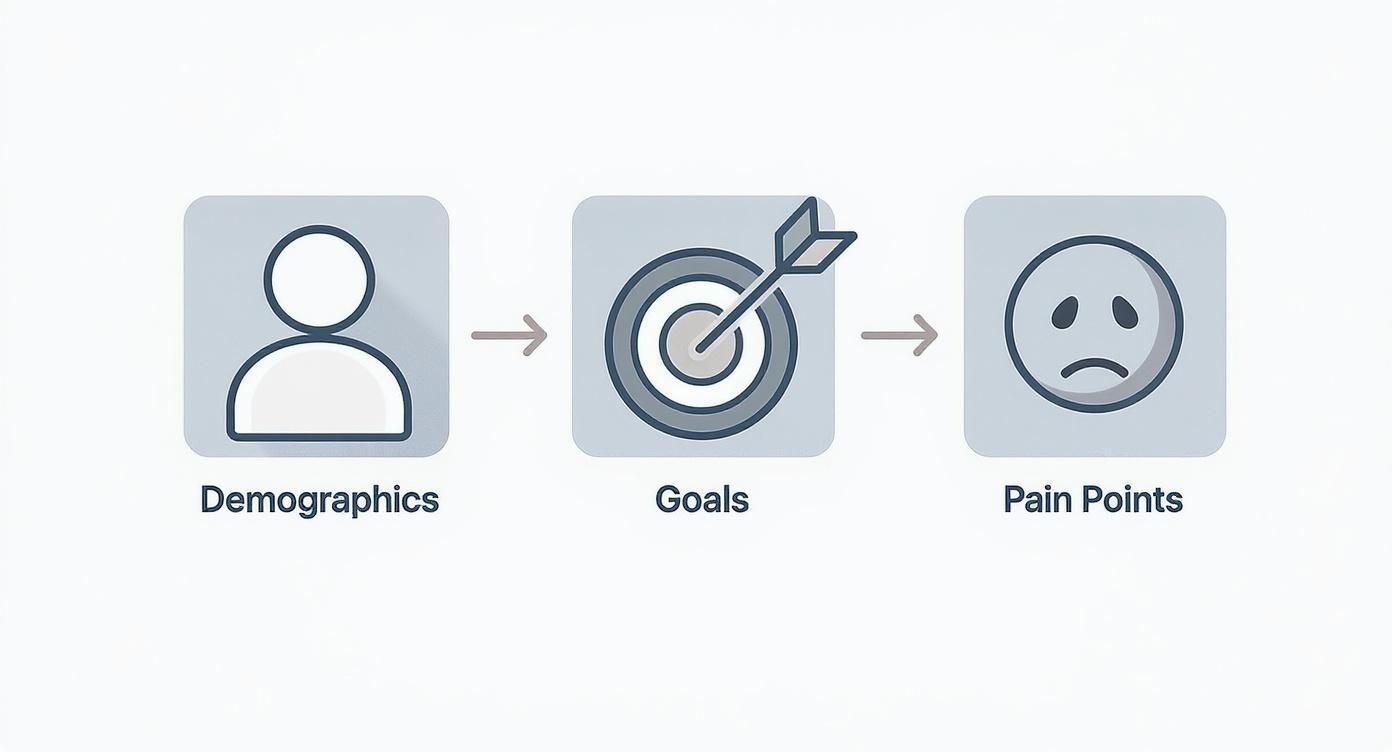
As you can see, a strong persona moves way beyond basic data to get at the core drivers of customer behavior—their goals and their pain points. The whole point of this exercise is to truly understand customer needs on a fundamental level.
Conducting Customer Interviews That Actually Yield Results
Interviews are the heart and soul of persona development. Aim to conduct 3-5 interviews per persona you plan to create. And please, don't just cherry-pick your happiest, most loyal customers. You need a balanced view.
Talk to a mix of people:
- Recent Customers: They have the freshest memory of their buying journey and the specific problem they were trying to solve when they found you.
- Long-Time Loyal Customers: They can provide deep insights into the ongoing value your product delivers and why they stick around.
- Prospects Who Chose a Competitor: This is often the most valuable group. Understanding why they didn't choose you reveals your critical weaknesses and the objections you need to overcome.
When you reach out, be crystal clear that this isn't a sales call. You're doing research to improve your customer experience. Offering a small incentive, like a gift card, can also significantly boost your participation rate.
Pro Tip: During interviews, ask open-ended questions that encourage storytelling. Instead of "Do you like our product?" ask, "Can you walk me through the day you realized you needed a solution like ours?" This uncovers the context and emotion behind their decision, which is where the real gold is.
Leveraging Surveys for Scalable Validation
While interviews provide depth, surveys provide scale. Once you've identified patterns from your interviews, use simple surveys to validate those findings across a much larger audience. Tools like SurveyMonkey or Google Forms are perfect for this.
Keep your survey short and focused. Ask questions that confirm the pain points, goals, and demographic trends you've already uncovered. This final step ensures your handful of interview anecdotes truly represent a larger segment of your audience, giving you the confidence that your personas are built on a solid foundation of reality, not fiction.
Finding the Patterns in Your Customer Research
You’ve done the legwork. You’ve sat through the interviews, sifted through CRM data, and wrangled survey responses. Now you're staring at a mountain of transcripts, notes, and reports. This is the moment where all that raw information starts to become something you can actually use—where the research turns into real, actionable buyer personas.
The goal here isn't just to summarize what people said. It's about spotting the recurring themes and patterns that signal a distinct customer archetype. You’re hunting for the common threads that connect a group of otherwise different people.
From Raw Data to Meaningful Segments
First, you need to get your qualitative feedback organized. A simple spreadsheet or a digital whiteboard like Miro can be your best friend here. Go through every interview transcript and survey answer, pulling out key phrases, stated goals, common challenges, and underlying motivations.
As you start pulling this data, you'll see clusters begin to form organically. You might notice that 5 or 6 different people all mentioned the "struggle to prove ROI to their boss." Or maybe a handful of them complained about "software that requires weeks of team training." These aren't just one-off comments; they're the building blocks of a persona.
Your first job is to group similar responses. Don't even think about naming personas yet. Just focus on categorizing the shared pain points, goals, job titles, and company sizes you're seeing.
This whole process of finding patterns is really a form of effective market segmentation for B2B. It’s how you define the distinct buyer groups that will become the foundation for your personas.
Key Dimensions for Segmentation
To bring some order to the chaos, analyze your data across a few key dimensions. This helps ensure you don’t miss the subtle but important details that separate one persona from another. Look for patterns in these areas:
- Role and Responsibilities: Do people with certain job titles talk differently? A "Director of Marketing" is probably worried about strategic outcomes and budget, while a "Marketing Manager" is down in the weeds, focused on tactical execution and team productivity.
- Primary Goals: Group people by what they’re ultimately trying to accomplish. One segment might be laser-focused on "generating more qualified leads," while another is obsessed with "improving customer retention."
- Major Challenges (Pain Points): What roadblocks keep coming up? You might find one group constantly hits a wall because of "a lack of budget," while another is frustrated by "slow, inefficient internal processes."
- Information Sources: Where do they learn? Pay close attention to whether they trust industry blogs, get recommendations from peers on LinkedIn, or rely on formal analyst reports. This is absolute gold for your content strategy.
For instance, after going through your notes, you might spot two obvious groups. Group A is full of VPs at enterprise companies who are measured on revenue growth and are fed up with data silos. Group B is mostly managers at mid-sized companies who just need to make their teams more efficient and can't get buy-in for new tools.
These two groups have completely different needs and motivations. And just like that, you’ve identified your first two potential buyer personas.
How Many Personas Do You Really Need?
This question comes up every single time, and the answer is almost always "fewer than you think." The point of creating personas is to bring focus to your marketing, not to create a detailed encyclopedia of every customer you could possibly have.
For most businesses, starting with 2-3 core personas is the sweet spot. It's enough to tailor your messaging in a meaningful way without spreading your team and budget too thin.
Before you create a new persona for a segment, ask yourself these three questions:
- Does this group have a truly unique set of goals or pain points? If their core problems are basically the same as another group's, they probably don't need their own persona.
- Do we need a different marketing message to reach them? If you’d use the same value props, content, and channels to attract them, you can likely merge them into an existing persona.
- Is this segment big enough to be valuable to our business? Avoid the temptation to create personas for niche edge cases that don’t represent a significant chunk of your market.
Remember, a persona is only useful if it forces you to make different marketing decisions. If you create "Marketing Mary" and "Sales Sam" but end up sending them the exact same content on the same channels, you've just created more work for yourself with zero benefit. The real power is in using these archetypes to create distinct, targeted experiences that actually resonate.
Bringing Your Buyer Personas to Life
You've waded through all the interview transcripts, CRM data, and survey results. The hard part is over, right? Almost. You’ve spotted the patterns and identified the core segments that define your customers.
Now comes the fun part: turning those clusters of data into a living, breathing document that feels like you're describing a real person.
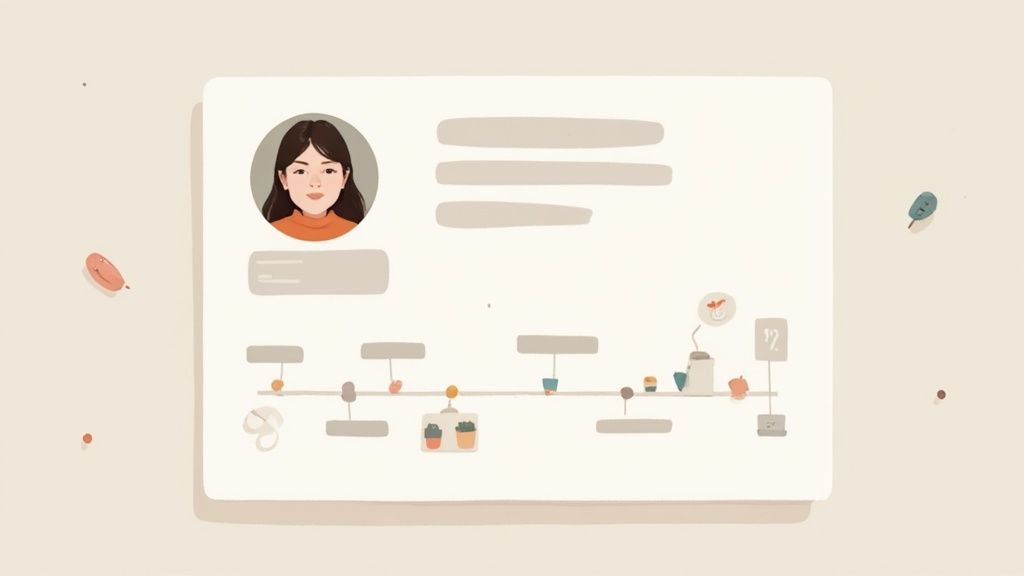
Let's be honest, a persona is completely useless if it’s just a collection of bullet points gathering dust in a Google Drive folder. The goal here is to build something your entire team—from marketing and sales to product and engineering—can actually use to build empathy and make smarter, faster decisions.
Crafting a Compelling Persona Narrative
The first order of business is to humanize your data. This is where you move beyond labels like "Segment B" and give your persona an identity that actually sticks in people's minds.
Start simple. Give your persona a realistic name and find a stock photo. "Marketing Manager Maria" is instantly more relatable and memorable than some generic customer code. This small step makes the persona feel less like an abstract concept and more like a person whose problems you’re genuinely trying to solve.
Next, it’s time to write their story. This narrative summary is the heart of the document, weaving together all the demographic details and qualitative insights you’ve gathered.
- Background: Briefly touch on their career path, current role, and the kind of company they work for. What’s their team structure like? Who do they report to?
- Demographics: Fill in key details like age, education, and even family life if it’s relevant. These elements help paint a fuller picture of their world outside of the office.
- Identifiers: Note their communication style and general personality. Are they a direct, data-driven person, or do they prefer building relationships and hearing a good story?
This isn’t supposed to be a novel. It just needs to be rich enough to give your team an immediate sense of who this person is, what they care about, and what really makes them tick.
Defining Goals, Motivations, and Frustrations
With the foundational story in place, you can now zero in on what matters most for your marketing and sales strategy. This is where you clearly articulate what drives your persona and what’s constantly getting in their way. Whenever you can, use their own words.
Pulling direct quotes from your interviews makes their challenges feel immediate and authentic. A line like, "I'm tired of manually pulling reports every week just to prove my team's value," is infinitely more powerful than a bland bullet point that says "Lacks reporting tools."
Organize these insights into clean, scannable sections:
- Primary Goals: What are they trying to accomplish in their role? What does a big win look like for them?
- Key Frustrations: What are their biggest daily roadblocks? What are the pain points that keep them up at night?
- Motivations: What are the underlying drivers behind their goals? Are they chasing a promotion, trying to make their team look good, or seeking recognition in their industry?
This structure makes it incredibly easy for anyone in your company to quickly grasp what matters most to your ideal customer.
By framing goals and challenges from their perspective, you create a powerful empathy tool. It shifts the internal conversation from "How can we sell our product?" to "How can we help Maria solve her problem?"
Building Empathy with a Day in the Life
Want to take your persona from good to great? Add a "Day in the Life" section.
This is a short, first-person narrative that walks through a typical workday from your persona's point of view. It’s where you illustrate how their goals and frustrations actually play out in real-world scenarios.
This exercise is incredibly effective for building true empathy. It forces you to think about their environment—the back-to-back meetings, the pressure from leadership, the clunky, outdated software they’re forced to use. It’s one thing to know your persona struggles with "inefficient workflows," but it’s another thing entirely to describe the hour they waste every morning juggling three different spreadsheets.
When you bring your buyer personas to life this way, you create more than just a document. You create a reference tool that aligns your entire organization and ensures everyone is working from a shared understanding of the customer. And that makes it a whole lot easier to build products, create content, and craft messaging that genuinely connects.
Putting Your Personas to Work in Marketing and Sales
All that research, data crunching, and story-building you’ve done? It all comes down to this. Creating buyer personas isn’t an academic assignment—it’s a strategic move designed to deliver real, measurable business results. This is the moment your hard work stops being a document and starts being the engine behind your growth.
Activating your personas means translating those rich insights into action across every customer-facing part of your business. From here on out, every piece of content, every ad campaign, and every sales call gets filtered through the lens of your personas.
Sharpening Your Website and Content Strategy
Your website is often the first real conversation a prospect has with your brand. A persona-driven approach ensures that conversation feels relevant and hits home from the very first click. Instead of broadcasting generic messages, you can speak directly to the specific pains and ambitions of each persona.
Let's say your primary persona is "Startup Founder Sarah." She's drowning in admin work and values speed and efficiency over everything else. Your website headline shouldn't just say, "Powerful Automation Software." It needs to talk to her. Something like, "Stop Drowning in Admin. Launch Your Big Ideas Faster."
This laser-focused approach should ripple through your entire content strategy:
- Blog Posts: Write the articles your personas are already searching for. "Founder Sarah" might be googling "how to scale a small team without hiring," while "Enterprise Manager Ed" is looking for "best practices for cross-departmental workflow."
- Lead Magnets: Ditch the one-size-fits-all ebook. Create resources that solve a specific problem for each persona. For Sarah, it might be a simple checklist. For Ed, a detailed ROI calculator.
- Video Content: Develop videos that match their viewing habits. Sarah probably wants short, punchy explainers she can watch on her phone. Ed is more likely to block off time for an in-depth webinar.
The difference this makes is staggering. Research shows that using buyer personas can make websites two to five times more effective at converting visitors. Why? Because you're turning your site from a generic brochure into a personalized problem-solving machine. Check out more on the strategic impact of personas on business results.
Driving Hyper-Targeted Ad Campaigns
Running paid ads without personas is like throwing money out of a moving car—you might hit something, but you'll waste a ton of cash in the process. Personas give you the precision to squeeze every drop of value from your ad spend.
With a clear persona, you know exactly where to find your audience. "Founder Sarah" is probably active in entrepreneurial groups on LinkedIn. "Developer Dave" might spend his time on Reddit or Stack Overflow. That insight alone can save you a fortune.
Personas allow you to craft ad copy that feels less like an interruption and more like a helpful solution. You're no longer just targeting a demographic; you're speaking to an individual's specific challenge.
Beyond just targeting, personas shape the creative and the message itself. You can A/B test different value props tailored to each persona's core motivation. For "Sarah," you’d test messaging around speed and growth. For "Ed," you’d test copy focused on security, compliance, and team adoption.
Empowering Sales with Actionable Intelligence
Your sales team is on the front lines. Personas are their secret weapon for building instant rapport and closing deals faster. A well-built persona document is basically a cheat sheet for every conversation, giving them a deep understanding of a prospect’s world before they even dial the number.
Here's how sales teams can put them to use immediately:
- Tailor Discovery Questions: Instead of asking the same five generic questions, they can ask smart, targeted questions based on the persona’s known challenges.
- Anticipate Objections: Good personas outline common pushback. If you know "Enterprise Ed" is always worried about integration, your rep can address it proactively before he even brings it up.
- Frame the Value Proposition: The pitch is no longer one-size-fits-all. The value of your solution is framed around the specific goals and metrics that matter most to that persona.
For a platform like GetViews.AI, this is non-negotiable. When talking to a founder on LinkedIn, the conversation is all about building a personal brand to drive inbound leads. But when talking to a sales leader, the focus shifts to predictable pipeline and team efficiency. The persona dictates the entire conversation.
This is a cornerstone of modern B2B sales. By truly understanding who you're talking to, you make every interaction valuable—a core principle in successful prospecting with LinkedIn. Ultimately, putting your personas to work is what separates the companies that just have personas from the ones that use them to build a real competitive advantage.
FAQ About Creating Buyer Personas
Even with the best framework, a few questions always seem to pop up when teams start building out their buyer personas. Getting the details right here is what separates a persona that actually drives your marketing from one that just becomes a pretty PDF no one looks at.
Let’s tackle some of the most common ones we hear.
How Many Buyer Personas Do I Really Need?
This is, without a doubt, the most frequent question. And the answer is almost always: "fewer than you think." The goal here isn't to create a giant encyclopedia of every possible customer. It's about focus.
For most businesses, the sweet spot is 2-4 key personas. That’s a manageable number to build distinct, effective strategies for without spreading your team too thin. If you’re just starting out, my advice is to pick just one—your single most profitable or ideal customer—and nail that before you even think about adding another.
Before you create a new persona, ask yourself one simple question: "Does this group need a fundamentally different message or a different channel to reach them?" If the answer is no, they can probably be rolled into an existing persona.
The whole point of a persona is to force you to make different and better marketing decisions. If two personas lead you to the exact same marketing plan, you really only need one of them.
What Is the Difference Between a Persona and a Target Audience?
This distinction is crucial, and it’s a place where a lot of marketers get tripped up.
A target audience is broad and demographic-based. It's a wide snapshot of a group. For example: "Women, aged 25-40, who live in major cities and work in marketing." It tells you what they are.
A buyer persona, on the other hand, is a deep, semi-fictional archetype of a specific individual from that audience. Think: "Marketing Manager Maria, 32, who is totally overwhelmed by manual reporting and needs a tool to finally prove her team's ROI to her VP." It tells you who she is and why she makes decisions.
Here's an easy way to think about it: the target audience is the entire stadium, but the persona is the specific fan you're sitting next to, having a one-on-one conversation with.
How Often Should I Update My Buyer Personas?
Personas are not static documents. You don't create them once and file them away forever. Markets change, customer problems evolve, and your own business shifts. Your personas have to be living, breathing documents to stay relevant.
As a general rule, you should plan to review and refresh them at least annually.
However, certain events should trigger an immediate review. Think of these as wake-up calls to re-evaluate who you're talking to:
- A major product launch: Your new offering might suddenly attract a completely new type of buyer you hadn't considered.
- Entering a new market: Expanding into a new industry or geographic region will absolutely require fresh persona research.
- A significant shift in your sales data: If you suddenly see a new customer segment becoming your most profitable, it's time to build a persona that reflects them.
Keeping your personas current is what ensures your marketing stays sharp and effective. It’s the difference between guessing what your customers want and knowing exactly what they need.
We've covered a lot of ground, but sometimes seeing the most common questions laid out can help solidify the concepts. Here's a quick-glance table with answers to the essentials.
| Question | Short Answer |
|---|---|
| What is a buyer persona? | A detailed, semi-fictional profile of your ideal customer, focusing on their goals, challenges, and motivations. |
| Why do I need them? | To ensure your marketing, sales, and product decisions are centered on real customer needs, not assumptions. |
| How many personas should I have? | Start with one, and aim for 2-4 key personas. Focus is more important than quantity. |
| What's the difference vs. a target audience? | A target audience is a broad group (the "what"); a persona is a specific archetype within that group (the "who" and "why"). |
| What data should I use? | A mix of qualitative (interviews, sales feedback) and quantitative (analytics, surveys) data is best. |
| How often should I update them? | Review them annually or whenever your business undergoes a major change (new product, new market, etc.). |
| Can personas be used for B2B? | Absolutely. B2B personas are critical for understanding the different roles and decision-makers within a buying committee. |
Hopefully, that clears up any lingering confusion. The key is to see personas not as a one-time project, but as a strategic tool that evolves with your business.
Ready to turn your LinkedIn presence into a predictable pipeline? GetViews.AI uses AI to help you create consistent, high-performing content that builds authority and attracts inbound leads, so you can stop chasing prospects and start having conversations. Discover how it works.