Generate Leads With LinkedIn A Modern Playbook
Discover how to generate leads with LinkedIn using proven strategies. Our playbook covers profile optimization, content that converts, and scaling with AI.
Wilmer KarlssonTarstad
To really start generating leads with LinkedIn, you first have to stop thinking about your profile as a resume. It’s not. It’s a landing page, and its only job is to turn visitors into prospects. This means every part of it, especially your headline and 'About' section, needs to speak directly to your ideal client's biggest headaches and ambitions.
A well-built profile is your 24/7 salesperson. It warms people up long before you ever slide into their DMs.
Build Your LinkedIn Profile Into a Lead Magnet
Before you write a single post or send one outreach message, your profile has to do the heavy lifting. It's the foundation for everything. A weak, half-finished profile screams that you don't pay attention to detail. But a sharp, thoughtfully crafted one? That builds instant credibility and makes prospects want to connect.
Think about it. When you land on a company’s website, you expect it to be clear, professional, and focused on solving your problem. Your LinkedIn profile is no different. It’s the digital HQ for your personal brand, and every single visitor is a potential lead.
Craft a Client-Centric First Impression
Your profile picture and headline are the first two things anyone sees. They pop up in search results, in the comment sections, and in every connection request you send. So, ditch the generic job title like "CEO at Company X." It does nothing for you.
Instead, write a headline that’s all about the benefit you provide. It should instantly answer the question "What's in it for me?" from your prospect's point of view.
For example, a marketing consultant could go from "Founder at ABC Marketing" to "I Help B2B SaaS Founders Double Their Demo Requests with Predictable Paid Ads." See the difference? The second one communicates immediate value and filters for the exact right audience. Your headline is your mini-pitch. For a deeper dive, check out our guide on https://getviews.ai/blog/how-to-optimise-your-linkedin-profile.
Key Takeaway: Your LinkedIn profile isn't a history of your career. It's a strategic tool designed for your future. Optimize every element to attract, engage, and convert your ideal customer.
Tell a Compelling Story in Your About Section
This is your chance to go beyond a boring list of skills and actually tell a story. Your 'About' section is where you make a human connection. Don't just list what you do; explain why you do it and, more importantly, who you do it for.
Try structuring it like a short narrative:
- The Hook: Start with your core value prop. Hit on the #1 pain point your audience is dealing with right now.
- The Proof: Briefly mention your track record or some results that prove you can actually solve their problem. Use real numbers if you have them.
- The Process: In simple terms, explain your unique approach. What makes you different?
- The Call-to-Action: End with a clear next step. Tell them exactly what you want them to do—connect with you, book a call, or grab a free resource.
This approach makes your profile far more memorable than a simple list of achievements. The goal here is to make a real connection, not just broadcast your resume. For a fantastic, in-depth guide on this, check out this resource on how to get leads from LinkedIn the right way.
To really hammer home why this is so critical, look at the numbers. LinkedIn is the undisputed king of B2B. A staggering 80% of all B2B leads from social media come straight from this platform. And it's no surprise that 62% of B2B marketers consistently report that LinkedIn is a reliable source of leads for their business. Your profile is the front door to that entire ecosystem.
The table below breaks down the key parts of your profile and how to think about them not as static fields, but as active tools for lead conversion.
Key Profile Elements for Lead Conversion
| Profile Element | Optimization Goal | Example Tactic |
|---|---|---|
| Headline | Grab attention and state your value proposition instantly. | "Helping [ICP] achieve [Outcome] with [Method]." |
| About Section | Build trust and guide prospects toward a conversation. | Structure as a story: Hook, Proof, Process, Call-to-Action. |
| Featured Section | Showcase tangible proof of your expertise. | Pin a top-performing post, a client case study, or a link to a free guide. |
| Experience | Frame past roles in terms of outcomes, not just duties. | "Grew ARR from $1M to $5M by implementing..." instead of "Managed sales team." |
| Recommendations | Provide third-party validation from real clients. | Actively request specific, results-focused recommendations after successful projects. |
By optimizing these elements, you shift your profile from a passive online resume to an active, lead-generating asset that works for you around the clock.
Create Content That Pulls In Your Ideal Buyers
An optimized profile turns visitors into leads, but it's your content that gets them to your profile in the first place. Posting randomly won't cut it.
If you want to generate leads with LinkedIn, you have to treat your content like a strategic engine. Its job is to attract, educate, and eventually convert your ideal customer profile (ICP). The goal is to build so much trust that prospects start reaching out to you.
This isn’t about just shouting company updates into the void. It's about becoming the go-to resource in your niche by consistently delivering real value. When you solve your audience's problems for free in your content, they can't help but assume your paid solutions are even better.
The Three Pillars of High-Converting Content
Every single piece of content you create should fit into one of three buckets. Each one serves a different purpose in nudging a prospect from a passive scroller to an active lead. A healthy mix is crucial for nurturing your audience at every stage.
Think of it like a real-life conversation. You wouldn't walk up to a stranger and immediately pitch your product. You'd build some rapport, understand their challenges, and then offer a solution. Your content needs to follow that same natural flow.
- Educate: These posts are all about your ICP’s biggest pain points and aspirations. You're sharing insights, frameworks, and practical "how-to" advice that actually helps them solve a problem. This is how you position yourself as the expert.
- Engage: This is the content that sparks conversations and builds a community around you. Share personal stories, ask thought-provoking questions, or post your take on industry trends to get people talking in the comments.
- Convert: These posts are more direct. They might show off a big client win, highlight a specific product feature, or include a clear call-to-action to book a demo or download a resource.
By cycling through these pillars, you create a content experience that feels valuable, not salesy. You're building a relationship one post at a time.
Mapping Content to the Buyer’s Journey
To make your content really hit home, you need to align it with where your prospect is in their buying journey. Someone just becoming aware of their problem needs totally different information than someone who is actively comparing solutions.
For prospects in the awareness stage, your job is to help them name their problem. Focus on educational content. A post like, "Five Signs Your Manual Invoicing Process is Costing You Money" is perfect for someone who feels the pain but hasn't yet identified the cause.
Once they move to the consideration stage, they're actively looking for solutions. This is where you can share case studies or comparison posts. For example: "How We Helped a SaaS Company Cut Invoicing Time by 80% with Automation." This gives them a tangible solution to their now-defined problem.
Finally, at the decision stage, they're ready to buy. This is where your conversion-focused content comes in. A direct post offering a free consultation or a product demo can be the final nudge they need to take action. This targeted approach is what makes your content feel incredibly relevant and helpful.
Your content's job is to meet buyers exactly where they are. Educate the unaware, guide the considering, and convert the ready. This alignment is what turns content from noise into a predictable lead pipeline.
Post Formats That Drive Engagement
The format of your post is just as important as what's in it. Both LinkedIn’s algorithm and its users favor content that’s easy to consume and encourages interaction. The platform is built for meaningful conversations—in fact, 40% of active monthly users engage with business pages organically each week without any ad spend. This is a goldmine for anyone creating smart content. You can dig deeper into these powerful LinkedIn marketing stats on BrentonWay.com.
Here are a few formats that consistently crush it:
- Text-Only Posts: Short, punchy posts with lots of white space are surprisingly effective. Start with a killer hook, tell a story or share a key insight, and end with a question to get the comments flowing.
- Carousels (PDFs): These are fantastic for breaking down complex topics into digestible, bite-sized slides. They have a high "dwell time," which is a strong signal to the algorithm that your content is valuable.
- Polls: Polls are a super low-effort way for your audience to engage. Use them to gather quick market research, validate a new idea, or just start a fun conversation around an industry topic.
The key is to mix up your formats. Keep your feed interesting and cater to the different ways people like to consume information. Crafting compelling posts is a skill, and if you're looking to level up, our guide on how to write LinkedIn posts is packed with actionable frameworks and examples.
Ultimately, the best content strategy is the one you can stick with consistently.
Master Your Engagement and Outreach Strategy
An optimized profile and killer content get you on the runway. But to actually take off and start generating leads on LinkedIn, you need an engine. That engine is smart, consistent engagement.
This is where the magic happens. It’s how you turn passive profile views and post likes into real business conversations. Just broadcasting content into the void isn't a strategy. You have to proactively jump into conversations, build real rapport, and then—only then—guide those interactions toward a meeting.
This is the long game. It’s about relationship-building, not just hunting for a quick sale. When you get this right, you close the loop and turn your content efforts into a predictable pipeline.
The whole process really boils down to three stages: Educate, Engage, and Convert.
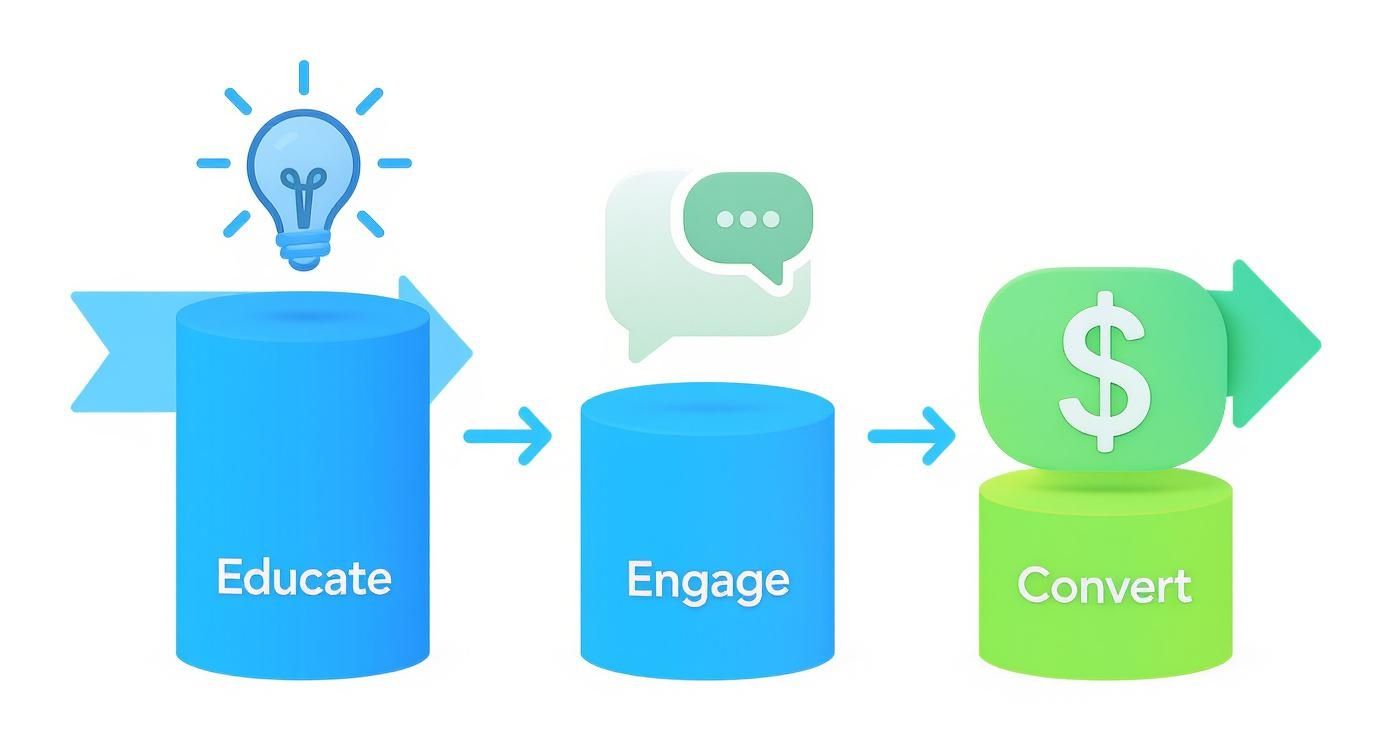
This shows how your audience moves from just learning about their problem to actually interacting with your solutions, which eventually leads them to a buying decision. Your engagement strategy is the active work that moves them along that path.
Build a Repeatable Daily Engagement Routine
Here's a secret: consistency crushes intensity. You don't need to live on LinkedIn for hours every day. A focused 15-20 minute daily routine is all it takes to build serious momentum.
The goal is simple: become a visible, valuable member of your prospects' online world before you ever ask for anything.
Your daily workflow should hit these high-impact activities:
- Comment on prospect posts: Find 5-10 key prospects or industry leaders and leave thoughtful, insightful comments on their content. Don't just say "Great post!" Add to the conversation. Ask a smart question. Share a related experience.
- Engage with your own content: Make a point to respond to every single comment on your posts. This does more than just boost your post's visibility in the algorithm; it shows your followers you’re an active, engaged expert who values their input.
- Send personalized connection requests: Only connect with people you’ve identified as a good fit or have already interacted with in the comments. And always, always add a personal note.
This routine primes the pump. When you finally slide into their DMs, you're not a stranger—you're that person who left that smart comment last week. That simple shift dramatically increases your response rates.
Engagement is the bridge between your content and your pipeline. Every thoughtful comment you leave is like laying another plank on that bridge, making it easier for a prospect to walk over to your side.
Crafting DMs That Actually Get Replies
Once you've warmed up a prospect through consistent engagement, it's time to move the conversation to DMs. This is where most people completely blow it. They go straight for the pitch, instantly turning a warm connection ice-cold.
Your first outreach message should never be a sales pitch. It should be a simple, human conversation starter that adds more value. Your only goal for that first message is to get a reply, not to close a deal.
Here are a few value-first scenarios that work:
- The Comment Follow-Up: After a good back-and-forth in the comments, send a DM. "Hey [Name], really enjoyed our chat about [Topic] on your post. I found this article on a similar theme and thought you might find it interesting. No strings attached!"
- The Shared Interest Connection: "Hi [Name], I noticed we both follow [Influencer] and saw your profile. I'm also passionate about [Shared Interest]. Would be great to connect and learn more about your work at [Company]."
- The Content Appreciation: "Hi [Name], I've been following your content for a while, and your post on [Topic] was incredibly insightful. It really clarified [Specific Point] for me. Just wanted to say thanks and connect."
See the pattern? No pitch. No ask. Just genuine, personalized value. This conversational approach builds trust and practically begs for a response, turning what would have been a cold outreach into a warm conversation.
Only after you've established some back-and-forth and built real rapport should you even think about guiding the discussion toward a business need. This is how you sustainably generate leads on LinkedIn without torching your reputation.
Scale Your Lead Generation With AI and Automation

Let's be real. Manually managing every single comment, connection request, and follow-up message is a one-way ticket to burnout. You know the human touch is what builds real relationships, but trying to do it all by hand simply doesn't scale.
This is where AI and automation come in. The trick is to use them intelligently to handle the repetitive, top-of-funnel work. This frees you up for the high-value conversations that actually move the needle and close deals.
The goal isn't to automate your personality away; it's to automate the right things. Think of it as hiring a hyper-efficient assistant to handle the grunt work—like identifying potential prospects or sending initial connection requests—while you focus on the strategy and relationship-building that only you can do.
Balancing Automation With Authenticity
The biggest mistake I see founders and sales teams make is letting their automation tools run wild. A robotic, generic outreach message is actually worse than sending nothing at all. It kills trust instantly.
The whole point of using technology is to create more opportunities for genuine human connection, not to replace it. For anyone serious about generating leads at scale, incorporating AI marketing automation gives you a massive competitive edge, especially on a crowded platform like LinkedIn.
So, how do you decide what to hand off to the machines and what to keep for yourself? I break it down like this:
Tasks perfect for automation:
- Profile Views: Automatically viewing the profiles of people in your ICP is a low-effort way to get on their radar. It triggers a notification and often leads to a reciprocal view.
- Initial Connection Requests: You can send templated (but still personalized) connection requests to a pre-vetted list of prospects. The key is pre-vetted.
- Data Scraping: Gathering public info from profiles, like job titles or company size, is a mind-numbing task that’s perfect for a machine. This helps you build laser-focused lead lists.
Tasks that demand a human touch:
- Writing Thoughtful Comments: Sure, AI can spit out generic ideas, but a truly insightful comment that adds to the conversation has to come from you. This is how you build authority.
- Crafting Follow-Up DMs: The very first follow-up might be semi-automated, but any real conversation needs to be highly personalized based on their profile and what they say back to you.
- Closing the Deal: No AI is going to replace the nuance, empathy, and trust required to run a great sales call or navigate a final negotiation. This is your time to shine.
This hybrid approach gives you the best of both worlds: efficiency at the top of the funnel and the personal touch that wins clients at the bottom.
Choosing the Right Tools for the Job
The market is flooded with tools promising to 10x your LinkedIn results. When you're looking at options, focus on safety and personalization above all else. You want a co-pilot, not a rogue bot that could get your account flagged for spammy behavior.
And the stakes are higher than ever. LinkedIn's user base has exploded to over 1.15 billion members, up from 644 million just a few years ago. Reflecting this growth, a recent Cognism report on LinkedIn statistics noted that 68% of B2B marketers have increased their use of the platform in the last year. It’s the place to be, so you need to play smart.
Modern, AI-powered tools can do a lot more than just send canned messages. Look for features like:
- Conversation Starters: Some tools can analyze a prospect’s recent activity or profile to suggest unique icebreakers, so you don't have to start every DM from scratch.
- Content Ideation: AI can analyze top-performing content in your niche and even suggest first drafts for your posts, saving you hours of brainstorming.
- Message Optimization: The ability to A/B test different connection requests or follow-up messages is huge. It lets you see what actually works and double down on it.
Pro Tip: Never, ever use an automation tool that asks for your LinkedIn password. Stick to tools that use secure browser extensions or official APIs. It's a simple rule that will save you a world of hurt and protect your account.
To make this clearer, let's compare what these activities look like with and without AI assistance.
Manual vs AI-Assisted LinkedIn Tasks
| Activity | Manual Approach (Pros/Cons) | AI-Assisted Approach (Pros/Cons) |
|---|---|---|
| Prospecting | Pro: Highly targeted, great for niche markets. Con: Extremely time-consuming; limited by individual capacity. | Pro: Scans thousands of profiles in minutes based on ICP. Con: Requires careful filter setup to maintain quality. |
| Initial Outreach | Pro: Every message is 100% personalized. Con: Unscalable; impossible to reach hundreds of leads per week. | Pro: Reaches a large volume of leads consistently. Con: Risk of sounding generic if not personalized with snippets. |
| Content Creation | Pro: Authentic voice and unique insights. Con: Prone to writer's block; can take hours per week. | Pro: Generates ideas, outlines, and drafts in seconds. Con: Needs human editing to add personality and nuance. |
| DM Conversations | Pro: Builds deep rapport and trust. Con: Hard to manage more than 10-15 active conversations. | Pro: Handles initial follow-ups; suggests replies. Con: Should not handle complex conversations. This must remain human. |
| Engagement | Pro: Genuine comments build your brand. Con: Easy to miss opportunities in a busy feed. | Pro: Flags relevant posts and comments for you to engage with. Con: Automated comments are spammy and ineffective. |
Ultimately, AI doesn’t replace the core strategies. It’s a force multiplier. It takes the proven playbook of optimizing your profile, creating great content, and engaging with your network—and lets you execute it at a scale that would be impossible otherwise.
If you want to dive deeper into the different options available, our guide on the best LinkedIn automation tools breaks down the top players to help you find the right fit.
By automating the repetitive stuff, you free up your most valuable resource—your time—to focus on building the real relationships that drive revenue.
Measure What Matters to Optimize Your Results
Let’s be honest: you can't improve what you don't measure. A winning LinkedIn strategy is built on hard data, not just hopeful guesswork. It’s far too easy to get mesmerized by vanity metrics like post views and likes, but those numbers almost never tell you the full story about your pipeline's health.
To turn all this LinkedIn activity into a predictable source of revenue, you have to track the metrics that actually impact your bottom line.
This means you need to stop chasing the numbers that feel good and start obsessing over the ones that show you exactly where your process is working—and, more importantly, where it’s breaking down.
Think of it as a data-driven feedback loop. Every single action you take becomes a small experiment. You test, learn, and fine-tune your approach until your efforts get more effective and profitable over time.
Identifying Your Core KPIs
Let's cut right through the noise. While LinkedIn Analytics throws a ton of data at you, only a handful of key performance indicators (KPIs) are directly tied to generating leads. These are the numbers that represent real, tangible progress in moving someone from a stranger to a scheduled meeting.
Your entire focus should be on tracking the conversion rates at each critical stage of your outreach funnel. This gives you a clear, diagnostic view of your performance.
Here are the only metrics that truly matter:
- Connection Request Acceptance Rate: This is your first major hurdle. It tells you how effective your profile headline and personalized connection notes are. A low rate here is a dead giveaway that your initial targeting or messaging is off.
- DM Reply Rate (First Message): Once someone accepts, how many actually reply to your first message? This number is a direct reflection of your opening line's quality. A poor reply rate usually means your message feels too salesy, generic, or just plain boring.
- Positive Reply Rate: Not all replies are created equal. This metric tracks how many responses show actual interest or are open to continuing the conversation. It helps you filter out the "not interested" replies to see how well your value proposition is actually landing.
- Meetings Booked: This is it—the ultimate goal of all your top-of-funnel work. Tracking the number of sales calls or demos scheduled from your LinkedIn conversations is the most concrete measure of your ROI. Simple as that.
A low connection acceptance rate is a profile problem. A low DM reply rate is a messaging problem. Knowing the difference is how you stop guessing and start fixing the right part of your funnel.
Creating a Simple Tracking System
You don't need some complex, expensive dashboard to get started. A simple spreadsheet is more than enough to track these KPIs and uncover some incredibly powerful insights.
The real key here is consistency. You have to make it a non-negotiable weekly habit to update your numbers. This is how you spot trends and make smart adjustments before you waste another month on a broken strategy.
Here’s a dead-simple structure for your tracker:
| Week | Connection Requests Sent | Connections Accepted | Acceptance Rate | DMs Sent | Replies Received | Reply rate | Meetings Booked |
|---|---|---|---|---|---|---|---|
| Week 1 | 100 | 35 | 35% | 35 | 11 | 31% | 2 |
| Week 2 | 100 | 42 | 42% | 42 | 12 | 28% | 3 |
| Week 3 | 100 | 28 | 28% | 28 | 13 | 46% | 4 |
Looking at this simple table, you can immediately start asking the right questions.
In Week 2, the acceptance rate jumped—what did I change in my connection note that week? But look at Week 3: the acceptance rate tanked, while the reply rate soared. What happened? Maybe I targeted a much smaller, more niche group. While fewer people connected, the ones who did were far more interested.
This is the power of tracking. It turns your frantic activity into actionable intelligence. You finally start to understand the specific levers you can pull to influence your results, moving from random acts of outreach to a systematic process of optimization. This methodical approach is the secret to building a reliable lead generation machine on LinkedIn.
Got Questions? We've Got Answers
Jumping into LinkedIn lead gen can feel like a lot, but a few core ideas drive almost every successful strategy. Here are the most common questions I hear from founders and sales teams trying to build a predictable inbound machine.
How Much Time Do I Really Need to Spend on This Each Day?
Forget spending hours glued to your screen. Consistency beats intensity, every single time. A focused 20-30 minutes a day is more than enough to get serious traction.
This isn't about mindless scrolling. It's about a repeatable, high-impact routine.
- 10 minutes: Jump into your feed and leave 5-7 thoughtful comments on posts from ideal prospects or key voices in your industry.
- 10 minutes: Circle back to your own content. Reply to comments and manage your DMs.
- 5 minutes: Send a few hyper-personalized connection requests to people you’ve already warmed up through your comments.
This simple routine ensures every minute you spend is actually moving prospects down the funnel.
Is Sales Navigator Actually Worth It?
If you're serious about generating leads on LinkedIn at any kind of scale, the answer is a hard yes. The free version is fine for getting your feet wet, but you'll hit a wall pretty fast.
Think of Sales Navigator as an investment in pure efficiency. Its superpower is the advanced search filters. You can build incredibly targeted lead lists based on things like company size, seniority, and even recent job changes. This means your outreach is aimed at much higher-quality prospects from day one.
The free version of LinkedIn is like fishing with a single line in a massive ocean. Sales Navigator is like a high-tech fish finder that shows you exactly where the schools of your ideal fish are swimming.
What’s the Best Way to Follow Up Without Being Annoying?
The golden rule here is to always, always lead with value. Ditch the self-serving "just checking in" messages for good. A great follow-up should feel like a helpful continuation of the conversation, not a desperate nudge.
If a prospect goes quiet after you've had a good back-and-forth, give it a week, then try one of these moves:
- Share a Relevant Resource: Find an interesting article, a case study, or a tool that speaks directly to their challenges. A message like, "Hey [Name], I came across this piece on [Topic] and it made me think of our chat about your goals. Figured you might find it useful," is a game-changer.
- Reference Their Activity: Did they just post something interesting or get mentioned in the news? Use that. "Congrats on the new product launch! That [X] feature looks fantastic. Curious to hear how the market is responding."
This approach keeps you top-of-mind by proving you’re paying attention and are genuinely invested in their world. It’s about being a resource, not just another salesperson.
Ready to turn your LinkedIn presence into a predictable revenue machine without the manual grind? GetViews.AI uses an AI Story Engine to help you create high-performing content that builds pipeline on autopilot. Stop chasing leads and start attracting them. Learn more and get started at GetViews.AI.