How to Build Executive Presence and Lead with Impact
Learn how to build executive presence with proven strategies for communication, personal branding, and confident leadership to accelerate your career growth.
Wilmer KarlssonTarstad
Learning how to build executive presence isn't about faking a new personality. It's about sharpening three core skills so you can project the confidence and competence you already possess. Think of them as the pillars of presence: how you act (gravitas), how you speak (communication), and how you look (appearance).
It's a process, one that can be learned and mastered.
What Executive Presence Really Means
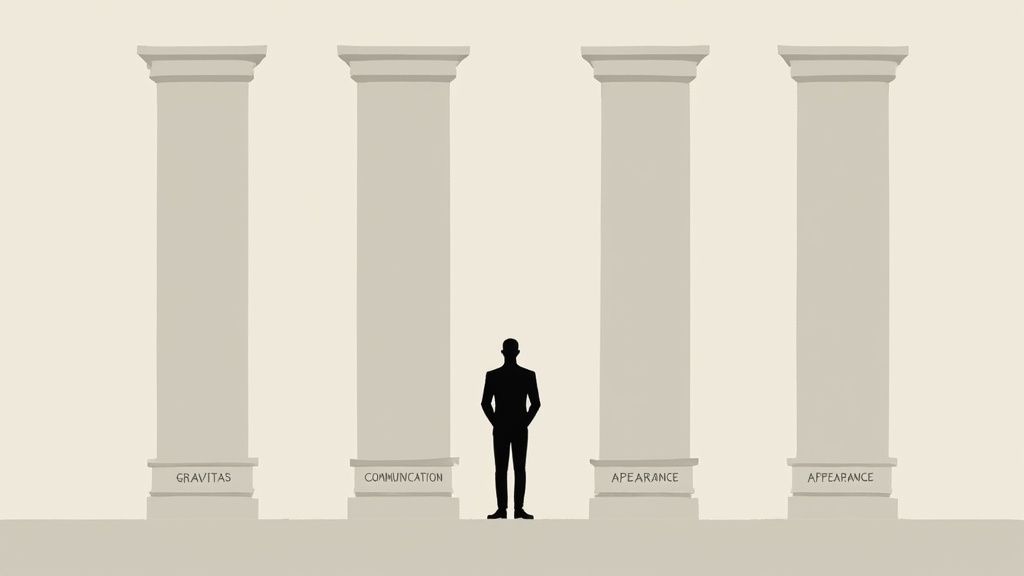
When people hear "executive presence," their minds often jump to a stereotype: the intimidating, larger-than-life CEO. But that's a seriously narrow—and frankly, outdated—view.
At its heart, executive presence is simply your ability to signal to others that you're a capable, credible, and confident leader. It's that unspoken quality that makes people lean in when you talk and trust your judgment when a tough call needs to be made.
And this isn't some magical trait you're born with. Research shows that a staggering 98% of leaders have to actively work on developing their presence through deliberate practice and feedback. It's a skill, not a gift.
Why It Matters More Than Ever
In today's world, your technical skills will get you in the door, but executive presence is what gets you a real seat at the table. It’s a huge factor in who gets promoted, accounting for roughly 26% of what it takes to move up. You can dig into more of the research behind these executive presence statistics if you're curious.
This is even more critical now that so many of us work in hybrid or remote setups. When you’re not physically in the room, projecting authority and building trust takes a much more intentional effort. Every video call, every email, every Slack message is a chance to either build or chip away at your presence.
"Executive presence is the ability to connect, influence, and stay composed, no matter the room or the moment."
Ultimately, this is all about authenticity and impact. It’s making sure the expertise you have on the inside is reflected in how you show up on the outside.
When you nail this, you gain the ability to:
- Inspire Confidence: Your team feels secure in your leadership, even when things are chaotic.
- Command Attention: People actually listen to your ideas because you deliver them with conviction and clarity.
- Drive Action: You can rally people around your vision and get things done.
Let's take a closer look at the three pillars that make up a strong executive presence.
The Three Pillars of Executive Presence
To make this tangible, it helps to break executive presence down into its core components. These are the specific areas you can focus on to see real improvement.
| Pillar | Key Traits | Impact on Perception |
|---|---|---|
| Gravitas | Confidence, composure under pressure, decisiveness, emotional intelligence. | Signals you're a steady hand, reliable, and in control. Builds trust. |
| Communication | Clarity, assertiveness, concise speaking, active listening, storytelling. | Makes your ideas memorable, influential, and easy to understand. |
| Appearance | Professionalism, polish, appropriate dress, intentional body language. | Conveys that you take yourself—and your work—seriously. |
By focusing on these distinct areas, you can start a targeted journey of self-improvement. It's not about changing who you are, but about becoming a more effective, impactful version of yourself.
Cultivating Gravitas to Command Respect

Gravitas. It’s that unshakable substance that makes people feel your leadership. It’s the quiet confidence that signals you’re in control, even when everything’s hitting the fan.
This isn’t about being loud, intimidating, or overly serious. Gravitas is the weight and seriousness you bring to your role, convincing everyone in the room that you’re a credible, reliable force. It’s what makes people put down their phones and actually listen when you start talking.
When you have it, your team trusts your judgment. They see a steady hand, someone capable of navigating choppy waters with a clear head. Developing it is an intentional practice, one that starts with mastering your internal state so you can project strength on the outside.
Remaining Composed Under Pressure
The true test of gravitas isn't when things are going smoothly; it’s when the pressure is on. A missed deadline, a tense client negotiation, an unexpected crisis—these are the moments that define you as a leader.
Losing your cool instantly torpedoes your authority. Maintaining composure reinforces it.
One of the most effective tools I’ve seen work in real-time is tactical breathing. When stress spikes, your body’s fight-or-flight response kicks in. Your heart races, your thinking gets fuzzy. Tactical breathing short-circuits this entire process.
- Inhale slowly for a count of four.
- Hold your breath for a count of four.
- Exhale slowly for a count of four.
- Hold your breath again for a count of four.
Just three to five cycles of this can completely reset your nervous system. It buys you the space to think clearly and respond thoughtfully, rather than just reacting on emotion.
Picture this: A major project has a critical error just hours before launch. Panic sets in. A reactive manager starts pointing fingers, creating chaos. But a leader with gravitas takes a beat, gathers the key players, and calmly says, "Okay, not ideal. Let's focus on the solution. What are our immediate options?"
That composure is contagious. It empowers the team to solve the problem instead of just dwelling on it.
Gravitas is grace under fire. It's the ability to absorb pressure and transform it into focused, productive action.
Making Decisive, Data-Backed Calls
Decisiveness is the backbone of gravitas. Leaders who constantly waver or delay big decisions project uncertainty, and that erodes trust fast.
But here’s the key: decisiveness isn't about making impulsive, hip-shot choices. It’s about making confident calls backed by solid reasoning and data—and then owning the outcome, no matter what.
Before making a significant call, you have to balance your gut feeling with hard evidence. Ask yourself these questions:
- What does the data tell us? Ground your thinking in objective facts first.
- What are the potential second-order consequences? Think past the immediate result. What happens next?
- Whose expertise do I need? The most confident leaders I know aren't afraid to admit they don't have all the answers. They consult others.
Once you’ve made a decision, how you communicate it is just as important. Avoid sounding arrogant by simply explaining your "why."
Instead of a blunt, "We're moving forward with Option B," frame it with the context that got you there. "After reviewing the performance data and talking with the engineering lead, I've decided on Option B. The data suggests it has a 20% higher probability of success and aligns better with our long-term goals."
This approach does two things. It shows your decision wasn't arbitrary—it was a thoughtful process. It also shows respect for your team by bringing them into your thought process, which builds trust and gets people on board, even if they initially disagreed. These small, consistent demonstrations of thoughtful authority are what executive presence is all about.
Mastering Communication That Inspires Action

Deep confidence and gravitas are your foundation, but communication is how your presence truly comes to life. It’s how your ideas land, how your vision catches fire, and ultimately, how you move people to act.
This isn’t about becoming some flawless, slick orator overnight. It’s about being deliberate—with your words, your body language, and even your use of silence. When you speak with clarity and conviction, people don’t just hear you; they feel the importance of what you’re saying. That’s how abstract authority becomes tangible influence.
Sharpening Your Verbal Delivery
The words you choose and how you say them can make or break your message. The goal is to be concise, clear, and compelling. Leave no room for doubt.
One of the fastest ways to project more authority is to ditch the filler words. Things like "um," "ah," "like," and "you know" are just verbal static. They broadcast uncertainty and can make you seem less prepared than you actually are.
Here’s a simple trick: get comfortable with the pause. When you feel an "um" about to slip out, just stop. Take a breath. That brief silence doesn’t make you look lost; it makes you look composed and thoughtful.
Beyond that, start playing with your vocal dynamics:
- Pacing: Don’t be a monotone robot. Vary your speed. Slow down to drive home a critical point, then pick up the pace a bit when you’re conveying excitement or urgency.
- Tone and Pitch: A lower, steady pitch tends to be perceived as more authoritative. But use inflection to add color and emotion to your words so you don't sound flat.
Structuring Your Thoughts for Maximum Impact
Brilliant ideas get completely lost in a rambling delivery. To make sure your message is not only heard but remembered, you need to structure your thoughts before you open your mouth.
A powerful framework I’ve seen work wonders is the Minto Pyramid Principle. It flips traditional storytelling on its head. Instead of building up to a conclusion, you lead with it.
- Start with the Answer First: Kick things off with your main point or recommendation. This grabs your audience's attention right away and tells them exactly why they need to listen.
- Group Your Supporting Arguments: Next, lay out the key arguments that support your conclusion. Think of these as the main pillars holding up your big idea.
- Back It Up with Evidence: Finally, support each of those arguments with concrete facts, data, or examples. This is where you build credibility and prove your case.
This top-down approach forces you to be clear and it respects everyone's time. They get the most important information up front, with the details to follow.
The Unspoken Language of Leadership
What you don’t say often speaks louder than what you do. Your non-verbal cues are constantly broadcasting signals about your confidence, credibility, and engagement. For anyone serious about executive presence, mastering body language is non-negotiable.
It all starts with your posture. Whether you're standing up to present or sitting in a meeting, keep your shoulders back and spine straight. Slouching projects disinterest or a lack of confidence. An open posture—uncrossed arms and legs—signals you're receptive and engaged.
Eye contact is just as crucial. It’s how you build trust and connection. When you’re speaking, make a point to connect with different people around the room. When you’re listening, maintain steady eye contact to show the speaker you’re focused and that you value what they have to say.
The rules of what constitutes powerful presence are also shifting. While gravitas remains the top factor, modern executive presence increasingly values inclusiveness and respect for others, which are now ranked as the third and fourth most important traits. This reflects a significant move toward more empathetic and collaborative leadership styles. You can read more about how the rules of executive presence are shifting to benefit women.
Projecting Presence in a Virtual World
With so much of our work now happening through a screen, you have to adapt. The camera can either flatten your presence or amplify it.
Here’s how to command the virtual room:
- Get Your Camera Right: Position your camera at eye level. Looking down into a laptop is not only unflattering, it can make you seem disengaged.
- Mind Your Background: Keep your background professional and free of distractions. It’s a part of your professional brand, like it or not.
- Lean In: When making a key point, physically lean toward the camera slightly. It’s the digital equivalent of leaning in across a conference table, and it creates a sense of importance.
- Amplify Your Gestures: Small movements get lost on camera. Use slightly larger, more deliberate hand gestures to emphasize points and project energy.
Whether you're in the office or on a video call, communication is all about being intentional. By focusing on these verbal and non-verbal techniques, you ensure your presence is felt and your leadership inspires action.
If you're looking to extend this presence to your professional network, check out our guide on formatting LinkedIn posts for greater impact.
Building Your Professional Brand and Image
Your gravitas and communication skills are the engine, but your professional brand is the sleek, well-designed chassis that carries them. Think of it as the packaging for your expertise. It’s not about having a closet full of expensive suits; it’s about presenting yourself with an intention that screams credibility and a deep respect for your work.
This brand is your silent ambassador, working for you 24/7.
A powerful professional brand is all about consistency. The leader people meet in the boardroom should feel like the exact same person they encounter on LinkedIn. This alignment is what builds deep-seated trust, making your presence feel authentic—not like a performance you put on for big meetings.
Aligning Your Physical Appearance with Your Brand
How you show up physically is your most immediate brand signal. The goal here is to match your appearance to your role, your industry, and your company’s culture, without losing your personal style. It's the uniform for your ambition.
Just picture the difference between a creative director at a buzzy tech startup and a CFO at a legacy financial institution. Their "professional" attire will be worlds apart, but both need to broadcast the same core messages: competence and self-respect.
- Dress for the role you want. Your clothing should telegraph that you're ready for the next step. It shows foresight.
- Prioritize polish over price. A well-fitting, clean, and wrinkle-free outfit always wins against an expensive but sloppy one. The details are everything.
- Be consistent. Develop a signature professional look. This makes you instantly recognizable and cements your personal brand in people's minds.
Crafting a Powerful Digital Footprint on LinkedIn
Let's be honest: in today's world, your digital presence—especially on LinkedIn—is almost always the first impression you make. It’s your digital handshake, your dynamic resume, and your thought leadership stage all rolled into one.
Leaving your profile unoptimized isn't just a small oversight; it's a massive missed opportunity to build your brand while you sleep.
Every single element on your LinkedIn profile should work together to tell a cohesive story about who you are and the value you bring. This isn't just nice to have; it's a core pillar of executive presence in our connected world.
The biggest mistake I see executives make is treating LinkedIn like a dusty, static resume. You have to see it as a living portfolio of your expertise—a place to actively demonstrate your leadership through the content you share and the conversations you join.
This digital side of your brand is more critical than ever. As workplace norms have shifted, so have perceptions of leadership. While 59% of global employees are back in the office full-time, only a mere 19% actually prefer it. Your digital brand has to be strong enough to project influence whether you're in the room or on a Zoom call. Korn Ferry has some fascinating insights on these changing leadership perceptions if you want to go deeper.
Optimizing Your LinkedIn Profile for Executive Presence
Turning your profile from a simple career history into a powerful branding tool means getting intentional with a few key areas. Each section needs to be deliberately crafted to reinforce your authority.
Your Headshot and Headline
Your profile picture is your digital first impression. No exceptions. It needs to be a high-quality, professional shot where you look confident and approachable.
Your headline is your personal tagline. It absolutely must go beyond your job title to scream the value you deliver.
- Weak Headline: "Sales Director at ABC Corp"
- Powerful Headline: "Driving Revenue Growth for B2B SaaS Companies | Building High-Performance Sales Teams"
See the difference? One is a label, the other is a promise.
Your Summary and Featured Sections
The "About" section is where you tell your story. Don't just list jobs. Weave a compelling narrative about your career journey, your passions, and your leadership philosophy.
Then, use the "Featured" section to prove it. This is the perfect spot to showcase articles you've written, presentations you've given, or big projects that put your expertise on full display. For a much deeper dive, check out our complete guide on how to optimize your LinkedIn profile.
A quick audit can help you spot the gaps in your own profile. Use this checklist to see where you can make immediate improvements to better project executive presence.
LinkedIn Profile Audit for Executive Presence
| Profile Section | Action Item | Impact on Presence |
|---|---|---|
| Profile Photo | Use a professional, high-resolution headshot where you look confident and approachable. | Establishes immediate credibility and professionalism. |
| Headline | Go beyond your job title. State the value you deliver and for whom. | Clearly communicates your expertise and unique value proposition. |
| About Section | Write a compelling narrative (first-person) about your career, philosophy, and key achievements. | Builds a personal connection and showcases your strategic thinking. |
| Featured Section | Pin your best content: articles, interviews, presentations, or high-impact projects. | Provides tangible proof of your thought leadership and expertise. |
| Experience | For each role, use 2-3 bullet points with quantifiable results (metrics!) instead of just listing duties. | Demonstrates a results-oriented mindset and a track record of success. |
| Recommendations | Actively request recommendations from senior leaders, clients, and direct reports. | Offers third-party validation of your skills and leadership qualities. |
| Activity | Consistently share insightful content and engage in meaningful conversations in your industry. | Positions you as an active, authoritative voice in your field. |
By taking the time to audit and refine these areas, you transform your profile from a passive record into an active branding asset.
When you thoughtfully curate both your physical and digital image, you create a powerful, unified brand. It's a brand that amplifies your executive presence and ensures your leadership is felt long before you ever say a word.
Your Action Plan for Developing Presence
Knowing what executive presence is and actually building it are two very different things. This isn't about grand, one-time gestures. Real presence is forged through consistent, intentional effort.
The trick is to break down this big, abstract goal into small, manageable actions you can weave into your daily, weekly, and monthly routines. This way, you build momentum with a series of small wins instead of getting overwhelmed.
Daily Habits for Immediate Impact
The bedrock of a strong executive presence is built on tiny, daily disciplines. Think of them as micro-investments in your leadership that compound over time, eventually becoming second nature.
Start with these two simple but surprisingly powerful habits:
- The Two-Minute Mindset Check: Before you jump on a big call or walk into an important meeting, take just two minutes. Stand up, pull your shoulders back, and take a couple of deep, grounding breaths. Remind yourself of the value you bring to the table and the one key message you need to land. This simple ritual flips a switch, moving you from a reactive to a proactive state of mind.
- The Active Listening Focus: Just once a day, pick one conversation and commit to listening without planning what you'll say next. Focus entirely on their words, their tone, and their body language. Not only does this build deeper connections, but it also strengthens your gravitas by making the other person feel genuinely heard and understood.
True presence is cultivated in the small moments. It’s the deliberate choice to be fully engaged, even in a routine conversation, that builds the muscle for high-stakes situations.
Weekly Goals for Measurable Growth
Your weekly goals are all about pushing you just a little bit past your comfort zone. This is where you practice, gather feedback, and start spotting your own blind spots.
Try adding these two objectives to your week:
- Record and Review: Got a presentation coming up? Record yourself practicing on your phone. Then, brace yourself and watch it back. Be honest. Are you peppering your sentences with "um" and "uh"? Does your body language project confidence? This kind of self-assessment is one of the fastest ways to sharpen your communication skills.
- Seek Specific Feedback: Don't just ask a trusted colleague, "How am I doing?" That's too vague. Instead, get specific. "Hey, in the team meeting this week, how was my pacing when I gave the project update? Did my main point actually land clearly?" Pinpointed questions get you actionable answers.
The infographic below breaks down a simple process—polish, align, and amplify—that is crucial for building the personal brand component of your presence.
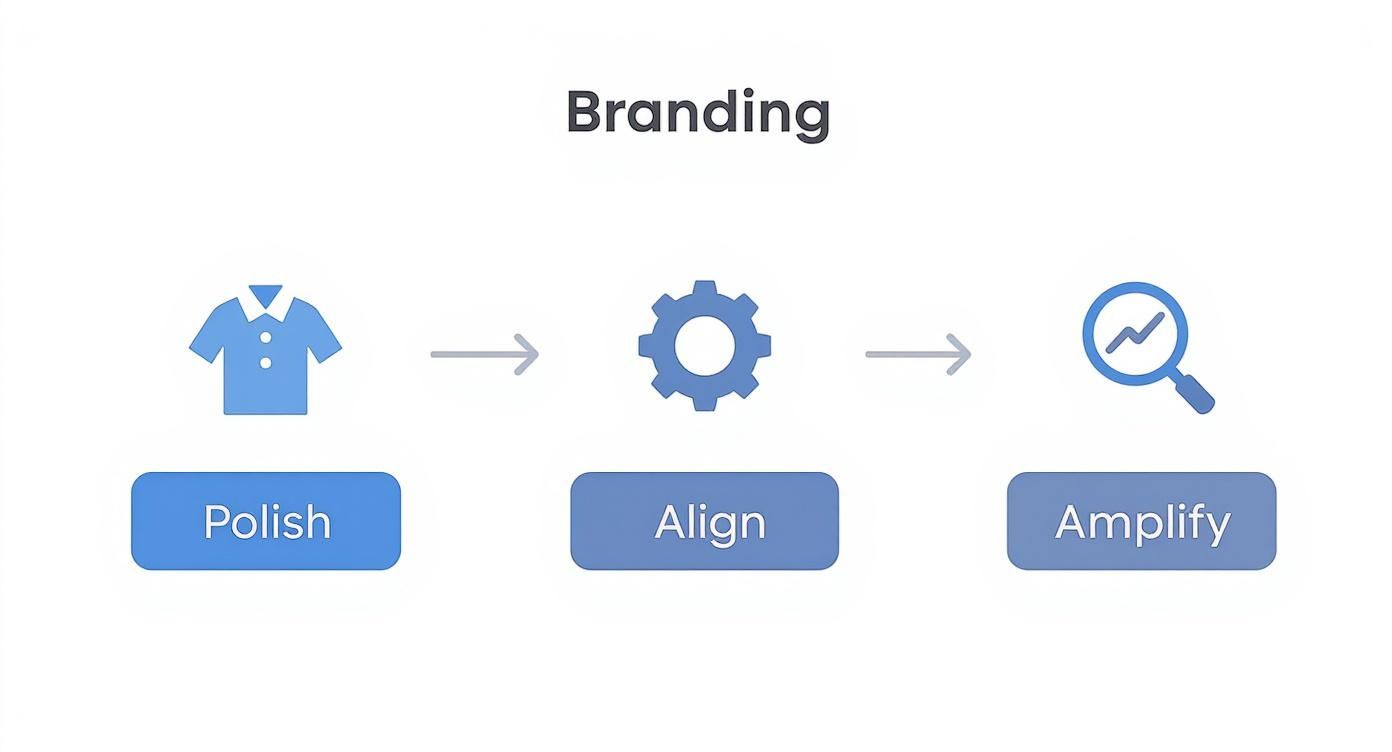
The flow here is key: a polished image is useless until it's genuinely aligned with your core values and expertise. Only then can you effectively amplify it to your network.
Monthly Challenges to Solidify Your Skills
Monthly challenges are about taking your newly honed skills and pressure-testing them in the real world. This is where you see how far you've come.
Try tackling one of these each month:
- Lead a high-stakes meeting: Volunteer to run a major project kickoff, a tough client negotiation, or a cross-departmental strategy session. Own the agenda, guide the conversation, and drive the team toward clear, concrete action items.
- Present to a new audience: Get out of your bubble. Find an opportunity to present to another department, an industry group, or a new batch of stakeholders. This forces you to adapt your style on the fly and build rapport from scratch.
By weaving together these daily, weekly, and monthly actions, you’re not just learning about presence—you’re actively building it. If you're a founder looking to apply this directly to your public identity, our guide on a personal branding plan for founders offers an even more detailed roadmap. The secret is consistency. Turn presence from a concept into a practice.
Of course, as you start working on your executive presence, some questions—and maybe a little self-doubt—are bound to pop up. That's totally normal. Let's tackle a few of the big ones I hear all the time.
Think of this as a quick-reference guide for those moments when you feel a little stuck. The path to a stronger presence is unique to you, but the roadblocks are pretty universal.
"I'm an Introvert. Can I Really Have Executive Presence?"
Yes. Let's get this one out of the way immediately. People often confuse executive presence with being a classic, table-pounding extrovert. It's not about being the loudest person in the room; it's about making your voice matter when you choose to use it.
Your introverted nature actually gives you a few superpowers you can lean into:
- You're a preparer. Your instinct to think things through before speaking means that when you do contribute, your points are solid, insightful, and well-reasoned. That's gravitas.
- You're an active listener. You naturally give others the floor, which makes them feel seen and respected. That's a massive leadership skill.
- You're calm under pressure. Your measured, steady demeanor can be an anchor for the entire team when things get chaotic.
The trick isn't to change your personality. It's to find your authentic style of communicating with conviction. Focus on making one or two strategic points in a big meeting or building influence through focused, one-on-one conversations.
Executive presence is your ability to connect authentically, influence effectively, and stay cool under fire. It’s a skill, not a personality type.
"How Do I Get Real Feedback on My Presence?"
Getting honest feedback is tough but critical—it’s how you find your blind spots. The secret is asking the right people the right questions.
First, find someone you trust whose professional presence you admire. This could be a manager, a mentor, or even a peer.
Then, don't ask a vague question like, “How’s my presence?” You'll just get a vague, polite answer. Be specific and ask about observable behaviors. Try something like, “In that presentation I just gave, how was my pacing? Did my main argument land, or did it get lost?” This gives them something concrete to react to and gives you actionable advice you can actually use.
"How Long Until I See a Real Difference?"
This is a marathon, not a sprint. But the good news is you can start seeing small, tangible wins in just a few weeks. If you focus on one or two specific habits—like cutting out filler words or making a conscious effort to improve your posture on video calls—you'll notice an immediate shift.
Developing that deep, unshakable gravitas, however, takes time. It’s a process of consistent practice, self-reflection, and refinement. Don't look for an overnight transformation. Instead, focus on incremental progress. Celebrate the small wins, keep track of your practice, and maybe do a personal check-in every quarter. You'll be surprised at how far you've come.
Ready to turn your growing presence into measurable pipeline? GetViews.AI helps you translate your expertise into consistent, high-performing LinkedIn content that attracts inbound leads without cold outreach. Learn more at getviews.ai.