How to Get Consulting Clients A Practical Guide
Learn how to get consulting clients with proven strategies for outreach, content, and closing deals. This guide provides actionable advice for real results.
Wilmer KarlssonTarstad
Before you can start chasing down leads or crafting the perfect LinkedIn post, you need to lay the groundwork. This is the part most consultants skip, and it's precisely why so many of them struggle. They try to be everything to everyone, and they end up being nothing to anyone.
Success isn't about having the slickest outreach script. It's about clarity. You need to know exactly who you serve and the specific, tangible results you can get for them.
Think of this foundational work as the engine of your entire client acquisition machine. Without it, your messaging is mushy, your outreach is a shot in the dark, and your value proposition is invisible to the people who need you most.
Building Your Foundation for Client Attraction
Let's get one thing straight: the "generalist" consultant is dead. The market is just too crowded and too sophisticated for that anymore.
Why Specialization Is Your Greatest Asset
The consulting world is absolutely massive. We're talking about a global market projected to hit a staggering $1,230 billion by 2034. Diving into that ocean without a clear direction is a recipe for failure.
The data backs this up. Tech consulting alone makes up over 28.7% of that market, and large enterprises account for more than 70.5% of all consulting clients. What does that tell you? It tells you that clients are paying for specialized expertise in high-demand areas. You can get a deeper look into these numbers by reading the full research on the management consulting services market.
Stop being a generic "business consultant." That's too broad. Even "marketing consultant" is vague.
Instead, get specific. A "content marketing consultant for Series B SaaS companies" isn't just a title—it's a beacon. It signals deep, focused expertise and immediately attracts the right kind of client.
Being a specialist lets you become a big fish in a small pond. It's far easier to dominate a narrow market segment than it is to scream for attention among thousands of generalists. The goal is to make yourself the only logical choice for a very specific client with a very specific problem.
This isn't a random process. It’s a logical flow that builds on itself.
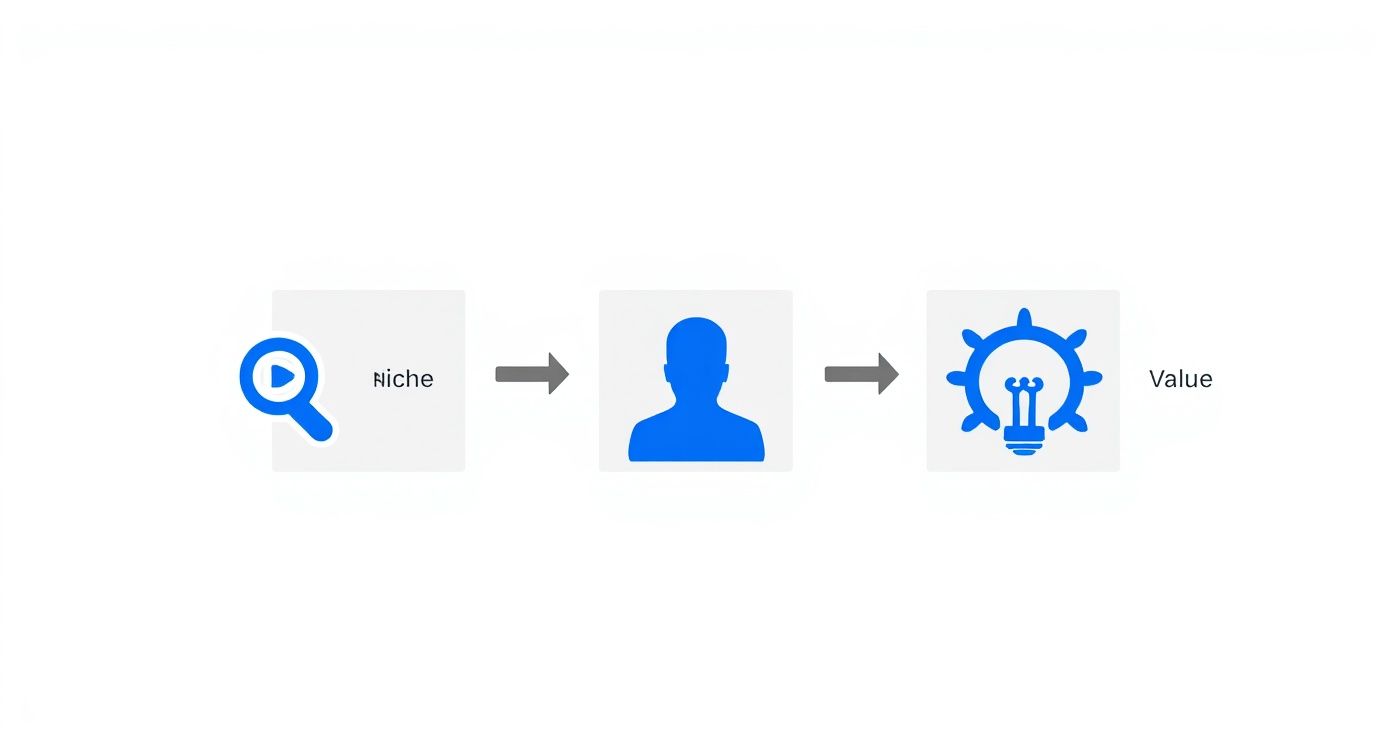
As you can see, a tight niche lets you define your ideal client, which then gives you everything you need to build a value proposition that actually lands.
Define Your Ideal Client and Value Proposition
Once you've picked your niche, it’s time to get obsessed with your ideal client. Go way beyond surface-level details like their job title or company size.
What are their real-world professional headaches? What goals are keeping them up at night? What solutions have they already thrown money at that didn't work?
When you know these things, you can craft a value proposition that speaks directly to their pain. It needs to instantly answer their one burning question: "Why should I hire you over anyone else?"
Here’s what that looks like in practice:
- A Hyper-Specific Niche: Don't just work in "finance." Instead, you "help e-commerce brands optimize cash flow for inventory management." See the difference?
- An Ideal Client Profile (ICP): Write it down. Document their role, industry, company size, daily frustrations, and what a "win" looks like for them.
- A Compelling Value Proposition: This is your one-liner. It's a clear, concise statement that explains the tangible results you deliver. For example: "I help B2B tech founders reduce customer churn by 15% in 90 days through proven retention strategies."
This initial work is non-negotiable. It dictates where you'll find your clients, the language you'll use to connect with them, and ultimately, why they’ll choose to pay you.
Before you move on to outreach and content, you need to have these three elements locked in. The following checklist summarizes the essential actions you need to take.
Client Acquisition Foundation Checklist
| Element | Key Action | Why It Matters |
|---|---|---|
| Niche | Choose a specific industry, problem, or technology and commit to it. Go from broad (e.g., "marketing") to focused (e.g., "LinkedIn ads for B2B legal tech"). | Makes you a specialist, not a generalist. It's easier to stand out, command higher rates, and attract the right clients when you're the go-to expert. |
| Ideal Client Profile (ICP) | Create a detailed document outlining your target client's role, challenges, goals, and company specifics (size, industry, revenue). | Prevents you from wasting time on bad-fit prospects. Every piece of content and outreach can be tailored directly to this person's world. |
| Value Proposition | Craft a single, powerful sentence that clearly states the tangible outcome you provide for your ICP. Format: "I help [ICP] achieve [Result] by [Method]." | This becomes your headline, your pitch, and your guiding star. It immediately tells prospects if you're the right person to solve their problem. |
Nail these three things, and you've built a solid launchpad for everything that comes next. Skip them, and you’re just guessing.
Turning Your LinkedIn Profile into a Client Magnet
Most consultants treat their LinkedIn profile like a dusty, digital resume. It’s a static list of past jobs and skills, left there hoping the right person might just stumble upon it.
This is a massive mistake.
In a crowded market, your profile has to be an active, client-attracting machine. Think of it as your digital storefront. Its only job is to speak directly to your ideal client's biggest headaches and convince them you’re the one person who can solve them. Every single section needs to work together to build that trust and pull qualified prospects into your world.
Your Headline Is Your Hook
This is the single most valuable piece of real estate on your profile, and it's almost always wasted. "Consultant at XYZ Corp" tells a prospect absolutely nothing. It’s generic, passive, and instantly forgettable.
A powerful headline is a mini value proposition. It needs to state exactly who you help and the tangible result you deliver.
For example, instead of "Marketing Consultant," you could say, "I help B2B SaaS founders build predictable demo pipelines with LinkedIn content." See the difference? This instantly qualifies you, repels clients who aren't a good fit, and grabs the attention of the people you actually want to work with.
It's the sign on your digital storefront—make it clear, compelling, and all about the client.
Your LinkedIn headline isn't about your job title; it's about your client's transformation. It should answer their unspoken question: "What can you do for me?"
Craft an About Section That Connects
Your "About" section is where you get to build a human connection. This isn't the place for corporate jargon or a stuffy bio written in the third person.
Write in the first person. Tell a story.
Start by hitting on their main frustrations. Show them you genuinely understand their world, their challenges, and what’s at stake. Then, briefly explain how your unique approach is the key to solving that specific problem. The goal isn't to list every skill you have; it’s to build empathy and position yourself as the trusted guide they've been looking for.
Use the Featured Section as Your Portfolio
The Featured section is your chance to show, not just tell. This is where you provide undeniable proof of your expertise. Think of it as a visual portfolio that builds instant credibility and backs up the claims you made in your headline.
Here’s a perfect example of a profile that uses the headline and featured sections to communicate value right away.
Notice how her headline is completely outcome-focused. Then, her featured posts offer immediate social proof and high-value insights. This simple strategy turns a passive profile into an active lead-generation tool that works for you around the clock.
Pack this section with your best assets:
- Case Studies: Break down a client's problem, your solution, and the measurable outcome.
- Video Testimonials: There's nothing more powerful than a happy client telling their story.
- Lead Magnets: Offer a valuable checklist, guide, or template that showcases what you know.
- Webinar Recordings: Feature a presentation where you taught a key topic related to your niche.
Each piece of content should be a solid piece of evidence supporting the claim you made right at the top of your profile. For a full walkthrough, check out our complete guide on how to optimise your LinkedIn profile for maximum impact.
Once you make these changes, your profile stops being a passive resume and starts actively working to get consulting clients for you.
Crafting Outreach That Actually Gets Replies
Let’s be honest: cold outreach has a terrible reputation. Why? Because most of it is lazy, self-serving, and completely disconnected from the recipient's world. To land consulting clients, you have to flip that script. Your goal isn't to pitch; it's to start a real conversation by offering value upfront.
Think of yourself as a helpful expert, not a pushy salesperson. This requires a bit of detective work, some empathy, and a genuine desire to solve a problem. Before you even think about hitting "send," you should have a solid hunch about the specific challenges your prospect is up against.

Find Your Prospects and Do Your Homework
First things first, you need to identify the right people at your target companies. A tool like LinkedIn Sales Navigator is your best friend here. It lets you slice and dice by industry, company size, and specific job titles to zero in on the key decision-makers.
Once you’ve got a shortlist, the real work begins. This isn't about a quick glance at their profile. You need to dig for a genuine "hook" that makes your message feel like it was written just for them.
- Recent Company News: Did they just announce a funding round, launch a new product, or get a big feature in a trade publication?
- LinkedIn Activity: What are they posting about? What articles are they commenting on? This is a goldmine for understanding their current priorities.
- Shared Connections: Do you know someone in common who could offer an introduction or at least some context?
This research is what separates you from the noise. It gives you the ammo to craft a message that feels timely and relevant, instantly standing out from the dozens of generic templates flooding their inbox.
Your outreach should feel like a thoughtful suggestion from a peer, not an automated blast from a stranger. The more you know about their specific context, the more likely they are to see you as a potential ally.
Lead with Value, Not a Sales Pitch
Okay, you've done your homework. Now it's time to write the message. The single biggest mistake consultants make is immediately talking about themselves and their services. Newsflash: your prospect doesn’t care about you. They care about their own problems.
Your entire message needs to revolve around them. So, instead of the classic, "I'm a marketing consultant who can help you," try an approach that actually offers something useful.
A Simple Framework That Works
Here’s a breakdown of a message that gets replies:
- The Opener: Start with your hook. "Hi [Name], I saw your recent post on [Topic] and it got me thinking about the challenges with [Specific Problem]."
- The Value Add: Briefly connect their problem to a result you've achieved. "I recently helped a similar company in the [Industry] space navigate this by implementing [Brief, High-Level Strategy], which led to a 20% increase in qualified leads."
- The Soft CTA: Make it easy to say yes. "No strings attached, but I put together a few thoughts on how this might apply to [Their Company]. Would you be open to me sharing them?"
This approach instantly positions you as a helpful expert who has already invested time in their world. You earn their attention by giving first. For a masterclass on this, check out the Instantly.ai cold email playbook that helped them scale like crazy.
By leading with a specific, relevant insight, you start the conversation on the right foot and make them want to hear more.
Creating Inbound Leads with Your Expertise
Imagine waking up to an inbox with inquiries from qualified prospects—people who already know who you are and are interested in your work. That’s the real power of inbound. While posting on LinkedIn every day is a great start, building a true inbound engine means creating assets that cement you as the go-to authority in your niche.
The goal is to stop chasing clients and start attracting them. It’s a fundamental shift from interrupting their day with a pitch to being the expert they discover when they’re actively looking for a solution.
Expand Your Reach Beyond Social Feeds
One of the fastest ways to get in front of your ideal consulting clients is to borrow someone else's audience. Guest appearances on industry podcasts or speaking gigs at niche webinars can put you in front of hundreds, sometimes thousands, of potential clients in one shot.
Think about it: the people listening to a specialized podcast are already pre-qualified. They've opted in to learn about the very topic you’re an expert in.
- Industry Podcasts: Pinpoint the podcasts your ideal clients are listening to. Don’t just ask to be a guest—pitch the host a specific, valuable topic that solves a nagging problem for their listeners.
- Niche Webinars: Find a non-competing business that serves the exact same audience and partner up. Offer to present a practical workshop that delivers actionable advice and subtly showcases your expertise.
This strategy builds instant credibility. You're no longer just another consultant in the feed; you're the expert chosen to educate a community that someone else has already built trust with.
Build a Lead Generation Asset
A fantastic way to turn those passive podcast listeners or webinar attendees into warm leads is to create a simple, high-value lead magnet. This is a free resource you offer up in exchange for an email address, giving you a direct line to nurture that new relationship.
A lead magnet isn’t a sales brochure. It's a genuine piece of value that proves you know your stuff by helping a potential client get a small, tangible win. That first act of generosity is what a real consulting relationship is built on.
This could be a practical checklist, a short report packed with industry data, or a template that simplifies something they find complicated. The only rule is that it has to solve a real, specific problem. For a deeper look at creating these kinds of assets, check out our guide on content marketing for consultants. This approach isn't a short-term trick; it's about building a long-term asset that keeps a steady flow of leads coming your way.
The demand for this kind of specialized, accessible expertise is only growing. A joint study from Harvard Business School and BCG found that leaders using digital talent platforms saw huge gains, with 40% reporting significant improvements in speed and productivity. This just goes to show that consultants who share their knowledge effectively online are perfectly positioned to attract clients hungry for agile, expert solutions. You can learn more about these consulting industry findings here.
Alright, you’ve got a qualified prospect on the phone. This is a huge win, but don’t celebrate just yet. This is where most consultants stumble.
They either give away the entire strategy for free in a 45-minute "brain dump," or they switch into a sleazy sales pitch that makes everyone uncomfortable.
Let's fix that. The goal isn't to "sell." It's to diagnose. Think of yourself less as a salesperson and more as a specialist, like a doctor. Your job is to listen, ask sharp questions, and get to the root of their business pain.

Run a Diagnostic Discovery Call, Not a Sales Pitch
Your only objective on this call is to uncover the gap between where your prospect is right now and where they desperately want to be. More importantly, you need to help them see the real, dollar-sign cost of that gap.
You do this by asking questions that quantify the pain of staying put. This isn't about making them feel bad; it's about bringing clarity to a problem they've probably only felt vaguely.
Try asking questions like:
- "If this problem isn't solved in the next six months, what's the realistic impact on revenue?"
- "Roughly how many hours is your team wasting on this each week? What's that costing you?"
- "If we hit that [desired outcome] you mentioned, what would that be worth to the business over the next year?"
When you focus the conversation on the cost of their problem, you anchor the entire discussion around value. The fee you propose later will feel like a smart investment, not an expense, because it’s a fraction of what they’re already losing. This is how you land clients who are happy to pay premium rates.
A great discovery call ends with the prospect basically selling themselves on the solution. You just guided them there with the right questions.
Write Proposals That Sell Outcomes, Not Activities
Throw out your old proposal template. Nobody cares that you’re going to run "four stakeholder meetings" or deliver a "comprehensive 50-page audit." They care about the result.
Your proposal should be a business case, not a to-do list.
Instead of this:
- "Conduct a full content audit."
Write this:
- "Identify and cut underperforming content to boost qualified organic traffic by 20% in Q3."
See the difference? You’re framing your fee as an investment in a tangible business outcome. It completely changes the conversation from "How much does this cost?" to "How quickly can we get that return?"
Price with Confidence
When it's time to talk money, state your price and then be quiet. Any hesitation on your part signals that you don't fully believe in the value you deliver.
While your LinkedIn content and networking get you in the door, your pricing conversation is what seals the deal. It's no surprise that around 60% of consultants get most of their business from referrals. Coming in through a trusted source gives you the upper hand, making confident pricing even more essential.
And since about 58% of consultants juggle six or fewer clients a year, you have to make each project count. Price accordingly. (You can dig into more of these numbers in this breakdown of consulting statistics.)
Deciding how to price can be tricky. Here’s a quick look at the most common models to help you figure out what works for your business.
Consulting Pricing Models Compared
A comparison of common consulting pricing structures to help you choose the best fit for your services and clients.
| Pricing Model | Best For | Pros | Cons |
|---|---|---|---|
| Project-Based Fee | Projects with a clear scope, start, and end (e.g., website redesign, market research report). | Predictable revenue for you, predictable cost for the client. Simple to sell. | Scope creep can kill your profit margin if not managed carefully. |
| Monthly Retainer | Ongoing advisory, coaching, or implementation support where the work is continuous. | Creates stable, recurring revenue. Fosters a long-term client relationship. | Can be harder to sell upfront. Value needs to be demonstrated continuously. |
| Value-Based Pricing | Engagements where your work is tied directly to a significant business outcome (e.g., revenue growth, cost savings). | Highest profit potential. Directly ties your fee to the client's ROI. | Requires a sophisticated sales process to uncover and agree upon the value. |
| Hourly Rate | Short-term tasks, unpredictable scopes, or when the client needs flexible access to your expertise. | Simple to track and bill. Ensures you're paid for all time spent. | Can penalize you for being efficient. Clients may micromanage hours. |
Ultimately, the right pricing model depends on the client, the project, and your own business goals. Choose the one that aligns with the value you discussed on the discovery call.
When you present your fee, tie it directly back to the pain points and desired outcomes you uncovered earlier. The decision becomes a simple business calculation for them, not an emotional one.
Frequently Asked Questions About Getting Clients
Even with the best blueprint, you’re going to hit roadblocks. It’s part of the process. Below are the straight-up answers to the questions that pop up most often for consultants trying to land their first clients.
How Long Does It Take to Get the First Client?
This is the million-dollar question, and the only honest answer is: it depends. I’ve seen consultants tap into their warm network and land a client in a week. I’ve also seen others, building from absolute scratch, grind for two or three months before signing that first contract.
Your timeline is a direct result of your foundation. A consultant with a laser-focused niche, a value prop that hits like a ton of bricks, and a targeted list of people to talk to will always get there faster than a generalist throwing spaghetti at the wall.
Forget the timeline and obsess over the inputs you control: the quality of your outreach, the value of your content, and the number of conversations you start. Consistency is the accelerator.
What’s More Important: Outbound or Inbound?
When you’re just starting out, outbound is your engine. Period. You can't afford to sit around waiting for clients to discover you; you have to go out and find them. Targeted, personalized outreach is the most direct path to your first contracts and, just as importantly, to real-world market feedback.
Once you have some momentum, you can start building your inbound machine. This is your long game—creating valuable LinkedIn content, getting on podcasts, building a lead magnet. Inbound is the asset that eventually creates a predictable, sustainable flow of leads.
Think of it this way: Outbound is hunting. You need it to eat today. Inbound is planting a garden that will feed you for years. You need both, but you absolutely start with hunting.
How Much Should I Charge My First Client?
Pricing feels more like art than science, but the biggest mistake you can make is undercharging because you’re nervous. Your price tag is a signal. Price too low, and you attract clients who don’t respect your expertise and will nickel-and-dime you to death.
For a first project, a simple "cost-plus" model can give you a baseline. Figure out your desired annual income, tack on business expenses and taxes (a good rule of thumb is 30%), then divide by the billable hours you plan to work. This gives you an hourly rate to build a project fee from.
But here’s the real key: remember that value conversation from your discovery call. If you’ve helped them see their problem is costing them $100,000 a year, your $15,000 project fee isn't an expense—it's an investment with a clear ROI. Anchor your price to their outcome, not your time.
Do I Need a Website Before I Start?
Short answer: Nope. A beautiful website is a "nice-to-have," not a "need-to-have" when your sole focus is getting those first paying clients. Your priority is starting conversations and closing deals, not debating font choices.
Your optimized LinkedIn profile is your first website. It has your value proposition, your social proof (recommendations and content), and an easy way for people to reach you. I know plenty of six-figure consultants who landed their first dozen clients using nothing more than a solid LinkedIn presence and a well-written proposal.
Focus on revenue-generating activities first. Once you have cash flow and testimonials, you can invest that money into building a professional website that works for you as a long-term inbound asset.
Ready to turn your LinkedIn profile into a predictable client-generating machine without spending hours on outreach? GetViews.AI uses AI to help you create high-performing content that attracts your ideal buyers, sparks conversations, and fills your pipeline on autopilot. Transform your LinkedIn presence today.