A Guide to How to Grow on LinkedIn and Build Your Brand
A practical guide on how to grow on LinkedIn. Learn to optimize your profile, create content that connects, and network effectively to build your brand.
Wilmer KarlssonTarstad
Before you even think about posting content or sending a single connection request, we need to talk about your LinkedIn profile. It’s not a dusty old resume—it's your 24/7 sales page, and right now, it’s probably not pulling its weight.
Getting this right is the absolute bedrock of growing on LinkedIn. Without a rock-solid profile, all your other efforts—the content, the networking, the outreach—will fall flat.
Turn Your Profile Into a Magnet for Opportunities
Let's be honest, most people treat their profile like a chore. They fill in their job history, slap up a generic title, and call it a day. That’s a massive mistake. The LinkedIn algorithm actually rewards profiles that are complete, strategic, and keyword-rich, making it your single most important tool for getting discovered.
To really get traction, you have to build a powerful personal brand online that screams expertise and value from the moment someone lands on your page.
Nail Your Headline
Your headline is the most valuable real estate you own on LinkedIn. It follows you everywhere you go: search results, comments, connection requests, everywhere.
A generic job title like "Sales Manager at Company X" tells people nothing and helps no one. It’s a wasted opportunity.
Instead, a killer headline instantly answers three questions:
- Who you help: Get specific. Is it "SaaS Founders" or "Marketing Leaders"?
- How you help: What’s the value? Do you "scale revenue" or "build high-performing teams"?
- The outcome: What’s the tangible result? Think "predictable pipeline growth."
So, instead of a boring title, try something like: "Helping B2B SaaS Founders Scale MRR with Actionable Go-to-Market Strategies | GTM Advisor." See the difference? It immediately qualifies you and attracts the right people.
Tell a Story, Don't Just List Jobs
Your 'About' section is where you connect with people. This isn't the place to copy and paste your job duties from your resume. It's your chance to tell a story that makes people want to know you.
Start with a hook that speaks directly to your ideal client's biggest problem. Then, weave in your expertise and highlight a few key wins. Most importantly, end with a clear call-to-action telling them what to do next.
"Your 'About' section should answer three questions for a visitor: Who are you? What problem do you solve? And why should I trust you? Frame it as a conversation, not a monologue."
This approach makes you memorable and relatable, which is how real connections are made. If you want to dive deeper, we have a whole guide on exactly how to optimise your LinkedIn profile.
Your LinkedIn Profile Optimization Checklist
Think of your profile as a high-performance engine. Every component needs to be finely tuned to attract the right opportunities and drive growth. This checklist breaks down the essential elements and explains why they matter.
| Profile Element | Optimization Tactic | Impact on Growth |
|---|---|---|
| Profile Photo | Use a professional, high-resolution headshot where you look approachable. | Builds instant trust and recognition. Profiles with photos get up to 21x more views. |
| Banner Image | Create a custom banner that reinforces your value proposition, features a client testimonial, or has a CTA. | Acts as a billboard for your brand, immediately communicating who you serve and what you do. |
| Headline | Craft a value-driven statement: "I help [Target Audience] achieve [Outcome] by [Method]." | Your primary tool for discoverability. A strong headline stops the scroll and qualifies you in search results and comments. |
| 'About' Section | Write a compelling narrative that addresses audience pain points, showcases expertise, and includes a clear CTA. | Turns passive visitors into engaged prospects by telling a story that resonates and builds an emotional connection. |
| Featured Section | Pin your best content, case studies, client testimonials, or a link to your calendar/website. | Provides immediate social proof and directs traffic to your most valuable resources, shortening the sales cycle. |
| Experience Section | Describe your roles in terms of achievements and results (e.g., "Increased pipeline by 30%"), not just responsibilities. | Demonstrates your impact and proves your expertise with tangible results, making you more credible than competitors. |
| Skills & Endorsements | List at least 5 relevant skills and prioritize the top 3 you want to be known for. Actively seek endorsements. | Crucial for the LinkedIn algorithm. Boosts your visibility in searches and reinforces your credibility with social proof. |
| Recommendations | Proactively request and give genuine recommendations from clients, managers, and colleagues. | The ultimate form of social proof. Powerful, third-party validation of your skills and character that builds deep trust. |
By systematically checking off each of these items, you're not just updating a profile; you're building a powerful inbound marketing asset that works for you around the clock.
Use Skills & Endorsements to Signal Your Expertise
Don't sleep on the 'Skills' section. It's way more than just a list of buzzwords; it's a direct signal to the LinkedIn algorithm about what you do.
The data doesn't lie: profiles with at least five skills listed get up to 17 times more views. Why? Because each skill is like a tag that helps LinkedIn categorize your expertise and surface your profile in relevant searches.
To make this work for you, pin your top 3-5 skills—the ones you absolutely want to be known for. Then, make a point to get endorsements from colleagues and clients. It’s the social proof that backs up your claims and gives you a serious edge.
Creating a Content Strategy That Actually Connects
An optimized profile gets people to your door, but great content invites them inside. If your profile is the storefront, your content is the conversation that happens once they step in. Just posting to post won't move the needle. You need a simple, repeatable system for turning what you already know into content that sparks conversations and builds authority.
Forget the pressure to be a creative genius every day. This isn't about chasing viral hits. It’s about building a library of content that consistently proves you're the go-to expert in your field.
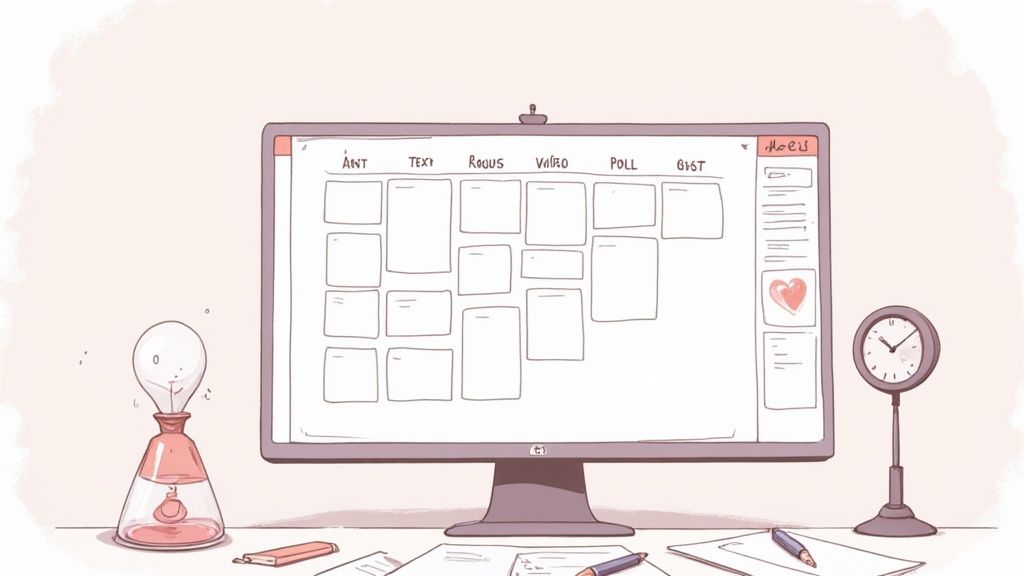
A little bit of planning goes a long way. Having a structured approach turns those "what should I post today?" moments into a clear, actionable schedule.
Uncovering Your Core Content Pillars
The fastest way to burn out is staring at a blank cursor. The fix? Define 3-5 core content pillars—these are the foundational topics you'll own and talk about over and over again. Your pillars should live at the intersection of your expertise and your audience’s biggest headaches.
Think of it like this:
- Pillar 1: Your Expertise. What’s your unique skill or perspective? This could be anything from "SaaS Go-to-Market Strategy" to "Leadership for Remote Teams." This is what you know better than anyone.
- Pillar 2: Audience Pain Points. What are the nagging problems, questions, and frustrations that keep your ideal clients up at night? Think "generating predictable pipeline" or "retaining top talent."
- Pillar 3: Industry Conversations. What’s happening in your space right now? This could be the impact of AI on sales, new regulations, or the future of work. Tap into existing conversations.
Once you have these pillars, you have a filter for every idea. Every single post should tie back to one of these themes, reinforcing your expertise and making sure your message always hits home for the people you want to attract. To really build out a framework that works, you need a proven LinkedIn content strategy.
Choosing the Right Format for Maximum Impact
Once you know what to talk about, you need to decide how you're going to say it. Mixing up your content formats keeps your feed from feeling stale and appeals to different ways people like to learn. Not every idea needs to be an epic essay.
Here’s a quick rundown of the heavy hitters and when to use them:
- Text-Only Posts: Perfect for telling a story, sharing a strong opinion, or asking a killer question. The key is formatting. Use short sentences and plenty of white space to make it scannable.
- Carousels (PDFs): These are absolute gold for breaking down complex topics into bite-sized, step-by-step guides. They keep people on your post longer, which the algorithm absolutely loves.
- Polls: The easiest way to get immediate engagement, hands down. Use them to take the temperature of your audience, validate an idea for a bigger post, or just start a conversation.
- Video: Short, authentic videos (1-2 minutes) are fantastic for building a real human connection. Don't overproduce it. Just share a quick tip or a personal insight from your phone.
The best LinkedIn strategies don't lean on just one format. They weave together storytelling, education, and interaction to create a dynamic feed that keeps people coming back for more.
Don't try to master every format at once. Start with what feels most comfortable—for most people, that's text posts—and slowly start experimenting with others. If you want to dive deeper, we have a guide that breaks down the specifics of a great Linked In content strategy.
The Power of Consistent Posting
If you take one thing away from this section, let it be this: consistency is everything. It's the single most important factor in winning with the LinkedIn algorithm and building a real audience. Posting once in a while is like shouting into the void. Posting regularly trains the algorithm to see you as a serious contributor worth showing to more people.
The data backs this up, big time. LinkedIn's own research shows that members who post 3–5 times per week are 3.2 times more likely to be found by recruiters and 2.7 times more likely to get inbound messages from potential clients.
Consistency builds momentum. It’s a snowball effect that’s impossible to create with random, infrequent posts.
Mastering Engagement and Authentic Networking
Pushing out great content is only half the job. If you treat LinkedIn like a megaphone, just shouting your message and walking away, you’re going to be met with silence. Real growth, the kind that leads to pipeline, happens in the replies, the comments, and the DMs.
This is where you stop being a broadcaster and become a community builder. The fastest way to get on the radar of influential people, build social capital, and prove you're an expert is by engaging with their content. It's about turning passive scrolling into an intentional, relationship-building habit.
Go Beyond Generic Comments
The difference between a comment that gets ignored and one that starts a relationship is simple: value.
"Great post!" or "Thanks for sharing!" is completely invisible. It adds zero to the conversation and does nothing to build your authority. Skip it.
Your goal is to drop a comment that’s a mini-piece of content in itself. It needs to add a new layer to the original post, showing you not only read it but also have a thoughtful take on the topic.
A high-value comment usually does one of three things:
- Asks a sharp question. "This is a great point about cold outreach becoming less effective. Have you seen this impact the top-of-funnel conversion rates for specific industries more than others?"
- Adds a new perspective. "Completely agree. I'd add that this trend is also being accelerated by the rise of product-led growth, where the value is shown before it's sold."
- Shares a brief, relevant experience. "This resonates. We shifted our sales team's focus from pitch to perspective last quarter and saw our reply rates on follow-ups increase by 25%."
This kind of engagement gets you noticed by the original poster and everyone else in the comments. You immediately position yourself as a peer and a thinker, not just another spectator.
A Framework for Smart Engagement
Randomly commenting on whatever pops up in your feed is a waste of time. The pro move is to create a "Dream 100" list—a curated group of 50-100 ideal prospects, partners, and industry leaders you genuinely want to build relationships with.
Once you have this list, your daily engagement becomes laser-focused. Instead of scrolling aimlessly, you can spend 15-20 minutes a day only interacting with their content.
This isn't just a "nice to do" activity; it's a critical growth driver. Users who spend this time actively engaging see their network grow 2.5 times faster than those who only post. In fact, LinkedIn’s own data shows that members who leave thoughtful comments are 3.1 times more likely to be followed back and 2.4 times more likely to receive connection requests. You can dive deeper into LinkedIn's demographic and engagement patterns in this detailed statistical breakdown from Statista.
Pro Tip: Find someone on your "Dream 100" list? Hit the bell icon on their profile. You'll get notified whenever they post, letting you be one of the first to engage and maximizing your visibility.
This focused effort builds familiarity. When you eventually send that connection request or DM, you’re not a stranger—you’re the person who always adds value to their conversations.
Sending Connection Requests That Actually Get Accepted
Sending blind connection requests is the fastest way to get your account restricted. Your acceptance rate matters to LinkedIn, and the key to a high rate is context.
Never, ever send a request without a personalized note. The default message is a guaranteed trip to the ignore bin.
A good connection request is short, direct, and answers the recipient's silent question: "Why should I connect with you?"
Here’s a simple, effective template to adapt:
"Hi [Name],
I've been following your posts on [Topic] and really valued your recent insight on [Specific Point from a Post]. The way you explained [Concept] was particularly helpful.
Would love to connect and keep learning from your content.
Best, [Your Name]"
This works because it's specific, genuine, and proves you’ve paid attention. You’re not asking for anything; you’re acknowledging their value, which makes them far more likely to accept. Building your network this way creates a foundation of real connections, not just a list of names.
Building a Sustainable Posting Routine
Consistency is the single most important part of the LinkedIn growth equation. It beats one viral post, every single time. You can have a perfectly optimized profile and a brilliant content strategy, but if you only show up once a month, none of it matters. The algorithm rewards consistency, and your audience learns to trust it.
But let's be real. Telling a busy professional to "just be consistent" is terrible advice. Life gets in the way. That's why you don't need more willpower; you need a sustainable system. You need a way to make posting and engaging a simple, repeatable habit—not a daily crisis. This is how you shift from random bursts of effort to a predictable growth engine.

Finding Your Cadence Without Burning Out
There’s no magic number for how often to post, but there is a minimum effective dose. You should aim for at least three high-quality posts per week. That’s frequent enough to stay relevant to the algorithm and top-of-mind with your network.
Sure, posting daily is powerful if you can sustain it. But it's far better to post three great pieces of content every week for a year than to post daily for a month and then burn out. The key is to pick a cadence you can actually stick to for the long haul.
Here’s a simple way to decide what’s right for you:
- Three Times a Week: This is the perfect starting point. It’s enough to build momentum without completely taking over your schedule. This cadence is a great fit for consultants, busy executives, and small teams.
- Five Times a Week (Daily): Go for this if you're in a serious growth phase or in a role where a strong personal brand is mission-critical—like for founders, sales leaders, and full-time creators. It maximizes visibility and speeds up relationship-building.
Just pick one and commit to it for 90 days. Don't overthink it. Choose your schedule, block it out on your calendar, and just execute.
The Power of Content Batching
Here’s the secret to effortless consistency: you don’t write a new post from scratch every morning. You use content batching. This just means you dedicate one block of time each week or month to create all of your content at once.
Instead of staring at a blank page every day, you can sit down for two hours on a Sunday afternoon and knock out two weeks' worth of posts. This approach saves a shocking amount of mental energy and guarantees you always have quality content locked and loaded.
By batching your content, you shift from being a reactive content creator to a strategic one. It allows you to think about how your posts connect, tell a larger story, and guide your audience on a journey.
Once your posts are written, pop them into a scheduling tool. This automates the publishing part, freeing you up to focus on what really drives growth on LinkedIn: engagement. Mapping everything out is a core part of building a successful presence, and you can learn more about how to create a content calendar to make this process even smoother.
Implement the 15-Minute Engagement Block
Hitting "post" is just the beginning. The real magic happens in the conversations that follow. To make this manageable, I want you to build a new habit: the "15-Minute Engagement Block."
This is a non-negotiable, focused window of time in your daily routine dedicated only to strategic engagement. No mindless scrolling, no distractions.
Here’s what your 15 minutes should look like:
- First 5 Minutes: Reply to every comment on your latest post. Thoughtful replies encourage more conversation and signal to the algorithm that your content is valuable.
- Next 7 Minutes: Go engage with your "Dream 100." Pick a few key prospects or industry leaders, visit their profiles, and leave value-add comments on their recent posts.
- Final 3 Minutes: Check your DMs and connection requests. Quickly reply to promising messages and accept relevant connections.
This simple daily habit transforms LinkedIn from a passive platform into an active, pipeline-generating machine. It’s how you build real relationships at scale without spending hours glued to the screen.
Using Analytics to Refine Your LinkedIn Strategy
Posting great content and showing up every day is a solid start. But if you're not tracking your results, you're just guessing. You're flying blind.
The final piece of the puzzle is turning all that activity into a predictable system. This means digging into the data to see what’s actually working so you can double down on it.
You can't improve what you don't measure. Analytics are what separate random acts of content from a real, data-driven strategy that gets results.
Moving Beyond Vanity Metrics
It’s so easy to get hooked on likes and impressions. These "vanity metrics" give you a nice little dopamine hit, but they rarely translate into actual business. A post can rack up thousands of views and still generate zero meaningful conversations or leads.
You have to shift your focus to the numbers that signal real progress and buying intent. These are the metrics that prove you’re not just getting seen—you’re connecting with the right people and building the trust that leads to a sale.
Here are the numbers that actually matter:
- Profile Views: Who’s checking you out? An uptick here, especially from your target audience, means your content is successfully pulling the right people into your world.
- Follower Growth: A steady increase in relevant followers is a clear sign that your message is resonating and your authority is growing in your niche.
- Post Engagement Rate: Look past the total likes. A high number of thoughtful comments and shares tells you the content is sparking real conversations, something the algorithm absolutely loves.
- Inbound Connection Requests: Are the right people trying to connect with you? This is a huge signal that your profile and content are perfectly aligned with who you want to attract.
- Inbound Messages: This is the big one. When people slide into your DMs to ask about your work without you reaching out first, your strategy is firing on all cylinders.
Watching these metrics gives you a much clearer picture of your actual influence and the health of your pipeline.
Navigating LinkedIn's Native Analytics
You don't need to pay for fancy third-party software to get started. LinkedIn gives you a pretty solid set of free analytics tools right out of the box.
Just head over to your profile and look for the "Analytics" section right under your headline. In there, you'll find dashboards for your posts, profile views, and even how people are finding you in search.
When you're looking at your post analytics, pay close attention to the demographics of the people who engaged. Are they the VPs of Marketing you're trying to reach? Or just your coworkers and industry peers? This data is pure gold for refining your content.
Take a few minutes to review your top-performing posts from the last 30-60 days. But don't just look at which ones got the most likes. You need to find the patterns. Ask yourself:
- What was the format? A text-only personal story? A carousel breaking down a process? A simple poll?
- What was the topic? Did you share a tactical tip, an industry trend, or a vulnerable story about a past failure?
- What was the hook? How did that first line grab their attention and stop the scroll?
This simple exercise will show you exactly what your audience craves, giving you a clear roadmap for what to create next.
Your Monthly Performance Review Framework
To make this a habit, schedule a simple 30-minute review at the end of each month. Block it on your calendar. During that time, answer these questions based on your analytics:
- What Worked? Pinpoint your top 1-2 posts based on comments and inbound messages. What can you learn from their format, topic, and hook?
- What Didn't Work? Which posts fell completely flat? It’s okay—not every post will be a home run. The goal is to understand why so you don't make the same mistake twice.
- Who Engaged? Did you attract your ideal customer? If not, how can you tweak your content or engagement strategy next month to get in front of the right people?
- What's the Plan? Based on your answers, set one simple, actionable goal for the next month. Maybe it's "create two more carousels" or "spend 15 minutes a day engaging with 10 target accounts."
This constant loop of acting, measuring, and refining is the real secret to sustainable growth on LinkedIn. It turns your presence from a content chore into a powerful, opportunity-generating machine.
Your Top LinkedIn Growth Questions, Answered
Alright, let's tackle some of the most common questions that pop up when you're trying to get real traction on LinkedIn. I get asked these all the time, so let's clear the air.
How Long Until I Actually See Results?
Look, anyone promising you overnight success is selling something. While you might see little wins like a bump in profile views in the first month, real, pipeline-driving growth takes time.
You should budget for 3 to 6 months of consistent, focused effort. That means you're actually doing the things in this guide—polishing your profile, posting quality content 3-5 times a week, and getting in the trenches with daily engagement.
Growth here is all about the compound effect. It’s a marathon, not a sprint. The magic really starts to happen after that 90-day mark when the algorithm finally starts to see you as a reliable voice in your space.
The secret to LinkedIn growth isn't genius; it's perseverance. A single viral hit is a vanity metric. Ninety days of steady, value-first activity is a pipeline-building asset.
Are Hashtags Still a Thing on LinkedIn?
Yes, absolutely. But you have to be smart about it. Hashtags are how you tell LinkedIn what your content is about, helping it get in front of the right eyeballs.
The sweet spot is between 3 and 5 relevant hashtags per post. Any more, and it starts to look messy and desperate.
Here’s the mix that works best:
- Broad Appeal (1-2 tags): These are your high-volume tags that get your content into bigger conversations (think #marketing, #technology, #leadership).
- Niche Focus (2-3 tags): These are the specific, lower-volume tags that attract the exact people you want to talk to (like #b2bsaas, #demandgen, or #contentstrategy).
This combo gives you the best of both worlds: broad reach to get discovered and niche relevance to attract qualified folks.
Should I Connect With Everyone or Be Picky?
Be picky. One hundred percent.
Your goal isn't to rack up the highest connection count. It's to build the most relevant network. A small, highly-engaged group of peers, prospects, and partners is infinitely more valuable than a massive, disconnected audience that ignores everything you post.
Before you hit "accept" or "connect," ask yourself one simple question: "Is this person actually relevant to my goals?"
This selective approach keeps your feed clean, ensures your content hits the right people, and ultimately makes the platform a powerful business tool instead of just a noisy social network.
What are the Biggest Mistakes People Make?
It's funny, most people stall out not because they're missing some secret growth hack, but because they're making one of three classic blunders. Avoiding these is just as crucial as doing the right things.
- The Disappearing Act: Posting like crazy for a week and then going silent for a month is the fastest way to kill your momentum. Consistency is everything.
- The Non-Stop Sales Pitch: LinkedIn is a place for conversations and value, not a billboard for your services. If your feed is just one long sales pitch, you’re doing it wrong. Build trust first, then sell later (and usually in the DMs).
- The "Post and Ghost": Dropping a piece of content and then logging off is a massive missed opportunity. The real magic happens in the comments and conversations. If you're not engaging, you're just talking at people, not with them.
Nail the fundamentals—consistent value and genuine interaction—and you’ll be ahead of 90% of the people on the platform.
Ready to turn your LinkedIn presence into a predictable pipeline without the manual grind? GetViews.AI uses an AI Story Engine to transform your expertise into high-performing content that builds authority and drives inbound leads. Stop guessing and start growing at https://getviews.ai.