how to improve social media engagement: proven tips
how to improve social media engagement: actionable tactics to boost content, grow your audience, and measure success.
Wilmer KarlssonTarstad
If you want to boost your social media engagement, you have to stop thinking like a broadcaster and start acting like a community builder. It’s a complete mindset shift.
The only way to win is by mastering three core systems: creating content that actually starts conversations, getting that message in front of the right people, and measuring what’s working so you can do more of it.
This isn't about posting more; it's about posting with a clear purpose.
Beyond Likes: The New Rules of Engagement
Let's get one thing straight: vanity metrics are dead. In a world where attention is the most valuable currency, the only thing that matters is genuine engagement—real comments, thoughtful shares, and actual conversations.
The challenge is immense. According to Kepios, there are 5.66 billion active social media users across the globe. The average person spends nearly three hours a day flipping between almost seven different platforms. You’re not just competing with other businesses; you’re competing with everything for a sliver of that attention. You can dive deeper into the data over at DataReportal.com.
This guide is your playbook for cutting through that noise. We’ll focus heavily on platforms like LinkedIn, where meaningful interactions can build a powerful professional network and turn passive scrollers into genuine followers.
Your Three-Part Engagement Framework
To make this dead simple, we're going to break the strategy down into a repeatable process. Think of this as a flywheel designed to build momentum, where every post becomes a chance to learn and sharpen your approach.
This is the system in a nutshell:
| Framework | Core Objective | Key Tactics |
|---|---|---|
| Content Catalyst | Create posts that demand a response. | Tap into pain points, share unique insights, tell relatable stories. |
| Audience Amplification | Get your content seen by the right people. | Post at peak times, leverage network effects, use DMs to spark discussion. |
| Iterative Measurement | Double down on what works. | Track comment quality, share velocity, and conversation starts—not just likes. |
This isn't just a list of tactics; it's a cycle. Great content gets amplified, which generates data, which then tells you what kind of content to create next. It's a self-sustaining engine.
This visual breaks down how the flow works. You move from ideation to amplification to measurement, and the insights from that final step feed right back into your next piece of content.
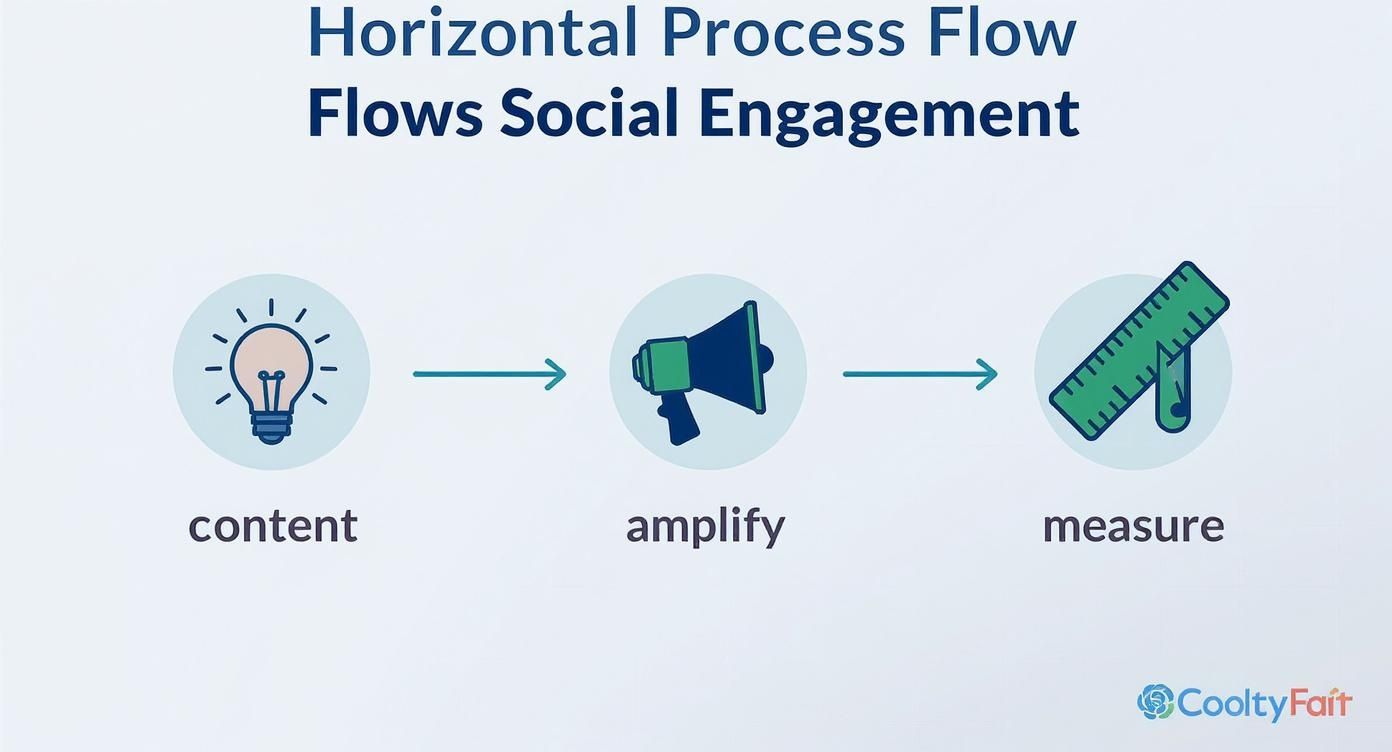
The key takeaway here is that each step directly fuels the next. When you get this right, you stop throwing random posts at the wall and start building a real growth engine.
Create Content That Demands a Response
Let's be honest: most social media content is just noise. It’s forgettable. If you want to improve engagement, you have to stop broadcasting announcements and start sparking conversations. This isn’t about guesswork; it's about psychology.
The real goal is to create a post so magnetic that someone physically stops scrolling because they feel they’ll miss out if they don’t. This requires a fundamental shift in thinking—from "What do I want to say?" to "What does my audience need to hear?"
Master Proven Content Formulas
Why start from scratch when proven frameworks already exist? These formulas work because they tap into predictable patterns of human psychology—our curiosity, our problems, and our desire for solutions.
Here are three of the most effective models, especially on a platform like LinkedIn:
- Problem-Agitate-Solve (PAS): This is a copywriting classic for a reason. You start by hitting on a painful problem your audience has. Then, you agitate that pain by digging into the consequences. Finally, you present your solution as the only logical way out.
- Data-Driven Insights: Nothing builds authority faster than unique data. Share a surprising statistic, a contrarian opinion backed by evidence, or an insight from your own work. People love content that makes them feel smarter or challenges what they thought they knew.
- Authentic Personal Stories: Vulnerability is a superpower. Sharing a personal failure, a tough lesson learned, or a behind-the-scenes moment makes you relatable. It humanizes your brand and gives others permission to share their own experiences.
Using these frameworks gives your posts a natural narrative arc. They hook the reader from the start and make commenting or sharing the obvious next step.
Crafting the Irresistible Hook
You have about three seconds to stop the scroll. That’s it. Your first line is everything. If it's weak, the rest of your brilliant content doesn't matter—no one will ever see it.
A great hook doesn't just state a topic; it creates an information gap. It makes the reader curious and forces them to think, "I have to know what happens next."
Let’s say you’re writing about team productivity. Compare these two openers:
- Weak Hook: "Our team has been working on improving our productivity lately." (So what?)
- Strong Hook: "I fired my most 'productive' employee last week. Here’s why."
The second one is a showstopper. It creates immediate tension and raises a dozen questions. It promises a story with a real lesson, making that "See more..." click almost impossible to resist.
Formatting for Maximum Readability
Even the best message will fail if it’s a giant wall of text. People don’t read online; they scan. Smart formatting is non-negotiable, especially on LinkedIn where attention is fleeting.
Your content's structure is just as crucial as its substance.
Break up your text. Use plenty of white space. Make it easy on the eyes.
- Keep paragraphs short. Seriously, one to three sentences max. This makes your content feel less intimidating and way more scannable.
- Use bullet points and numbered lists. They’re perfect for breaking down steps, listing key takeaways, or outlining a process.
- Emphasize with bold text. Use bolding to make key statistics, powerful phrases, or your main takeaway jump off the page. Just don’t overdo it.
This approach makes your content digestible, ensuring your audience actually sticks around to get your message. You can find more tips on getting the most from every post in our guide on content repurposing strategies for LinkedIn.
A Practical Example: The PAS Formula in Action
Let's see how this works in the real world. Imagine you're a sales leader who wants to share some hard-won wisdom on LinkedIn. Using the Problem-Agitate-Solve formula, your post could look something like this:
(Problem) Your top sales reps are spending less than 30% of their day actually selling.
(Agitate) The rest of their time is eaten up by admin, CRM updates, and internal meetings. Think about that—it’s hundreds of hours a month and millions in potential pipeline just vanishing into busywork. Meanwhile, your competitors with leaner systems are probably eating your lunch.
(Solve) We cut our non-selling activities in half with one simple rule: the "Zero-Admin Hour." Here's the exact framework we used and how you can roll it out this week to get your reps back to closing deals.
See how powerful that is? It mirrors a real conversation. It shows you get their world, validates their frustrations, and then offers a tangible, actionable solution. This is the kind of content that doesn't just get likes—it gets comments like, "We are struggling with this exact issue," and that’s how you start a real business relationship.
Amplify Your Reach and Spark Conversations
Creating great content is only half the job. The most insightful post on earth is useless if nobody sees it. This is where amplification comes in—the art of getting your message in front of the right people to kickstart conversations and turn passive scrollers into active fans.
It’s about being deliberate with your distribution, not just hitting “publish” and crossing your fingers. We need to move past the whims of organic reach and build a system that combines smart timing, targeted outreach, and using your network to create a ripple effect.
Nail Your Timing: Post When Your Audience is Actually Online
One of the easiest wins for engagement is posting when people are actually there to see it. Pushing content live at 2 AM might feel productive, but if your entire network is asleep, you’re shouting into an empty room.
Stop guessing. Start using your platform’s built-in analytics. LinkedIn, for example, will literally show you the days and times your followers are most active. This data is your secret weapon.
- Dig into your analytics: Head to the "Analytics" tab on your LinkedIn profile to see your audience's peak activity windows.
- Test and measure: Even within those peak times, experiment. A post at 9 AM might hit differently than one at 12 PM. Find what works for your audience.
- Look for patterns: Do Monday morning posts get more thoughtful comments while Friday afternoon posts get more likes? Use that insight to match your content type to the day.
By syncing up with your audience's habits, you give your content the best shot at getting that crucial initial traction. That first burst of engagement tells the algorithm your post is worth showing to more people.
Start Real Conversations with Strategic DMs
Direct messages are probably the most powerful, underused tool for sparking genuine engagement, especially on LinkedIn. Done right, a DM can turn someone who just liked your post into an active participant in a real discussion. The key? Be helpful, not salesy.
Whatever you do, don't send a generic, automated "Thanks for the like, want a demo?" message. That's a fast track to being ignored. Use their engagement as an opening for a real conversation.
The goal of a follow-up DM isn’t to sell; it's to deepen the connection. Add value, ask a thoughtful question, and show you’re actually interested in their perspective, not just their wallet.
Here’s a simple, non-sleazy template you can steal:
"Hey [Name], thanks for engaging with my post about [Topic]. I saw you're in [Their Industry], and I was curious—how are you seeing [Related Trend] play out for your team? No pressure to reply, just genuinely interested in your take."
This works because it’s personal, relevant, and opens a dialogue with zero expectation. You’re showing you did a tiny bit of homework, which goes a long way.
Turn Your Team into a Distribution Engine
Your employees are your most credible and powerful distribution channel, period. When your team shares and engages with company content, it doesn’t just expand its reach—it adds a layer of authenticity and trust that a branded post could never achieve on its own.
Encouraging your team to become advocates can blow up your visibility. Their networks are goldmines, filled with industry peers, potential customers, and future hires.
Of course, a structured approach is essential. You can find a complete playbook on how to get this right in our guide to launching effective employee advocacy programs.
A huge piece of this puzzle is making sure your content is optimized for where people actually see it. For instance, 80% of all social media activity now happens on mobile devices, meaning your content has to be scannable and look good on a small screen. This is especially true on LinkedIn, where 57% of all engagement is mobile. You can learn more about how platform-specific behaviors should shape your content in this deep dive into social media statistics.
Measure What Matters to Fuel Growth
If you're not measuring, you're just guessing.
It's that simple. Pushing out great content and amplifying it is a fantastic start, but without a clear feedback loop, you’re flying blind. To really see your engagement climb, you have to look past the vanity metrics—like follower counts—and drill down on the numbers that show you have a healthy, connected audience.
This is where our system becomes a cycle: post, measure, learn, and repeat. This loop turns every single piece of content, whether it's a massive win or a total flop, into a data point that fuels your next move.

Ditch Vanity Metrics for Actionable Insights
Let's be real: a huge follower count with zero interaction is a ghost town. True engagement isn't about the size of your audience; it’s about the quality of the conversation. It’s time to stop chasing numbers that look good in a report and start tracking the ones that actually mean something.
So instead of obsessing over likes, let's redefine what a successful post looks like. Your new key performance indicators (KPIs) should reflect genuine connection.
- Engagement Rate: This is your north star. It's the percentage of people who saw your post and actually did something—commented, shared, reacted. It's a direct measure of how much your content resonated.
- Comment Quality: Are people dropping one-word replies like "Great!" or are they asking thoughtful questions and sharing their own experiences? One detailed comment is worth 20 generic ones. Seriously.
- Share Velocity: How quickly and widely is your post being passed around? This is a huge signal. It means your content is so valuable that people are willing to stake their own reputation on it by sharing it with their network.
- Click-Through Rate (CTR): If your post has a link, how many people are actually clicking it? This tells you if your hook and call-to-action were compelling enough to make someone leave the platform.
These metrics tell a story. They show you what your audience truly cares about, guiding your content strategy with hard data instead of just a gut feeling.
The Post-Measure-Optimize Loop
Let’s put this into practice. Imagine you posted a data-heavy insight you thought was brilliant, but it completely tanked. A few likes, zero comments. Crickets. This isn't a failure; it's a data point.
Here’s how you break it down to learn from it:
- Form a Hypothesis: Start asking why. Was it the hook? Maybe that first line was too boring. Was it the timing? Maybe you posted when your audience was offline. Was it the visual? Perhaps a simple graphic would have hit harder than a stock photo.
- Run a Test: For your next post on a similar topic, change just one of those things. For example, keep the core insight but rewrite the hook to be more provocative or to ask a direct question.
- Analyze the Results: Compare the new post’s performance against the old one. Did the engagement rate jump? Did you get more thoughtful comments? If so, your hypothesis was likely correct.
This iterative process—hypothesize, test, analyze—is the secret sauce for sustainable growth. You stop guessing what works and start building a repeatable system for creating content that connects, every single time.
Your Simple Engagement Tracking System
You don't need fancy, expensive software to get started. A simple spreadsheet is all it takes to begin tracking what matters and spotting patterns.
Set up a sheet with these columns to track your LinkedIn posts. It's basic, but it's powerful.
| Post Date | Post Topic/Hook | Impressions | Comments | Shares | Clicks | Engagement Rate (%) | Notes/Hypothesis |
|---|---|---|---|---|---|---|---|
| 10/21 | "I fired my most productive employee..." | 15,200 | 45 | 12 | 88 | 0.95% | Story-based hook worked well. |
| 10/23 | "5 tips for better team productivity" | 4,500 | 8 | 2 | 15 | 0.33% | Listicle hook was too generic. |
| 10/25 | "Productivity is a trap. Here's why..." | 18,900 | 62 | 21 | 110 | 1.02% | Contrarian hook sparked debate. |
Fill this out for every single post. Within weeks, you’ll see exactly which formats, topics, and hooks resonate the most. This data-backed approach transforms your content strategy from a creative guessing game into a predictable engine for audience growth.
Using AI and Tech to Work Smarter
Let's be honest: trying to manage social media effectively can feel like you've taken on a second full-time job. You're constantly hunting for fresh ideas, trying to nail the perfect posting time, and showing up every single day to engage. It's a grind.
This is where technology stops being a buzzword and starts becoming your most valuable team member. The goal isn't just to schedule posts and walk away. It’s about using tech to work smarter, freeing you from the monotonous tasks so you can focus on what actually builds your business—genuine relationships.
Think of AI as your own personal data analyst, content strategist, and creative assistant, all working for you 24/7.
Beyond Drafting Posts: AI as Your Strategy Partner
The real game-changer in social media tech isn’t about simple automation anymore. It's about strategic assistance. Instead of just scheduling a post you wrote, imagine a tool that uncovers the trending topics in your niche, analyzes audience sentiment at scale, and even predicts which content formats will pop off with your specific followers.
This is already here. You can literally ask an AI to give you an executive summary of last month's LinkedIn performance, highlighting your top three posts and breaking down exactly why they worked. This kind of insight used to take hours of manual digging through analytics. Now, it takes seconds.
This strategic layer lets you shift from a reactive mindset ("What on earth should I post today?") to a proactive one. You start building a content plan based on real data about what your audience actually wants, not just what you think they want.
Understand Audience Intent with Data
To actually boost your engagement, you have to know why people are showing up in the first place. Recent data for 2025 shows the top reason people use social media is “keeping in touch with friends and family,” which makes sense for 50.8% of users.
But look closer. “Filling spare time” (36.8%) and “reading news stories” (over 33%) are right behind. The companies that are winning are the ones who adapt their content to these motivations. In fact, those who use AI to get these insights see 1.6x higher engagement.
This is where tech gives you an almost unfair advantage. AI can comb through thousands of comments and posts to decode the real drivers behind your audience's behavior.
- Sentiment Analysis: Instantly see if the vibe around your brand or a certain topic is positive, negative, or just neutral.
- Topic Clustering: Find out the most common themes, questions, and pain points people are talking about in your industry.
- Competitor Benchmarking: See what's working for others in your space—what topics and formats are getting them the most traction?
By using tech to get a read on audience intent, you can stop guessing. You start creating content that perfectly aligns with what people are looking for, whether that's a connection, a bit of entertainment, or a solution to their problems.
Automate Thoughtfully and Scale Authentically
Automation gets a bad rap, and for good reason. We’ve all seen those spammy, impersonal messages. But when you use it right, automation is how you scale genuine interactions without losing your human touch.
The secret is to automate the process, not the personality.
Instead of blasting out a generic "thanks for the follow" message, you can use tools to identify everyone who left a thoughtful comment on your latest post. From there, you can send a personalized follow-up that references what they said and asks a relevant question. It shows you're paying attention and opens the door to a real conversation.
For an even deeper analysis, our LinkedIn Post Analyzer tool can help you pinpoint which parts of your content are sparking the most conversation, giving you the data you need to make your outreach even smarter.
This is the killer combo: AI-driven insights paired with thoughtful automation. You'll generate ideas faster, understand your audience on a deeper level, and scale your outreach—all while keeping the authenticity that builds a truly loyal and engaged community.
Still Got Questions? We've Got Answers.

Even with the best playbook, you're going to hit a few snags. It happens. This is where we tackle the most common questions that pop up when you're in the trenches, trying to make this whole engagement thing work.
Think of this as your quick-reference guide for those "what am I doing wrong?" moments. Let's get straight to it.
Why Are My Posts Getting Crickets?
It’s the most frustrating feeling in the world: you post something you think is great, and... nothing. If you’re posting into the void, it almost always comes down to one of three things: your content, your timing, or a total lack of momentum.
Maybe your posts are a little too "me-focused" and self-promotional, without offering real value that makes someone stop scrolling. Or maybe you're posting at 9 PM when your entire audience is offline, so your content is buried before anyone sees it.
The other big one? The algorithm. Without an initial burst of likes and comments, the platform assumes your post isn't interesting and won't show it to a wider audience.
Takeaway: Zero engagement is rarely a single mistake. It's usually a cocktail of a weak hook, bad timing, and no system in place to get those first few crucial interactions.
What’s a “Good” Engagement Rate, Anyway?
Everyone wants a magic number, but the truth is, "good" depends heavily on the platform and your industry. As a very general baseline, anything over 1% on a professional network like LinkedIn is decent. On more visual platforms like Instagram, you might shoot for 1-3%.
But honestly, the raw percentage is a vanity metric. What you should obsess over is the quality of the interactions.
- Low-Quality Engagement: A post with 100 likes but zero comments or shares. It's superficial.
- High-Quality Engagement: A post with 20 likes, but it sparked 15 thoughtful comments and got shared 5 times. That’s infinitely more valuable. It shows you hit a nerve.
Instead of chasing some universal benchmark, focus on beating your own average. If you can steadily increase your engagement rate month-over-month, you're winning. That's real growth.
How Much Time Should I Actually Spend Engaging Every Day?
You don't need to live on social media to see results. What you need is a focused system. I'm a big fan of the 15/15/30 Rule. It carves up your daily social media time into three purposeful blocks.
- The First 15 Minutes: Go on offense. Spend this time dropping thoughtful comments on posts from key people in your network—think industry leaders, top prospects, and strategic partners. This is about being seen in the right places.
- The Next 15 Minutes: Play defense. Your job here is to reply to every single comment on your own content. Don't just "like" it; ask a follow-up question. Turn a simple reply into a real back-and-forth. This tells the algorithm your content is sparking conversations.
- The Final 30 Minutes: This is your content and strategy time. Use it to draft tomorrow's post, look at what performed well yesterday, and brainstorm new ideas.
An hour a day, broken down like this, is more powerful than three hours of aimless scrolling. You can adjust the times, but the ratio is what matters. It keeps you balanced between building your community and creating the content that fuels it.
Ready to stop guessing and start growing? GetViews.AI transforms your expertise into a predictable pipeline on LinkedIn. Our AI-powered platform helps you create high-performing content, amplify your reach to the right audience, and turn engagement into real business opportunities. Put your LinkedIn growth on autopilot and see the results for yourself. Learn more at https://getviews.ai.