Improve Your Social Selling Index Score
Unlock your sales potential by improving your LinkedIn social selling index score. Learn proven strategies and practical steps to boost your SSI.
Wilmer KarlssonTarstad
Think of your Social Selling Index (SSI) score as something like a credit score, but for your sales game on LinkedIn. It’s a simple number from 0 to 100 that sizes up how well you’re doing at building your professional brand, connecting with the right people, sharing smart insights, and nurturing relationships. Ultimately, it’s a measure of how effectively you're using the platform to drive sales.
What Is The LinkedIn Social Selling Index Score?

If you picture your LinkedIn profile as your digital storefront, then your SSI score is essentially your foot traffic report. It shows how good you are at attracting the right kind of visitors, keeping them engaged, and converting that attention into real business relationships. This isn't just a number to brag about; it's a data-backed look at how well you're turning the world’s biggest professional network into a tool for B2B success.
LinkedIn rolled out the SSI back in 2014 to give sales pros a tangible way to track their social selling efforts. The score is calculated based on four key activities, giving you a holistic view of your performance. You can read more about the origins and components of the SSI score on Oktopost.
Why does this number matter so much? Because it's often a direct predictor of sales success. LinkedIn’s own research shows that social selling leaders create 45% more opportunities and are 51% more likely to hit their sales quotas. A high SSI is a strong signal that you’re consistently doing the right things to build a solid pipeline and close more deals.
The Four Pillars of Your SSI Score
Your total score is built on four distinct pillars, each worth a maximum of 25 points. Getting a handle on these pillars is the first real step to boosting your score—and your sales results. Each one maps to a critical part of the social selling process.
The table below breaks down exactly what these pillars are and why they're so crucial.
The Four Pillars Of Your SSI Score At A Glance
| SSI Pillar (25 Points Each) | What It Measures | Why It's Important |
|---|---|---|
| Establish Your Professional Brand | How complete and customer-focused your profile is. It also looks at whether you share valuable content to position yourself as an expert. | A strong brand builds trust and credibility. It’s what makes prospects see you as a go-to resource, not just another salesperson. |
| Find the Right People | Your skill at using LinkedIn's search tools to identify and connect with ideal prospects and key decision-makers. | Effective prospecting is everything. This pillar ensures you’re spending your time connecting with people who can actually buy. |
| Engage with Insights | How you find and share relevant content to start meaningful conversations. It tracks likes, comments, and shares on your posts. | Engagement is how you stay top-of-mind. Sharing valuable insights shows you understand your industry and your clients' challenges. |
| Build Relationships | Your ability to grow your network with the right people and effectively nurture those connections over time. | Social selling is a long game. This pillar measures your knack for turning connections into trusted relationships that lead to business. |
Getting a good handle on these four areas is the foundation for improving your score and, more importantly, your overall impact on LinkedIn.
Think of the four pillars like the legs of a chair. If one is weak or missing, the whole thing becomes wobbly and unreliable. To build a stable, sustainable inbound pipeline, you need a balanced approach that gives attention to all four areas.
For example, a low score in "Find the Right People" might mean your prospecting is off the mark. On the flip side, a high score in "Engage with Insights" shows you’re on your way to becoming a thought leader in your space. In the next sections, we’ll get into the nitty-gritty of how to master each pillar and turn your LinkedIn presence into a revenue-generating powerhouse.
Alright, theory is one thing, but seeing your own number is where the rubber meets the road. Let's get you in front of your Social Selling Index score. The good news? It's completely free and available to every single LinkedIn member—no Sales Navigator subscription required.
Think of it as your personal command center for social selling, showing you exactly how your day-to-day LinkedIn habits are paying off. It’s the first real step in turning these ideas into a concrete plan for improvement.
Getting to Your SSI Dashboard
Finding your score is incredibly simple. Just make sure you’re logged into your LinkedIn profile first.
- Open up your browser.
- Head straight to this link: www.linkedin.com/sales/ssi
- That's it. Your personalized dashboard will pop right up.
This page refreshes daily, giving you a near-live look at how you're doing. I’d recommend bookmarking it. A quick check once a week is a great habit for tracking your progress over time.
Once the page loads, you’ll see something that looks a lot like this:
This dashboard gives you your overall SSI score at a glance, plus a specific score for each of the four components we just covered.
What Your Score Actually Means
Your dashboard is more than just a set of numbers; it gives you crucial context by showing you how you stack up against others. This is where it gets interesting. You’ll see two main comparisons.
- Industry Rank: This tells you how your SSI score measures up against the average for people in your industry. If you're in the top 10%, you’re doing a great job outperforming your direct competition.
- Network Rank: This compares your score to the average of everyone in your professional network. It's a fantastic gauge of your influence among your peers and connections.
So, what's a "good" SSI score? Honestly, any improvement is a win, but most sales pros I know are shooting for a score above 75. Hitting that number puts you in a pretty elite group and is a solid sign that you’re genuinely getting traction on the platform.
A score below 50 isn't a bad thing—it's just a clear signal that there's a ton of opportunity waiting for you. A score between 50 and 70 is decent, but it usually means one or two of the pillars are lagging and could use some attention.
The best way to look at your score is not as a final grade, but as a diagnostic report. Let's say your overall score is a respectable 65, but your "Find the Right People" score is only 12 out of 25. Boom. You’ve just pinpointed your biggest area for growth.
This is what makes the SSI so powerful. It’s not just a vanity metric; it’s a roadmap that tells you exactly where to focus your efforts to make the biggest difference in your pipeline.
Mastering The Four Pillars Of Social Selling
To really move the needle on your Social Selling Index score, you have to stop thinking of it as one single number. Instead, see it as the sum of four different skills you're building on LinkedIn. Each of these four pillars—Establish Your Professional Brand, Find the Right People, Engage with Insights, and Build Relationships—is worth 25 points. Getting a high score means getting good at all of them.
This map gives you a great visual breakdown of how to think about your SSI score—it’s a cycle of finding your score, understanding what it means, and seeing how you stack up.
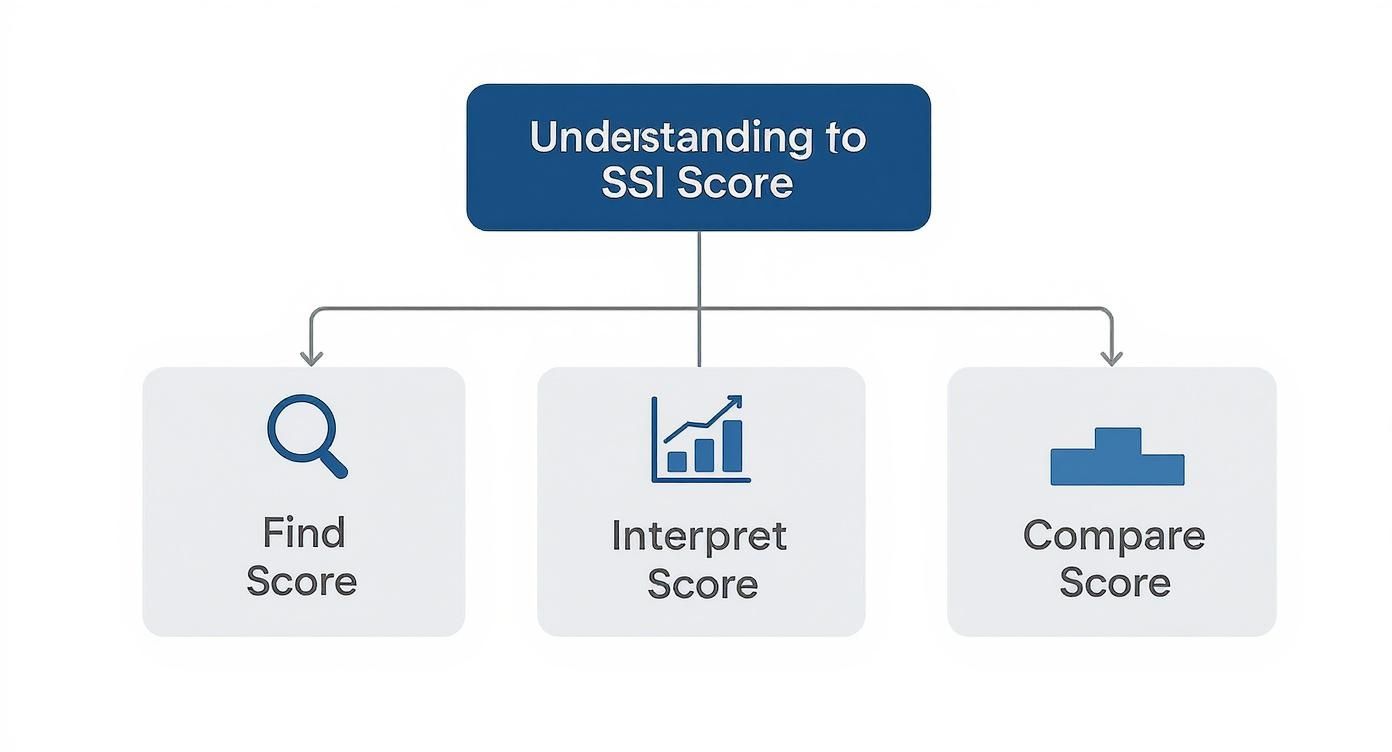
As you can see, improving your score isn't about just being "more active." It’s about being strategic—knowing where you are, understanding the data behind it, and then taking targeted action.
So, let's get into the practical, nitty-gritty steps you can take to nail each of these pillars and start seeing real results.
Pillar 1: Establish Your Professional Brand
Think of your LinkedIn profile as your digital storefront. This first pillar is all about making sure that storefront is 100% complete and built for your ideal customer, not for a recruiter. It’s not a resume; it’s a resource designed to draw your prospects in.
A powerful brand starts with nailing the fundamentals:
- A Professional Headshot: This one's non-negotiable. Get a clear, high-quality photo where you look like someone people want to do business with. No logos, no family photos—just a professional-looking you.
- A Compelling Headline: Ditch the generic job title. Instead of "Sales Manager," try something like, "Helping B2B Tech Companies Build High-Performing Sales Teams." See the difference?
- A Client-Focused 'About' Section: Use this space to tell a story. Who do you help? What big problems do you solve for them? Frame your entire experience around the value you bring to the table for your clients.
But a great profile is just the starting point. This pillar also rewards you for sharing valuable content. When you publish long-form posts or articles that share what you know, you're not just posting—you're positioning yourself as an expert. LinkedIn sees that activity and recognizes you as an authoritative voice worth listening to.
Your LinkedIn profile should answer a prospect's silent question: "What's in it for me?" Every section, from your headline to your featured content, should be crafted to demonstrate your value and understanding of their challenges.
Pillar 2: Find The Right People
You can't have a high SSI score if you're talking to the wrong people. This pillar is all about how well you identify and connect with the actual decision-makers in your target market. It's about quality over quantity, every time.
LinkedIn’s algorithm pays close attention to how you use its search tools. It rewards people who dig deep with advanced search filters or Sales Navigator to find prospects based on things like industry, company size, seniority, and location. Firing off random connection requests just won't cut it.
Here’s how to give this score a serious boost:
- Use Advanced Search: Make it a habit. Regularly use LinkedIn's search filters to create hyper-targeted lists of prospects who fit your ideal customer profile (ICP) to a T.
- View Profiles of Target Accounts: Simply viewing the profiles of key decision-makers sends a signal to the algorithm that you're actively and effectively prospecting.
- Track Your Connection Acceptance Rate: A high acceptance rate is proof that you're reaching out to the right people with messages that resonate.
The goal here is simple: build a network that isn't just big, but incredibly relevant to your business. That's how you make sure your content and outreach actually land with the people who can say "yes."
Pillar 3: Engage With Insights
This pillar is where the action is. It’s all about creating and sharing content that gets people talking. Your score here is a direct reflection of the likes, comments, and shares your posts get, and just as importantly, how much you engage with what other people are posting.
Just pushing out your own content into the void isn't enough. You have to become a trusted source of information and a genuine part of the conversation. Share interesting industry news, offer your unique take on a new trend, or ask a question that makes people stop and think. When it comes to engagement, comments are pure gold—they show you’re truly paying attention.
To nail your "Engage with Insights" score, make these your priorities:
- Share High-Value Content: Post articles, data, and perspectives that your audience will actually find useful. The guiding principle should always be to be helpful, not salesy.
- Comment Thoughtfully: Go beyond "great post!" Leave insightful comments on posts from prospects and industry leaders. Pro tip: comments over 15 words tend to have a much bigger impact.
- Mix Up Your Formats: Don't get stuck in a rut. Try text-only posts, carousels, polls, and even short videos to see what your audience responds to. If you're looking for ways to get more out of your ideas, check out these strategies for content repurposing on LinkedIn to turn one piece into many.
Pillar 4: Build Relationships
This is the pillar that ties it all together. It measures how good you are at turning those digital handshakes into real, trusted professional relationships. Social selling is a long game, and this part of your score shows how well you're playing it.
Your score here is heavily influenced by your connections with senior-level folks and how quickly you respond to messages. The algorithm rewards users who build a strong, deep network within their target accounts and keep the lines of communication open.
Focus your energy on these activities:
- Personalize Every Connection Request: Always—and I mean always—add a personal note. Mention a shared interest, a mutual connection, or something you noticed about their company.
- Nurture Your Network: Don't just collect connections. Engage with their posts, congratulate them on work anniversaries, and send them useful articles without asking for anything in return. Play the long game.
- Take Conversations to the DM: When you have a great back-and-forth in the comments, that's your cue. Take the next step and continue the chat in a direct message to build a real one-on-one connection.
By focusing on these four pillars, you can systematically improve your social selling index score and turn your LinkedIn activity into a reliable machine for generating inbound opportunities.
A Practical Playbook to Boost Your SSI Score
Alright, now we get to the good stuff. Knowing what the four pillars are is one thing, but actually improving your score comes down to consistent, daily action. Theory doesn't build a pipeline—habits do. Think of this section as your tactical guide, packed with specific strategies you can start using today.
The real trick is to weave these actions into your daily workflow so they don't feel like a chore. Even a small, focused effort each day compounds into some seriously impressive results over time.
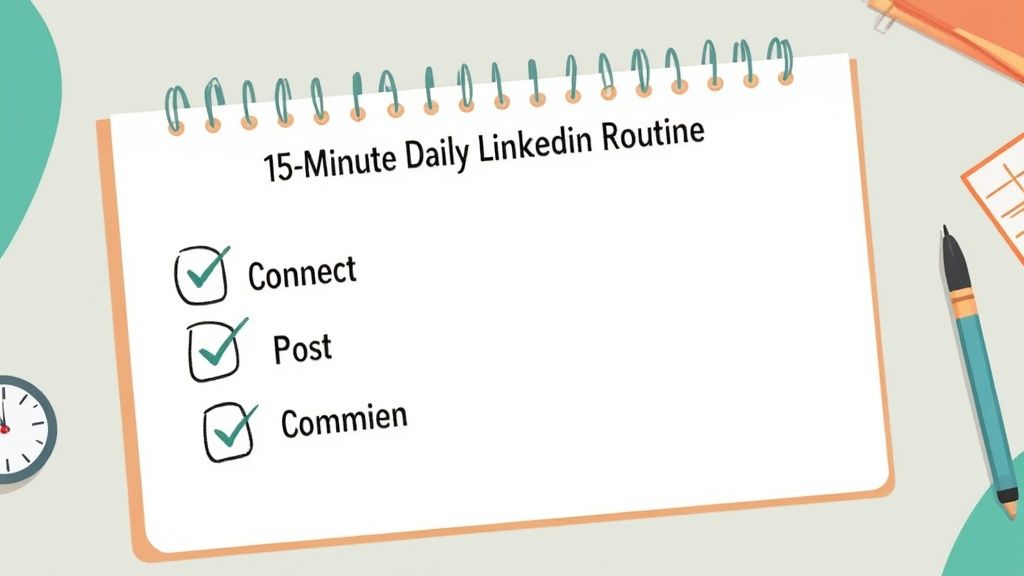
The 15-Minute Daily LinkedIn Routine
Let's be real: for busy sales pros, time is everything. This simple, 15-minute routine is built to hit all four SSI pillars efficiently, helping you build momentum without throwing your whole day off track.
Minutes 1-3: View and Connect
- Action: Take three minutes to look over the profiles of key prospects you earmarked yesterday. Send out 2-3 personalized connection requests.
- Why it works: This is a direct shot in the arm for your "Find the Right People" and "Build Relationships" scores. Consistency here is far more powerful than sending a huge batch of requests once a week.
Minutes 4-8: Engage Intelligently
- Action: Scroll through your feed and leave 3-5 thoughtful comments on posts from prospects, clients, and industry leaders. Try to make your comments more than 15 words—no more "Great post!" replies.
- Why it works: This is a high-impact move for your "Engage with Insights" score. The LinkedIn algorithm loves meaningful comments way more than simple likes.
Minutes 9-12: Respond and Nurture
- Action: Pop into your inbox and reply to any new messages or connection acceptances. Find one connection with a work anniversary or new job and congratulate them.
- Why it works: This strengthens the "Build Relationships" pillar. It shows you’re an active, engaged member of your network, not just a collector of contacts.
Minutes 13-15: Share and Plan
- Action: Share one genuinely useful piece of content or reshare a post with your own insightful take on it. Before you wrap up, identify three new profiles to review in tomorrow's session.
- Why it works: This boosts your "Establish Your Professional Brand" score and, just as importantly, sets you up for success the next day. It creates a sustainable loop of activity.
Templates for Connection Requests That Actually Work
A generic connection request is a wasted opportunity. The goal isn't just to add another number to your network; it's to start a real conversation. That means personalization is non-negotiable.
A great connection request shows you've done your homework. It should answer the unspoken question, "Why are you connecting with me specifically?"
Template 1: The Mutual Interest "Hi [First Name], I saw your recent comment on [Influencer's Name]'s post about [Topic] and completely agree with your take on [Specific Point]. I've been following that conversation closely. Would love to connect and share insights."
Template 2: The Content Appreciation "Hi [First Name], I just read your article on [Article Topic], and your perspective on [Specific Insight] was incredibly valuable. It’s given me a few new ideas to consider for my own work in [Your Industry]. I’d be honored to connect."
Template 3: The Shared Group "Hi [First Name], I noticed we're both members of the [LinkedIn Group Name] and saw you asking about [Question/Topic]. I've been working on that challenge recently myself. It would be great to connect with another professional in this space."
How to Share Content That Adds Value
Simply hitting "repost" on an article won't do much to build your brand. To truly move the needle on your "Engage with Insights" score, you need to add your own unique perspective. This is how you shift from being a content curator to a thought leader.
Try this simple framework:
- Hook: Start with a bold statement or a question that stops the scroll.
- Context: Briefly explain why this topic is important or relevant right now.
- Insight: Add your personal take. What do you agree or disagree with? What experience can you share?
- Call to Action: End by asking a question to get people talking in the comments.
Example in Action
- (Hook): "Most sales teams are measuring the wrong content metrics."
- (Context): "I just read a great report on B2B content trends, but it focused heavily on vanity metrics like views and likes."
- (Insight): "From my experience, the most powerful metric is 'conversation-starters.' How many DMs or comments did a post generate? That's what actually builds a pipeline."
- (Call to Action): "What's the one content metric you'd track if you could only pick one? Curious to hear your thoughts."
This approach doesn't just broadcast information; it starts a conversation—and that's exactly what the LinkedIn algorithm is designed to reward.
By applying these tactics, you can turn daily activity into a predictable growth engine. For those serious about scaling this effort, our guide on how to build a million-dollar LinkedIn pipeline in 90 days offers an even deeper dive into these strategies. Consistent, strategic action is the fastest way to improve your SSI score and see a real impact on your sales results.
The Real-World Impact of a High SSI Score
It can be tough to connect the dots between your daily grind on LinkedIn and actually hitting your annual quota. But your social selling index score isn't just a number to feel good about; it’s a real sign of future business results. A high score is the difference between constantly chasing leads and having them come to you.
Think of it like this: a low SSI score is like setting up a booth at a massive trade show, but you're tucked away in a back corner. A high score? You've got the main keynote stage. The effort you put into building your personal brand and genuine relationships pays off with more visibility, credibility, and inbound opportunities.
This isn't just a nice idea. Social selling leaders create 45% more opportunities than their peers who have lower SSI scores. They are also 51% more likely to reach their sales quotas. These stats paint a very clear picture of the power behind a smart social selling strategy.
From Digital Handshakes to Closed Deals
The best way to understand the impact of a high SSI score is to look at real-world examples from sales pros who have turned it into a revenue machine. Take a B2B SaaS account executive who was getting nowhere with cold outreach. Her SSI was a lukewarm 48, a reflection of her mostly passive approach to LinkedIn.
She decided to get serious and built a daily routine around the four SSI pillars. She completely revamped her profile to speak directly to her ideal customer's biggest problems, started using Sales Navigator to build highly targeted lead lists, and began sharing one insightful post each day about the challenges her prospects face.
The goal isn't just to increase a number on a dashboard. It's to build a powerful personal brand that attracts opportunities, shortens sales cycles, and accelerates career growth. A high SSI score is the byproduct of doing that work consistently.
Within just three months, her SSI shot up to 79. But more importantly, she started getting connection requests from VPs at her target accounts. These weren't cold leads; they were warm prospects who had seen her content and already saw her as a credible expert. The result? A 30% shorter sales cycle for deals that started on LinkedIn and a permanent spot at the top of her team's leaderboard.
Accelerating Your Career and Your Pipeline
A strong social selling index score does more than just fill your pipeline for this quarter; it has a huge effect on your career path. Being great at social selling is directly tied to better career outcomes. In fact, according to LinkedIn's own data, sales professionals with higher SSI scores get promoted about 17 months sooner than colleagues with lower scores. You can read more about the career benefits of a high SSI on Skrapp.io.
This happens because a high SSI is proof that you've mastered modern sales skills. It shows you can build relationships, create value, and drive revenue in a world that operates online.
Here’s how a high score directly fuels your growth:
- Attracts High-Quality Inbound Leads: When you establish yourself as a thought leader, your ideal customers find you. This flips the script from outbound hunting to inbound harvesting.
- Builds a Moat Around Your Relationships: Strong digital relationships are tough for competitors to break into. You become a trusted advisor, not just another vendor.
- Increases Deal Velocity: Prospects who come to you through your content are already educated and trust you more, which leads to quicker decisions.
Ultimately, mastering social selling is about building a sustainable system for growth that will pay you back for years. It's crucial to track the return on this effort, and you can learn more by understanding LinkedIn attribution and ROI.
Common Questions About The SSI Score
Once you start digging into your Social Selling Index score, you’re bound to have questions. It’s a powerful metric, but it’s not always straightforward. Getting a handle on the details is what separates people who treat it as a vanity number from those who use it to actually grow their pipeline.
Let's clear up some of the most common questions and myths we hear from sales pros. The goal here is to give you the confidence to move forward with a solid plan.
How Often Does The Social Selling Index Score Update?
Your SSI score updates daily. This is a massive plus because it means you get almost instant feedback on what you’re doing. The moves you make today—like polishing up your profile, sending a few thoughtful connection requests, or dropping insightful comments—will show up in your score within about 24 hours.
This rapid refresh rate lets you connect the dots between your actions and the results. If you spend a week really leaning into engagement, you'll see that "Engage with Insights" pillar start to climb. It’s a near-real-time confirmation that your strategy is hitting the mark.
Think of your SSI score not as a static report card, but as a live dashboard. Its daily updates give you constant feedback, so you can quickly adjust your strategy and double down on what’s working.
Do I Need LinkedIn Sales Navigator To Have A High SSI Score?
This is a big one. The short answer is no, you definitely don't need a paid LinkedIn Sales Navigator subscription to earn a high SSI score. All the core activities that build your score are available on a free LinkedIn account.
Even without a subscription, you can still:
- Establish Your Brand: Fully flesh out your profile with a killer headline, a detailed 'About' section, and relevant media.
- Engage with Insights: Post valuable content, and then like and comment on other people's posts to get conversations going.
- Build Relationships: Send personalized connection requests and stay in touch with your network through messaging.
So where does Sales Navigator come in? Think of it as an accelerator, especially for the "Find the Right People" pillar. Its advanced search filters and Lead Lists make zeroing in on your ideal prospects incredibly efficient. It's not a requirement for a high score, but it’s a tool that helps you get there faster and with more precision.
Is The SSI Score The Only Metric That Matters For Social Selling?
Absolutely not. While your SSI score is a fantastic diagnostic tool, it should never be the only thing you track. It’s what we call a leading indicator—it measures the activities that lead to sales outcomes. A high score is a great sign you're doing the right things, but it doesn't guarantee results by itself.
To see the full picture, you have to pair it with lagging indicators. These are the tangible business results that prove your efforts are paying off.
Your social selling dashboard needs to include metrics like:
- Number of qualified conversations started through LinkedIn
- Meetings booked from your LinkedIn activity
- New pipeline opportunities sourced from LinkedIn
- Deals closed that had a social selling touchpoint
A high SSI score is the means to an end. The real prize is measurable business impact, and your other KPIs are what connect your social selling efforts to the bottom line.
Can My Social Selling Index Score Go Down?
Yes, it can, and it will if your activity drops off. This isn't a score you hit once and get to keep forever. The LinkedIn algorithm rewards consistency, so if you go quiet for a bit, your numbers will take a hit.
If you stop engaging with your network, pause your prospecting, or don't share any content for a few weeks, you'll see your score slide. This is actually a good thing—it makes the score a true reflection of your current habits, not just a snapshot of something you did last quarter. To keep a high score, you have to bake these best practices into your daily routine.
Ready to transform your LinkedIn presence from a passive profile into a predictable revenue machine? GetViews.AI uses AI to automate your content creation, helping you consistently post high-performing content that builds pipeline without cold outreach. Turn your expertise into inbound leads and put your LinkedIn growth on autopilot. Discover how GetViews.AI can build your movement.