how to create a sales funnel: Turn Prospects into Loyal Customers
Discover how to create a sales funnel that turns prospects into loyal customers, with practical steps on stages, content, automation, and optimization.
Wilmer KarlssonTarstad
Building a sales funnel is all about mapping out the journey your ideal customer takes, from the moment they hear about you to when they sign a contract. It’s about guiding them with the right content at the right time, turning that initial spark of curiosity into a real business relationship.
Rethinking the B2B Sales Funnel for Today
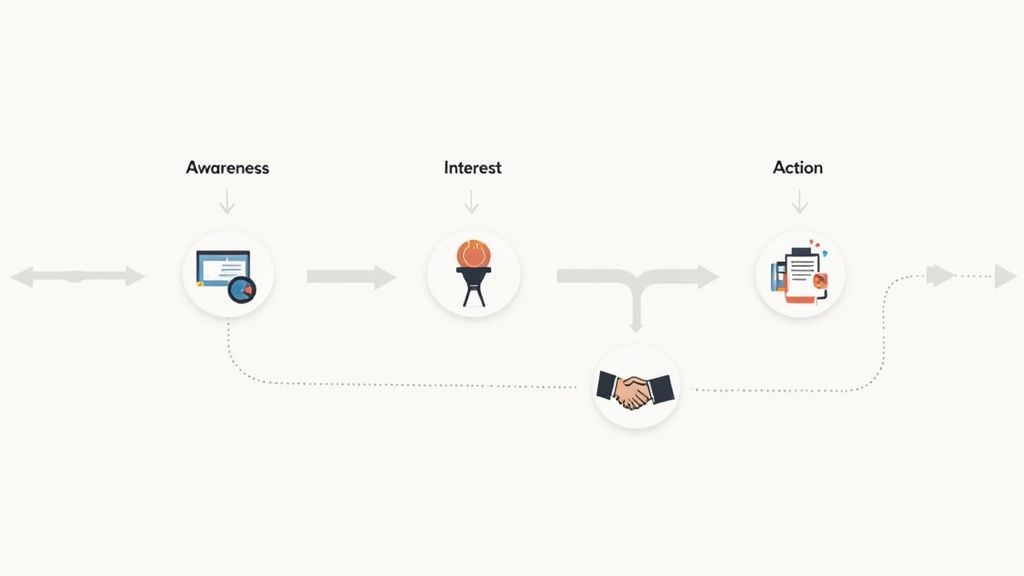
Before you touch a landing page builder or write a single line of copy, we need to get one thing straight: the modern B2B sales funnel isn't a rigid, one-way street anymore.
The old days of neatly slotting prospects into "Top of Funnel," "Middle of Funnel," and "Bottom of Funnel" are over. Today's B2B buyers are incredibly self-sufficient. They educate themselves, do their own research, and spend a ton of time on platforms like LinkedIn long before they ever think about raising their hand to talk to a salesperson.
This new reality calls for a more flexible, empathetic approach. Our job isn't to push prospects down a path we've designed. It's to guide them through a journey they already control. That’s where the classic AIDA framework comes in. It’s a time-tested model that’s more relevant than ever.
Here’s a quick overview of how the AIDA model breaks down in a B2B context, showing what’s going on in the buyer’s head and what our goal should be at each step.
The AIDA Sales Funnel Stages for B2B
| Stage | Buyer Mindset | Business Goal |
|---|---|---|
| Awareness | "I have a problem, and I'm starting to notice companies that might solve it." | Get discovered. Build initial brand recognition and establish credibility. |
| Interest | "Okay, I'm actively looking for solutions. Who really understands my challenge?" | Educate and inform. Provide valuable content that helps them define their problem. |
| Desire | "I've compared the options, and this specific solution seems like the best fit for me." | Build preference. Show them why your solution is the superior choice through case studies and proof. |
| Action | "I'm convinced. I'm ready to take the next step and engage with this company." | Drive conversion. Make it easy for them to request a demo, start a trial, or make a purchase. |
This table maps out the mindset shift. It’s not just about what we want them to do; it’s about aligning our actions with their natural progression from problem-aware to solution-ready.
Understanding the Self-Directed Buyer
Let's picture a marketing manager at a mid-sized tech company. She’s getting frustrated with the poor quality of leads coming from their content efforts. Her journey doesn't kick off with a Google search for "marketing automation software."
It probably starts on LinkedIn. She sees a post from an industry peer talking about how they improved their lead scoring. This is the moment of Awareness. She begins following a few thought leaders in the space, joining relevant groups, and paying closer attention to similar content in her feed.
From there, her Interest builds. She starts digging into more substantial content—webinars, whitepapers, and case studies from different companies that seem to get her specific challenge. She is absolutely not ready for a sales call. She's in full-on research mode, silently evaluating who’s providing the most value.
This self-guided process is exactly where so many traditional funnels fall apart. They push for a demo way too early, scaring off a buyer who is still in the learning phase. For a deeper dive into building, measuring, and optimizing for this modern buyer, check out this excellent guide to mastering the B2B sales funnel.
Why a Well-Defined Funnel Actually Matters
Mapping this journey isn’t just some theoretical exercise—it directly impacts your bottom line.
Across industries, the average sales funnel conversion rate is a dismal 2.35% to 3%. But here's the kicker: top-performing companies that really invest in optimizing their funnels see conversion rates of 5% or higher. They're more than doubling the average.
The data also reveals that a shocking 68% of businesses haven't properly defined or even documented their funnel strategy, which is a huge reason for this underperformance.
A successful B2B sales funnel is less about forcing a sale and more about building a relationship. It's about showing up with the right answer, at the right time, on the platform where your buyer is already looking for it.
By adopting the AIDA framework and seeing the world through your buyer's eyes, you can build a system that doesn't just capture leads—it builds trust and credibility. In the sections that follow, we'll walk through exactly how to design, build, and optimize a sales funnel that turns prospects into confident, loyal customers.
Crafting Your LinkedIn Content Strategy
On LinkedIn, your content is the engine of your B2B sales funnel. It's not just about posting updates; it's about strategically mapping every single post to a specific stage of your buyer's journey. You're not just broadcasting, you're guiding.
Think of it as a series of conversations. You deliver the right message at the right moment to build trust and prove your expertise, long before you ever ask for a sale.
Content for the Awareness Stage
At the top of the funnel, your only job is to get discovered and stop the scroll. Your ideal customers aren't searching for your exact solution yet. They're just becoming aware they have a problem, or they're simply looking for insights to be better at their jobs.
Your content here needs to be valuable, easy to share, and broad enough to grab attention.
Here are a few formats that consistently win at this stage:
- Insightful Text Posts: Share a strong opinion, a contrarian viewpoint, or a hard-won lesson from a recent project. Posts that challenge the status quo almost always spark the most conversation.
- Short-Form Videos: Whip up a quick, 30-60 second video explaining a single concept or offering a quick tip. The goal is high value with a low time commitment from the viewer.
- Simple Polls: Ask a thought-provoking question tied to a common industry pain point. Polls are a fantastic, low-effort way to get people engaging while you gather real-time market insights.
This top-of-funnel content isn't about selling. It's about establishing yourself as a credible, generous voice in your space.
Content for the Interest and Desire Stages
Once you've got their attention, it's time to nurture that flicker of interest into a real desire for what you offer. This is your middle-of-the-funnel content, and it needs to go deeper. It should directly address your audience's challenges and start showing them how you can solve them.
You're transitioning from broad industry insights to specific, tangible solutions.
The best middle-funnel content doesn't just tell prospects what you do; it shows them what's possible. It helps them imagine a better future—and positions your solution as the bridge to get there.
Consider these powerful content types for building interest:
- Case Studies and Success Stories: Break down a successful client project into a LinkedIn post. Detail the problem, the solution you built, and—most importantly—the measurable results. This is social proof gold.
- Webinar or Event Announcements: Promote live events where you can dive deep into a specific topic. Webinars are perfect for capturing leads and demonstrating your expertise in a more personal, interactive format.
- In-Depth Guides and Carousels: Create a multi-slide carousel that walks through a step-by-step process or breaks down a complex framework. This format lets you pack a ton of value right into the LinkedIn feed.
This is also where a tool like GetViews.AI becomes incredibly useful. It can help automate the ideation and drafting for these more detailed pieces, making sure you maintain a steady flow of value-packed content without burning out.
Here’s a glimpse of the GetViews.AI platform, which lets you manage this entire content workflow from a single dashboard.
This view highlights how you can plan, schedule, and analyze your content's performance—which is critical for understanding what actually resonates with your audience at each stage.
For a more comprehensive look at mapping this all out, our guide on building a winning LinkedIn content strategy dives even deeper into the frameworks and examples you can put to use right away.
Content for the Action Stage
At the bottom of the funnel, things get serious. Your prospect knows they have a problem, they know solutions like yours exist, and they're actively weighing their options. They are ready to decide.
Your content now must be crystal clear, direct, and make it ridiculously easy for them to take the next step.
The goal is conversion. The messaging shifts from "here's how to think about your problem" to "here's how we solve it for you."
Effective bottom-of-funnel content includes:
- Direct Consultation Offers: A simple, direct post like, "I'm offering three free 30-minute strategy sessions this week for B2B tech companies struggling with lead gen. Comment 'interested' below if you want one."
- Product Demo Videos: A short video that shows your product in action, focusing on the one or two key features that solve a massive pain point. No fluff.
- Client Testimonials: A post featuring a powerful quote or a short video clip from a happy customer. Let your clients do the selling for you by sharing their own stories.
Every single piece of content you create must have a purpose tied to a specific funnel stage. When you align your LinkedIn activity with your buyer's journey, your profile transforms from a simple social page into a powerful, automated engine for generating high-quality B2B leads.
Building Your Lead Capture and Nurturing System
Creating content that gets attention is a great start. But if you don't have a system to capture that attention, you're just creating noise. The real money in a B2B sales funnel is made when you convert that initial interest into a genuine conversation.
This is where the high-growth players separate themselves. They don't just hope leads will reach out; they build a seamless bridge from the moment a prospect shows interest to the point they're ready for a sales call. Without this, you're just letting good leads fall through the cracks.
Think of it as a journey you're guiding them on, from awareness to action.
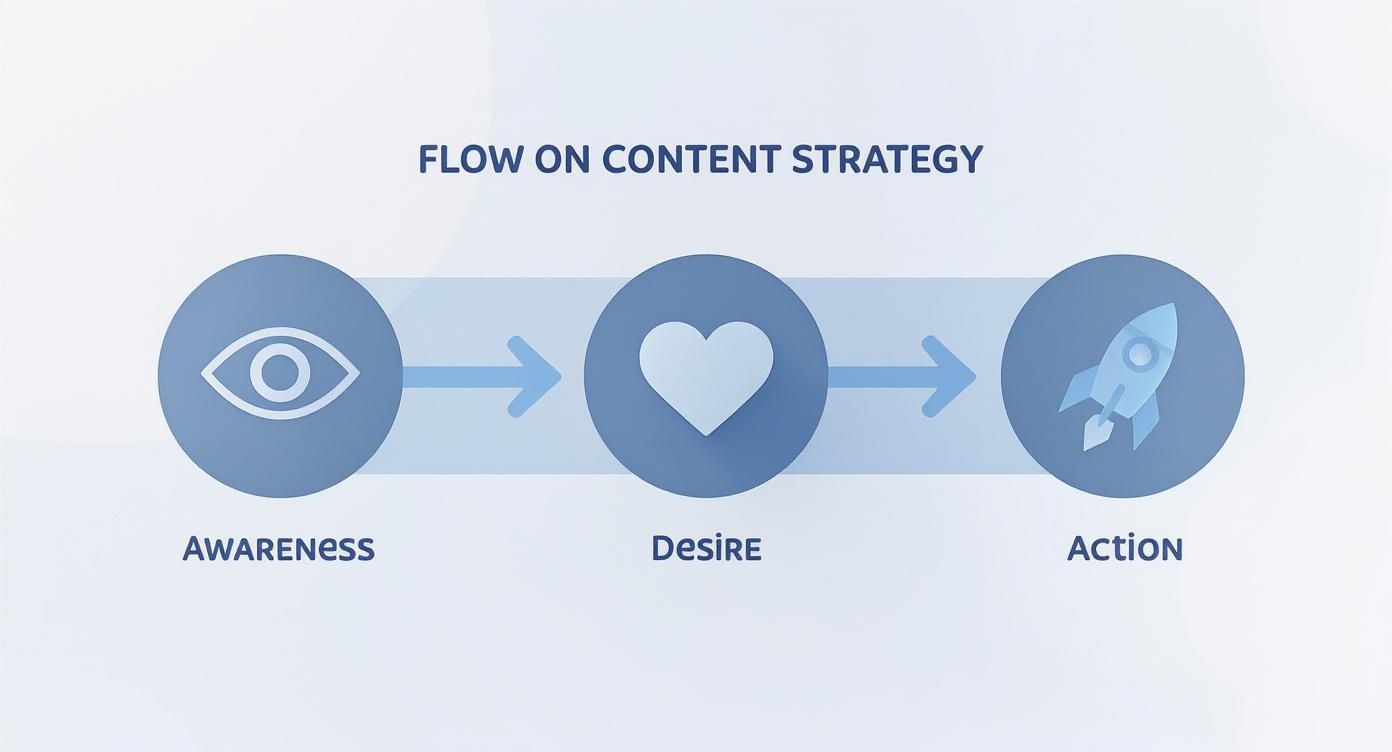
Each step is a deliberate move forward, and your job is to make that next step irresistible.
Designing Irresistible Lead Magnets
A lead magnet is your ethical bribe. It's the value you offer in exchange for someone's contact information. Generic ebooks and vague whitepapers just don't cut it anymore. Your offer needs to solve a specific, nagging problem for your dream client—and give them a quick win.
Here are a few ideas that actually work:
- Actionable Checklists: A "10-Point LinkedIn Profile Optimization Checklist" is way more compelling than a general guide. It gives someone a clear, tangible outcome they can achieve in minutes.
- Plug-and-Play Templates: Offer something they can use right now, like a "Cold DM Outreach Template" or a "Content Calendar Template." You're not just giving them information; you're saving them time.
- Exclusive Case Study Access: Gate a detailed case study behind a form, promising a peek behind the curtain at how you got a specific, impressive result for a client in their exact industry.
The goal is to make the value so obvious that giving you their email feels like a bargain. If you want to go deeper on this, check out this essential guide to lead capture automation.
Building High-Converting Landing Pages
Your landing page has one job and one job only: convince visitors to trade their information for your lead magnet. Simplicity wins. Clarity converts. Clutter is your enemy.
Every landing page that works has these four things:
- A Compelling Headline: Be specific about the benefit. Instead of "Download Our Ebook," try "Get the 5-Step Framework to Double Your Inbound Leads."
- Concise, Benefit-Driven Copy: Use bullet points to spell out exactly what they'll get. Focus on the outcome ("Book 3 more meetings this week") not just the features ("A 10-page guide").
- A Simple, Visible Form: Only ask for what you absolutely need. Name and email are usually plenty. Every extra field you add is another reason for them to bounce.
- A Strong Call-to-Action (CTA): The button text should scream action. "Get My Free Checklist" crushes a generic "Submit" every single time.
Pro tip: Remove all navigation, footers, and other links from your landing page. The only way out should be through the form.
Constructing Automated Nurture Sequences
Okay, you've got the lead. Now what? The nurturing process is where the real relationship building happens. This is your chance to build trust and educate your prospect over time, gently guiding them toward a sales call without being pushy or desperate. Automation is non-negotiable here.
This is critical because only 3% of website visitors are ready to buy on their first visit. Data also shows that a staggering 79% of marketing leads never convert simply because they aren't nurtured properly. On the flip side, companies that kill it with lead nurturing generate 50% more sales leads while spending 33% less to get them.
A great nurture sequence feels less like a marketing campaign and more like a helpful conversation. It anticipates the prospect's questions and provides answers before they even have to ask.
Your sequence can be a mix of emails and—if the lead came from LinkedIn—even some automated DMs. Here’s a simple three-step flow you can set up after someone downloads one of your checklists:
- Email 1 (Immediate): Delivers the goods. Thank them for downloading the checklist and tell them what's coming next (e.g., "Keep an eye out, I'll be sending over another helpful tip in a couple of days.").
- Email 2 (2 Days Later): Add more value. Send a short video tutorial explaining a key part of the checklist they downloaded. Reinforce your expertise.
- Email 3 (4 Days Later): Introduce a soft CTA. Share a relevant case study and invite them to a quick, no-strings-attached strategy call to see how they could apply these ideas to their own business.
This system ensures no lead goes cold. By automating your follow-up, you stay top-of-mind and build a relationship based on giving value, which makes the eventual ask for a sales call feel like the natural next step.
Automating and Scaling Your Sales Engine
A brilliant sales funnel built on manual processes is like a sports car stuck in city traffic. It has incredible potential but can never truly open up. If you want real growth, you have to move beyond manual effort and get your systems working for you.
The goal is to build an engine that runs 24/7, freeing you from the repetitive tasks so you can focus on what humans do best: having meaningful conversations with qualified buyers.
Without technology, your ability to scale is capped by the number of hours in your day. Automation isn't about removing the human touch; it's about applying it where it has the most impact. Let the tech handle the tedious follow-ups and data entry so you can dedicate your energy to closing deals.
Putting LinkedIn Workflows on Autopilot
LinkedIn is a goldmine for B2B leads, but prospecting on the platform can be a massive time sink. This is where workflow automation becomes your secret weapon. It turns manual sequences into a background process that consistently surfaces new opportunities.
Imagine this: someone in your target audience engages with one of your posts. Instead of you having to manually track that engagement, an automated workflow takes over.
It could trigger a sequence like this:
- Day 1: Automatically send a personalized connection request referencing the post they engaged with.
- Day 3: If they accept, send a follow-up message offering another piece of valuable content related to that first post.
- Day 7: Send a final, low-pressure message asking about their current challenges, opening the door for a real conversation.
This entire process can run without you lifting a finger. Platforms like GetViews.AI are designed for exactly this, letting you build sophisticated DM automations that feel personal and timely, not robotic. These systems ensure you never miss a chance to connect with a warm prospect.
For more on this, our guide on automated lead generation provides some great frameworks you can implement right away.
Syncing Your Tech Stack for Seamless Data Flow
Your sales funnel probably involves a few different tools—a CRM like HubSpot or Salesforce, your LinkedIn automation tool, maybe an email platform. A common point of failure is when these systems don't talk to each other. When data is siloed, leads get dropped and follow-up becomes a mess.
The key to a truly automated engine is integration. You need a seamless flow of information between your marketing and sales platforms.
When a new lead is captured from a LinkedIn campaign, their information should instantly and automatically populate in your CRM. This single action can prevent countless hours of manual data entry and eliminate the risk of human error.
This connection allows you to build a unified view of each prospect's journey. You can see when they engaged with a LinkedIn post, downloaded a lead magnet, and opened a nurture email—all in one place.
Practical Automation Workflows to Implement
So what does this look like in practice? A well-designed workflow ensures every action a prospect takes gets the right reaction from your system.
Here’s how automation can connect the dots in your sales funnel:
| Trigger Event | Automated Action | Business Outcome |
|---|---|---|
| Prospect engages with a "Desire" stage post on LinkedIn. | Add the prospect to a "warm lead" list in your CRM. | Prioritizes sales team follow-up on the most engaged prospects. |
| Lead downloads a case study from a landing page. | Enroll the lead into a 3-part email sequence showcasing related results. | Nurtures interest and builds credibility without manual email sends. |
| A prospect mentions a competitor in a LinkedIn comment. | Send a notification to the assigned sales rep. | Creates a timely opportunity for the sales team to engage in a relevant conversation. |
These automated workflows do more than just save time. They create a more responsive and personalized experience for your prospects.
By setting up these rules, you're building a scalable system that capitalizes on every signal of interest. Your sales funnel stops being a model on a whiteboard and becomes a dynamic, revenue-generating machine.
Measuring and Optimizing Funnel Performance
Here’s where most people go wrong: they build a funnel, launch it, and then walk away. But your funnel isn't a static brochure; it's a living system that needs constant attention. If you aren’t measuring its performance, you're flying blind, hoping for revenue.
Optimization is where you turn a decent funnel into a predictable, revenue-generating machine.
The trick is to ignore the vanity metrics. Things like social media likes or a spike in website traffic feel good, but they don’t tell you if your funnel is actually working. We need to focus on the numbers that have a direct line to your bank account.
This means getting surgical with your Key Performance Indicators (KPIs) to see exactly what’s happening at every step of the buyer’s journey.
What Numbers Actually Matter?
To build a funnel that really performs, you have to know your numbers. The quickest way to get a pulse check is by tracking the conversion rate between each stage. This instantly tells you where the biggest drop-offs are happening.
Here are the essentials you should have on your dashboard:
- Stage-to-Stage Conversion Rate: What percentage of people who see your awareness content actually move into the interest stage? From interest to desire? This is your number one diagnostic tool. A low number here is a giant red flag.
- Sales Cycle Length: How many days does it take for a prospect to go from first touch to closed deal? A shorter cycle usually means your messaging is tight and your funnel is efficient.
- Cost Per Acquisition (CPA): This is the bottom-line metric. Add up all your sales and marketing costs and divide by the number of new customers. It tells you exactly how much you're paying to win.
Tracking these metrics gives you a clear, unbiased picture of what's going on. For example, a big drop-off between your Interest and Desire stages might mean your case studies just aren't hitting hard enough. You can learn more about nailing this in our detailed guide on customer acquisition cost calculation.
Below is a quick-reference table of the key metrics you'll want to keep an eye on.
| Metric | What It Measures | Industry Benchmark |
|---|---|---|
| Lead Conversion Rate | Percentage of visitors who become leads (e.g., fill out a form). | 2-5% is average; 5%+ is strong. |
| MQL to SQL Rate | Percentage of Marketing Qualified Leads that become Sales Qualified Leads. | Varies widely, but 10-15% is a common starting point. |
| SQL to Opportunity Rate | Percentage of SQLs that turn into a real sales opportunity. | Aim for 20-30% or higher. |
| Opportunity to Win Rate | The percentage of qualified opportunities that result in a closed deal. | 20-30% for B2B. |
| Average Deal Size | The average revenue generated per closed deal. | Highly dependent on your industry and offering. |
| Sales Cycle Length | The average time it takes to close a deal from the first contact. | B2B cycles can range from 30-180+ days. |
| Customer Lifetime Value | The total revenue a business can expect from a single customer account. | Aim for a LTV:CAC ratio of 3:1 or better. |
| Cost Per Acquisition | The total cost to acquire a new customer. | Should be significantly lower than your LTV. |
These benchmarks are just starting points. The most important thing is to track your own numbers month-over-month to see improvement.
Pinpointing and Plugging Funnel Leaks
Once you have your data, it's time to play detective and hunt for the "leaks"—the specific spots where you're losing prospects. A funnel leak is any point of friction that makes someone give up and leave.
Seeing a massive drop-off on your lead magnet landing page? The headline probably isn't grabbing them, or the form is too long. Are people opening your first nurture email but ignoring the second? Your subject line for email #2 is likely the culprit.
Think of yourself as a detective. Each metric is a clue. A high bounce rate on a landing page isn't just a number; it's a sign that your message and your audience's expectations are misaligned.
Looking at your channel performance is also a game-changer. For example, some data shows that referrals are the top-performing channel, converting at an impressive 25.56%. This is followed by email marketing at 22.83% and SEO at 21.22%. In stark contrast, cold calling converts at just 9.38%, showing why inbound methods are so powerful. Discover more insights about sales conversion rates on Focus Digital.
The Power of Continuous A/B Testing
Finding a leak is step one. Fixing it is where the money is made. The most reliable way to boost your funnel’s performance is through continuous A/B testing, also known as split testing. You’re simply comparing two versions of one thing to see which one gets better results.
You don’t need a huge budget or a data science degree to do this right. Start with small tests on high-impact elements.
Here are a few simple A/B tests you could run this afternoon:
- Landing Page Headline: Test a benefit-driven headline ("Double Your Leads in 30 Days") against a question-based one ("Struggling to Generate Qualified Leads?").
- Call-to-Action (CTA) Button Color: It sounds trivial, but I've seen a simple button color change from blue to orange lift click-through rates. You never know until you test.
- Email Subject Lines: Pit a straightforward subject line ("Your Free Checklist is Inside") against a more intriguing one ("Is this the reason your lead gen is stuck?").
The golden rule of A/B testing: only change one variable at a time. If you change the headline and the CTA button, you’ll have no idea which change actually caused the lift (or drop).
By consistently measuring your metrics, hunting for leaks, and running disciplined A/B tests, you turn your sales funnel from a static model into a dynamic engine for growth. This is the iterative process that separates the companies that limp along from the ones that scale predictably.
Answering Your Top Sales Funnel Questions
Alright, let's address the questions that are probably running through your head. Building your first real sales funnel can feel like a massive project, and it's smart to get some clarity before you dive in.
Think of this as the FAQ section you'd actually want to read. We'll cut through the noise and tackle the big questions I hear all the time.
How Long Until I See Results?
This is always the first question, and the honest answer is: it depends.
If you already have a bit of a following on LinkedIn and you've been posting occasionally, you could start seeing new leads trickling in within the first 30 days. You’ve already done some of the legwork.
But if you're starting from a dead stop? Give yourself a more realistic 3-6 month runway. That’s the time it takes to build awareness, earn some trust, and get your content in front of the right people consistently. The funnel needs fuel, and in the beginning, that fuel is consistent, valuable content.
A burst of activity for two weeks followed by radio silence will get you nowhere. This is about building momentum, one post at a time. The payoff is a predictable pipeline, but it doesn't happen overnight.
What Kind of Budget Do I Need?
You can actually get started on a surprisingly small budget. Your biggest upfront investment isn't cash—it's the time you'll spend mapping out your strategy and creating content that doesn't suck.
That said, once you're ready to get serious, you'll want to budget for a few key pieces of tech to speed things up.
- Automation Software: Trying to manage LinkedIn DMs and email follow-ups manually is a recipe for burnout. This is non-negotiable for scaling.
- Landing Page Builder: Some CRMs have this built-in, but a dedicated tool like Leadpages or Instapage often gives you more templates and flexibility.
- Analytics Tools: You need to see where people are dropping off. This is how you find and fix the leaks in your funnel.
You don't need to break the bank. A few hundred dollars a month can cover the essential stack you need to automate the grunt work and optimize your process.
The most expensive mistake isn't paying for the right tools. It's the opportunity cost of all the qualified leads you lose while trying to manage everything in a spreadsheet for too long.
How Do I Adapt This for My Industry?
This is a great question. While the AIDA framework—Awareness, Interest, Desire, Action—is pretty much universal, the substance of your funnel needs to be tailored completely to your niche.
A funnel designed to sell SaaS to a CTO will look totally different from one selling consulting services to a VP of Marketing.
For that CTO, your lead magnet might be a dense whitepaper on system architecture or a security compliance checklist. For the marketing VP, it’s more likely a template for calculating campaign ROI or a swipe file of high-converting ad copy.
The structure stays the same, but the content, the language, and the offers have to change. Always, always, always start with deep research into your ideal customer. What are their biggest headaches? What terminology do they use? What do they actually care about? Nail that, and every piece of content you create will feel like it was written just for them, pulling them deeper into your world.
Ready to stop guessing and start building a predictable pipeline on LinkedIn? GetViews.AI transforms your expertise into a high-performing content and sales engine, automating everything from ideation to engagement so you can focus on closing deals. Discover how GetViews.AI can put your LinkedIn growth on autopilot.