How to Get Inbound Leads A Practical Guide
Learn how to get inbound leads with a proven system. This guide covers content strategy, LinkedIn optimization, and funnels to attract high-quality prospects.
Wilmer KarlssonTarstad
Forget chasing leads. It's time to make them come to you.
The secret to a predictable stream of inbound leads isn't some complicated hack. It’s about creating genuinely helpful content that solves your ideal customer's biggest problems, sharing it where they already are (hello, LinkedIn), and guiding them down a simple, optimized path. This isn't about selling; it's about building trust that turns strangers into warm, ready-to-buy conversations.
Why Inbound Is Your New Growth Engine
Moving away from cold calls and outbound spam isn't just a modern trend—it's a fundamental shift in how smart businesses grow. Instead of interrupting people, you're earning their attention.
This positions you as the go-to authority in your space, not just another salesperson clogging up their inbox. The result? A sustainable, predictable flow of high-quality opportunities.
The whole system boils down to a few core ideas, which this guide will unpack step-by-step:
- Attract: Pulling in your Ideal Customer Profile (ICP) with expert content that speaks directly to their pains and ambitions.
- Guide: Funneling that attention from your content to a central hub—like your LinkedIn profile—that's built to turn interest into action.
- Convert: Nurturing that interest through a dead-simple funnel that makes it easy for qualified prospects to raise their hand and book a call.
This flowchart lays out the powerful, straightforward journey of attracting, guiding, and converting your ideal clients.
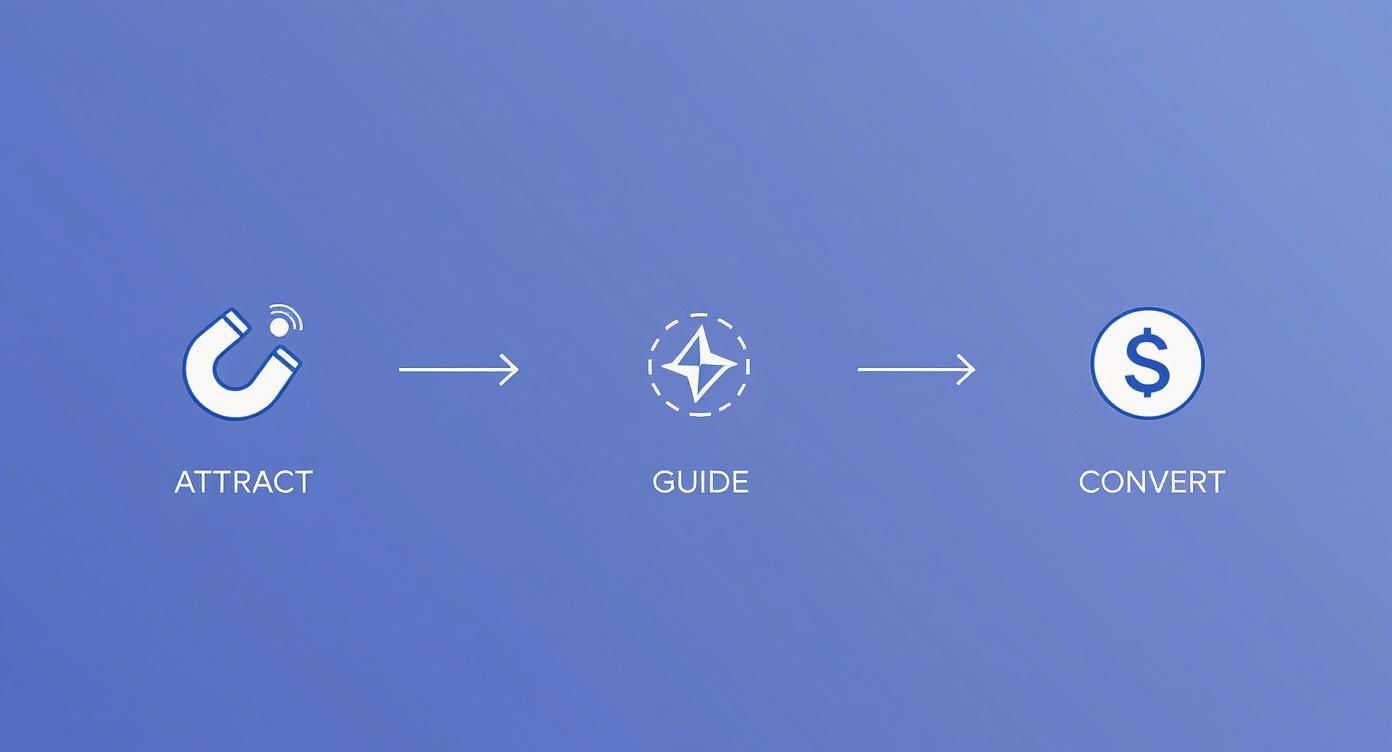
Each piece builds on the last, creating a smooth path from a casual scroll to a qualified sales call, all without resorting to aggressive or pushy tactics.
Before we dive into the "how," let's break down the key pillars of the system we're about to build.
| Core Components of Your Inbound Lead System | | :--- | :--- | :--- | | Pillar | Objective | Key Activities | | Audience Definition | Know exactly who you're selling to. | Define your Ideal Customer Profile (ICP) and Buyer Persona. | | LinkedIn Content | Become a trusted authority. | Create and publish problem-focused content consistently. | | Profile & Funnel | Convert attention into leads. | Optimize your LinkedIn profile and create a clear call-to-action. | | Amplification | Get your content in front of the right people. | Engage with prospects and use automation smartly. | | Capture & Qualify | Turn interest into sales conversations. | Build simple workflows to manage and qualify new leads. | | Measurement | Know what's working and what's not. | Track key metrics to iterate and improve your system. |
This table isn't just a list; it's the blueprint. Master these six areas, and you'll have a lead generation machine that runs on autopilot.
The Economic Case for Inbound Leads
Beyond just being a better way to engage, the numbers don't lie. Inbound marketing is drastically more efficient.
The data shows that inbound strategies generate 54% more leads than traditional outbound methods. Better yet, they cost, on average, 62% less per lead. That’s not a small difference—it’s a massive boost to your ROI and a huge weight off your marketing budget.
The core idea is simple: Be so helpful that your dream customers find you, trust you, and want to work with you. This isn't about a quick trick; it's about building a reliable revenue machine.
Ultimately, mastering how to get inbound leads changes your entire growth model. You stop hunting for business and start creating a magnetic brand that attracts opportunities 24/7.
This frees you up to focus on what you do best: closing deals with people who are already convinced of your expertise, not trying to win over strangers. This is the foundation for anyone looking to understand how to build your sales pipeline with qualified prospects who are already sold on you before the first call ever happens.
Pinpointing Your Ideal Customer Profile
Before you write a single post or design a lead magnet, you have to know exactly who you're talking to. The biggest mistake founders make is casting a wide net, hoping to attract anyone and everyone. That’s a surefire way to get lost in the noise and never connect with the people who actually need you.
The secret to predictable inbound leads isn't about volume; it's about precision.
This is where your Ideal Customer Profile (ICP) comes in. Think of it as a living, breathing description of the perfect company you want to work with. It goes way beyond basic demographics to nail the specific traits of businesses that get the most value from what you offer and, in turn, are the most profitable for you.
Moving From Vague to Actionable
A weak ICP is a list of generalities. Something like, "tech companies with 50-200 employees." An actionable ICP is much sharper.
For example, a consultant might define their ICP as: "B2B SaaS companies, Series A to B funding, with 75-150 employees, a dedicated sales team of at least 10 reps, and a CEO who is active on LinkedIn." See the difference? That level of detail makes every other decision a thousand times easier.
To build your own, start by looking at your best existing clients. Who are they?
- Firmographics: What's their industry, company size, and annual revenue?
- Success Indicators: Which clients see the most value from your service? Who sticks around the longest?
- Common Threads: What specific challenges were they all dealing with before they found you?
Your Ideal Customer Profile isn't just a marketing exercise; it's your strategic filter. It tells you who to create content for, where to spend your time, and which opportunities to ignore, ensuring you only attract high-quality inbound leads.
This analysis gives you a data-backed foundation. It shifts your targeting from pure guesswork to a calculated strategy, focusing all your energy on attracting more of your best-fit, highest-value customers.
Uncovering Deep Customer Pains
Once you know the type of company, you need to understand the people inside it. This means getting to the bottom of their real-world struggles, their goals, and the specific language they use to talk about them. Your content will only hit home if it speaks directly to these pain points.
So, how do you find this stuff? Simple. You listen.
-
Conduct "Pain Point" Interviews: Get on a call with your best clients. But don't ask them what they like about your service. Ask what their work life was like before you. What was frustrating them? What tasks were eating up their time? What goals felt completely out of reach?
-
Become a Social Listener: Go hang out where your ICP hangs out online. For most B2B folks, that’s LinkedIn. Search for keywords and hashtags relevant to their role. Pay attention to the questions they ask in comments, the frustrations they vent about in posts, and the topics that light up the engagement. Industry-specific subreddits are also goldmines for unfiltered, honest insights.
-
Analyze Sales Call Recordings: This is a game-changer. Listen to how prospects describe their problems in their own words. Note the recurring phrases, the objections they bring up, and the outcomes they're dreaming of. This is the exact language you need to mirror in your content to build instant rapport.
By combining firmographic data with these deep psychological insights, you create an ICP that feels like a real person you know. From that point on, every piece of content you create will feel like a direct answer to their problems. This is the foundational step that makes mastering how to get inbound leads a predictable process, not a shot in the dark.
Crafting Your LinkedIn Content Strategy

Alright, you've nailed down your Ideal Customer Profile (ICP). Now comes the fun part: creating content that actually speaks to them.
Too many people treat LinkedIn like a dusty digital resume. It's not. It's a B2B content powerhouse where you can build real authority, earn trust, and generate a predictable flow of inbound leads.
But just showing up and posting randomly is a recipe for crickets. You need a system. A structured approach that delivers value, day in and day out.
This means understanding what types of content actually work on the platform, when to post them, and how to frame your ideas to stop someone mid-scroll. It's about turning your profile from a static page into a magnet for your ideal clients.
Building Your Content Pillars
The idea of "endless content creation" sounds exhausting, right? It's not, as long as you build your strategy on a few core pillars. Think of these as the 3-5 big-picture topics your ideal client deeply cares about—the ones directly tied to the problems you solve.
Instead of staring at a blank page every morning, you'll just create posts that fit into these buckets. Simple.
Let's say you're a consultant helping SaaS companies slash churn. Your pillars might look like this:
- Customer Onboarding: Posts about creating those magic first moments for new users.
- Product Adoption: Content focused on clever ways to boost user engagement and feature usage.
- Feedback Loops: Ideas for collecting user feedback that isn't just noise and actually acting on it.
- Proactive Support: Strategies for getting ahead of customer problems before they even happen.
By sticking to your pillars, every single post reinforces your expertise in a specific area. This is how you stop being a generalist and become the go-to expert for a very specific problem. It's a non-negotiable step if you want to learn https://getviews.ai/blog/linked-in-content-strategy.
The goal of your LinkedIn content isn't to go viral with everyone. It's to resonate deeply with the right people. Your pillars act as a filter, pulling in your ideal buyers and gently pushing away everyone else.
This turns your content from random noise into a strategic asset that works for you 24/7.
Mastering Different Content Formats
Relying on one type of post is a surefire way to make your feed feel stale. The smartest folks on LinkedIn mix it up, using different formats to teach, engage, and inspire their audience in unique ways. A little variety goes a long way.
Here’s a quick breakdown of the heavy hitters and when to pull them out of your toolkit:
| Content Format | Best Used For | Pro Tip |
|---|---|---|
| Text-Only Posts | Dropping quick insights, telling relatable stories, or asking a killer question. | Keep your sentences short. Use tons of white space. People are reading on their phones, so make it easy for them. Always end with a question to get the comments rolling. |
| Image Posts | Visual storytelling, sharing a simple diagram, or pulling out a key stat. | The visual needs to add value, not just be a stock photo. A simple chart or a screenshot with an annotation works wonders. |
| Carousels (PDFs) | Breaking down a complex idea into bite-sized, step-by-step slides. This is my personal favorite for teaching. | Treat your first slide like a headline—it has to be compelling. Stick to one big idea per slide with large, clean text. Think of it as a mini-lesson. |
| Polls | Taking the temperature of your audience, validating a problem, or just starting a conversation. | Keep the poll dead simple with 2-4 clear options. The real magic happens when you follow up in the comments with your own take to fuel the discussion. |
By cycling through these formats, you cater to different preferences and keep your content from feeling predictable. You're not just a broadcaster; you're creating a multi-faceted experience for your followers.
Structuring Posts That Convert Attention
Even the most brilliant idea will fall flat if it's structured poorly. On LinkedIn, readability is everything. Your post needs to grab attention in the first second and guide the reader effortlessly from your first word to your last.
A battle-tested structure always has three parts:
-
The Hook: The first one or two lines are all that matter. Your hook must stop the scroll. Call out a pain point, make a bold claim, or ask a question that makes them think. For example: "Your best customers are the ones who complain the most. Here's why."
-
The Body: This is where you deliver the goods. Break down your main point with short paragraphs, bullet points, or numbered lists. Tell a story, share a framework, give a tactical tip. Just be helpful and clear.
-
The Call-to-Action (CTA): Every post needs a purpose. The CTA tells the reader what to do next. Forget the hard sell. Focus on starting a conversation. Simple prompts like, "What's the biggest hurdle you're facing with X?" or "Agree/disagree?" work incredibly well.
This simple framework transforms a random thought into a powerful piece of communication. Mastering a deeper LinkedIn content strategy like this one is about applying these principles over and over until you've built a library of assets that generate leads while you sleep.
And don't forget the broader context: lead generation is a top priority for marketers everywhere, with content being the primary engine. In fact, 76% of marketers use content specifically to generate leads, and for 68% of them, social media marketing has directly boosted their lead numbers. The system works if you work the system.
Turning Your Profile Into a Conversion Funnel
Creating great content is how you get your ideal customer's attention. It's the hook. But attention without a clear next step is just a wasted opportunity, a view that fades into the noise of the feed.
This is where your funnel comes in. The goal is simple: create a seamless path that guides an interested prospect from a casual profile click all the way to a qualified sales conversation.
Think of your LinkedIn profile as the heart of this system. It's not a resume; it’s a high-conversion landing page engineered to do one thing: turn curious visitors into real leads.
Optimize Your Profile to Convert
Every single element of your profile, from the banner down to your experience section, needs to be laser-focused on your Ideal Customer Profile (ICP). It should speak their language, address their pains, and gently nudge them to take action.
Let's break down the most critical parts.
The Low-Hanging Fruit: Banner and Headshot
First impressions are everything on a crowded platform. Your headshot needs to be professional but approachable—no blurry vacation photos.
Your banner, though, is prime real estate. It's a billboard for your value proposition. Use it to state exactly who you help and the tangible result you deliver. Don't waste it on a generic company logo.
The Headline: Your 220-Character Pitch
Your headline is so much more than a job title. It should scream the outcome you provide for your clients.
Instead of a generic "CEO at Company X," try something like, "I Help B2B SaaS Founders Cut Churn by 30% With Smarter Onboarding." This immediately qualifies you in the eyes of your target audience and repels everyone else. That's the point.
The About Section: Your Mini Sales Page
This section is where you make your case. Start with a hook that digs into your ICP's biggest pain point, then briefly outline how you solve it.
This is the perfect place to sprinkle in social proof—think client results, specific numbers, and testimonials. Most importantly, end with a crystal-clear call-to-action (CTA). Tell them exactly what to do next, whether it's connecting, sending a DM, or grabbing a free resource.
Your profile isn't about you; it's about what you can do for your ideal customer. Every word, from the headline to the About section, should be filtered through the lens of their problems and your solutions.
To help you get this right, here's a quick checklist to run through.
LinkedIn Profile Optimization Checklist
Your profile is the first stop for anyone interested in what you have to say. Follow this checklist to make sure you're not just telling people what you do, but showing them how you can solve their problems. Each element should work together to build a compelling case for why they should talk to you.
| Profile Element | Optimization Goal | Example |
|---|---|---|
| Banner Image | Communicate your value proposition visually. | A clean background with text: "Helping E-commerce Brands Scale to 8-Figures with Paid Ads." |
| Headline | Instantly qualify yourself to your ICP. | "We Help B2B Tech Companies Get 20+ Qualified Demos/Month from LinkedIn Content." |
| About Section | Tell a story that addresses pain points and offers a solution. | "Struggling to get consistent leads? We built a system that turns your expertise into a client magnet..." followed by a case study and a CTA. |
| Featured Section | Showcase your best content and social proof. | Link to a powerful case study, a valuable free guide (lead magnet), or your Calendly link for booking calls. |
| Experience Section | Frame past roles in terms of outcomes, not just responsibilities. | Instead of "Managed marketing campaigns," try "Led a team that generated $2.5M in pipeline through targeted ABM campaigns." |
Once these pieces are in place, your profile starts working for you 24/7, turning passive viewers into active prospects.
Create a Simple Lead Capture System
An optimized profile is step one. Now, you need a simple way to capture the interest you've generated. This is where a lead magnet comes in—a valuable, free resource you offer in exchange for an email address.
This doesn't need to be a 50-page ebook. Honestly, simple is better. The best lead magnets are hyper-specific tools that solve one small, painful problem for your ideal customer.
Here are a few ideas that work exceptionally well:
- A Detailed Checklist: "The 10-Point Pre-Launch Checklist for SaaS Startups."
- A Short Guide or Playbook: "The 5-Day Email Sequence to Re-Engage Trial Users."
- A Reusable Template: "My Go-To Content Calendar Template for LinkedIn."
The key is to offer something so immediately useful that your ICP can't resist downloading it. This is how you transition them from a passive follower into an active lead in your ecosystem.
Nurturing Leads Without Being Pushy
Getting an email address is just the beginning. Now comes the delicate part: nurturing that relationship and guiding them toward a conversation. This is where so many people go wrong, immediately pitching a sales call and scaring the prospect away.
You have to be patient. In today’s market, multi-touch journeys are the standard because buyers rarely make a decision after a single interaction. Data shows that while an inactive customer might convert after just 1 to 3 touches, warm inbound leads typically require 5 to 12 touches. Cold prospects? They can demand as many as 20 to 50 touchpoints before converting. You can find more insights on lead generation statistics and how they impact sales cycles.
This reality calls for a patient, value-driven approach.
The Nurture Workflow
Once someone downloads your lead magnet, they should enter a simple, automated follow-up sequence. This can be done via email or even personalized direct messages on LinkedIn using a tool like Outreach.
The goal of this sequence is not to sell. It's to continue building trust.
- Immediate Value Delivery: The first message delivers the lead magnet and says thank you. Simple.
- Follow-Up with Context: A few days later, send a message that adds value. "Hey [Name], hope you found the checklist useful. Most people get stuck on step #4. Here's a quick tip on how to handle it..."
- Introduce a Case Study: Share a short, relevant story about how a client used that same concept to get a specific result.
- The Gentle Ask: Finally, after you've provided more value, you can make a soft offer. "If you're thinking about how to apply this to your own business, I have a few spots open next week for a quick chat. No pressure at all."
This workflow feels helpful, not aggressive. It positions you as a trusted advisor, making it natural for interested prospects to raise their hand when the time is right.
Scaling Your Reach and Automating Outreach
Putting out great content is the engine, but even the best engine needs fuel to go anywhere. To get a predictable flow of inbound leads, you have to make sure the right people actually see your work. This isn't about shouting louder; it's about a smart, strategic approach to amplification that scales your effort without losing the human touch.
Posting and praying is a painfully slow path. Instead, you need to actively drop your content into the conversations where your ideal clients are already hanging out. It’s about being a proactive participant, not just a passive creator.
Tap Into Existing Conversations
One of the highest-leverage things you can do is engage in the comments section of industry leaders—the people your dream clients already follow and trust. Forget dropping a generic "great post!" comment. Add real value.
Your goal is to leave a thoughtful, supplementary insight that makes people stop and think, "Who is this?" They get curious, they click your profile, and boom—you've just turned someone else's audience into your potential audience, driving highly relevant traffic right back to your funnel.
Think of it this way: every thoughtful comment is a mini-advertisement for your expertise, placed directly in front of a pre-qualified audience. It’s one of the best ways to get more inbound leads without spending a dime.
This strategy positions you as a knowledgeable peer, not just another voice shouting into the void. It builds credibility and expands your network organically, all while feeding your system with warm prospects who found you through a source they already trust.
Maximize Your Content Lifespan
You spent hours crafting a brilliant post that really hit a nerve with your audience. Don't let it be a one-hit wonder. Repurposing your best stuff is non-negotiable for maximizing its reach and impact over time.
A single great idea can be repackaged into multiple formats to hit different platforms and appeal to different learning styles. This extends the life of your core message and makes sure it’s seen by the widest possible audience.
Here’s how you can turn one successful post into a content machine:
- Turn a Text Post into a Carousel: Got a text-only post that laid out a step-by-step process? Design it into a visually slick carousel. Each slide breaks down a single step, making it way more digestible.
- Create a Short-Form Video: Pull out your phone and record a quick 60-second video of you talking through the key takeaways. This is perfect for LinkedIn, Instagram Reels, or TikTok.
- Expand it into a Blog Article: Use the original post as the skeleton for a deeper dive on your website. This is great for SEO and gives your audience a long-form resource to sink their teeth into.
- Convert it into a Newsletter: Feature the core idea in your next email newsletter. Add some extra context or a personal story to give your subscribers exclusive value.
This is all about working smarter, not harder. You’re getting more mileage out of the content that’s already proven to work.
Automate Outreach Responsibly
As you start to scale, doing everything manually becomes a massive bottleneck. Automation can be a game-changer, but only if you use it responsibly. The goal here is to let tech handle the repetitive grunt work so you can focus on genuine, high-value conversations. Whatever you do, avoid robotic, generic messages.
Personalization is non-negotiable. Use automation tools to send connection requests or initial follow-ups based on specific triggers, like when someone engages with your content. A message like, "Hey [Name], I saw you liked my post on customer onboarding. Curious to hear your take on..." is a world away from a generic sales pitch and actually starts a real conversation.
Our guide on automated lead generation dives deeper into how to pull this off without sounding like a bot.
By mixing smart amplification with intelligent automation, you build a powerful system that multiplies your reach. This frees you from the manual grind, letting you invest your time where it truly matters: building relationships and closing deals with the steady stream of inbound leads you've worked so hard to attract.
Measuring What Matters for Growth
You can build the world’s best inbound engine, but if you don't know what's working, you're just guessing.
It's way too easy to get hooked on vanity metrics like likes and shares. They feel good, but they don't pay the bills. Real growth comes from obsessively tracking the specific actions that turn a stranger in your feed into a qualified lead in your pipeline.
The key is to shift your focus from broad engagement to specific, revenue-driving conversions. That means zeroing in on a handful of key performance indicators (KPIs) that actually signal progress.
Identifying Your Core Growth Metrics
Don't overcomplicate this. You don't need a massive analytics suite. A simple dashboard you can build in a spreadsheet, tracking just a few core numbers week-over-week, is all you need to spot trends and fix leaks in your funnel.
Start with the numbers that tell the story of your entire system, from first glance to first call.
- Weekly Profile Views: This is your top-of-funnel canary in the coal mine. When this number goes up, it means your content is working and people are curious enough to check you out. Your profile is your conversion hub—this metric shows how many people are walking through the door.
- Connection Request Acceptance Rate: Are you connecting with the right people? A high acceptance rate (aim for over 40-50%) proves your headline and profile resonate with your Ideal Customer Profile. If it's low, your targeting is off or your opening line isn't compelling.
- Lead Magnet Downloads: This is where prospects raise their hands and say, "I'm interested." It's the first real conversion, validating that your free resource is solving a genuine problem for your audience.
- Discovery Calls Booked: This is the only metric that truly matters. It's the direct link between your LinkedIn activity and your sales pipeline. This number represents real, tangible sales conversations.
Tracking these specific KPIs moves you from hoping to knowing. You can pinpoint exactly where your funnel is strong and where it’s weak, allowing you to double down on what works and fix what doesn't.
A Simple Dashboard for Weekly Tracking
You can build this in a Google Sheet or a Notion page. The tool doesn't matter; consistency does.
Make it a habit to review your numbers every Friday. This quick check-in tells you how the week went and where to focus your energy for the next one. This data-driven rhythm is the final piece of the puzzle.
And when a lead finally comes through that funnel? You have to act fast. Responding within the first five minutes can make them 100 times more likely to close.
Got Questions? Let's Talk Specifics.
Jumping into a new system for inbound leads always brings up a few "what ifs." Most founders and consultants I talk to are worried about the time commitment and whether this can actually work if they're starting from scratch.
Let's get right into the most common questions that pop up.
The big one is always time. Realistically, you're looking at about three to five hours per week to run this system properly. That time gets split between writing a couple of high-value LinkedIn posts, dropping thoughtful comments on other people's stuff, and handling the DMs that come your way. It’s all about consistency, not being chained to your desk.
"What If I Have No Followers?"
Trying to generate leads with zero followers can feel like shouting into an empty room. I get it. But it's not only possible; it's how most successful people on the platform started.
Your initial game plan isn't about your own posts. Forget about them for a minute. Instead, you'll spend 80% of your time leaving smart, genuinely helpful comments on posts from the big names in your niche.
Think of it as a shortcut. You're essentially borrowing their audience, putting your expertise on display, and pulling qualified, curious people back to your profile. I've seen a single well-crafted comment drive more high-quality profile views and connection requests than a post that gets almost no reach. It's the single best way to build that initial momentum.
One of the biggest mistakes I see is people trying to be everything to everyone. When you're just starting out, your message has to be razor-sharp and aimed directly at your Ideal Customer Profile. A narrow focus feels wrong, but it's the fastest path to becoming the go-to person for solving one specific, painful problem.
Another classic misstep is sporadic posting. Firing off five posts one week and then going dark for the next two just kills your momentum. The LinkedIn algorithm hates it, and your new audience will forget you exist. A simple content calendar with just two or three solid posts scheduled every single week is infinitely more powerful than random bursts of activity.
Ready to turn your LinkedIn into a predictable lead-generation machine? GetViews.AI uses AI to help you create high-performing content that builds pipeline without cold outreach. Start turning your expertise into inbound leads today at https://getviews.ai.