Master Content Repurposing Strategies Today
Unlock powerful content repurposing strategies to amplify your reach and drive growth. Learn proven workflows, AI tools, and KPIs to maximize your impact.
Wilmer KarlssonTarstad
An effective content repurposing strategy isn't about just hitting "share" on the same post over and over again. It's about building a system to squeeze every last drop of value from a single piece of your best work. Think of it as transforming one core idea into a whole family of content—turning a deep-dive blog post into bite-sized videos, a slick social media carousel, and a few insightful email snippets. This way, you meet different people where they are, on the platforms they actually use.
Building Your Content Repurposing Foundation
The best repurposing strategies don't happen after the fact. They start before you even write a single word. This is a big mental shift for a lot of people, moving away from the "one-and-done" content treadmill and embracing a "create once, distribute forever" philosophy. Instead of constantly hunting for new ideas, you design your content calendar around a few foundational, high-impact assets.
This whole approach revolves around what we call pillar content. These are the comprehensive, seriously valuable pieces that become the bedrock of your marketing.
- In-depth blog posts or guides (we're talking 2,000+ words) that leave no stone unturned on a topic.
- Webinars or live events that let you go deep on a specific subject and interact with your audience.
- Original research or data reports that offer fresh insights no one else in your industry has.
- Detailed video tutorials or case studies that put your expertise on full display.
These pillars aren't just articles or videos; they're content goldmines, packed with smaller ideas just waiting to be pulled out. When you start thinking this way, your content library stops being a random collection of posts and becomes a smart, interconnected system.
Before we dive deeper, it helps to clearly see the difference between the source material and the smaller pieces you'll create from it.
Pillar Content vs Micro-Content Breakdown
Here's a quick reference guide to help you distinguish between your foundational 'pillar' content and the smaller 'micro' assets you'll derive from it. This makes planning your repurposing efforts much easier.
| Attribute | Pillar Content (The Source) | Micro-Content (The Offshoots) |
|---|---|---|
| Purpose | To provide deep, comprehensive value and establish authority. | To capture attention, drive engagement, and funnel traffic back to the pillar. |
| Format | Long-form blog posts, webinars, eBooks, research reports, in-depth videos. | LinkedIn carousels, short-form videos (Reels/Shorts), quote graphics, email tips. |
| Length | Typically long (e.g., 2,000+ words, 60-min webinar). | Short and easily consumable (e.g., 10-slide carousel, 60-second video). |
| Audience | Those actively seeking in-depth knowledge and solutions. | Broader audience, often scrolling on social media or checking email. |
| Effort | High initial investment in research, creation, and production. | Low creation effort, as it's extracted from existing content. |
Understanding this distinction is the key to creating a sustainable workflow where one big effort fuels weeks, or even months, of smaller, high-impact content.
Identifying High-Potential Content
Let's be honest, not all content is worth repurposing. The secret to doing this efficiently is knowing which pieces are worth the effort in the first place. Before you start chopping up a blog post, you need to audit your existing library to find the hidden gems. The best place to start? Look at the data.
Your goal is to find content that has already proven it resonates with your audience. Start digging into your analytics:
- Organic Traffic and Keyword Rankings: Which blog posts are consistently your top performers in search? These are fantastic candidates because you already know people are actively looking for that topic.
- Audience Engagement Metrics: Look for posts with high comment counts, tons of shares, and long time-on-page metrics. A LinkedIn post with a buzzing comments section is a goldmine for follow-up topics, quotes, and Q&A-style content.
- Conversion Data: Which assets are actually driving email sign-ups, demo requests, or lead magnet downloads? This content has already shown it can persuade people to take action.
By focusing on data-backed winners, you take the guesswork out of the equation. You're no longer hoping a repurposed piece will hit the mark—you're betting on a proven concept.
This analytical mindset is a game-changer for anyone building their authority, and it's a cornerstone of effective content marketing for consultants who need to prove their expertise without wasting time.
The proof is in the numbers. A staggering 94% of professionals now actively repurpose their content for different channels, and for good reason—they see real boosts in traffic and engagement. With a solid foundation built on proven pillar content, you can finally move from random acts of content creation to a systematic, goal-driven strategy that gets results.
Your Workflow for Repurposing a Single Asset
It’s one thing to have a library of solid pillar content. It’s a whole different ballgame to systematically spin that content into a multi-channel campaign that actually works. This is where most repurposing efforts fall flat—not because of bad ideas, but because there's no repeatable workflow. Without a process, you're just making more work for yourself.
Let's get practical and walk through a playbook you can steal.
Say you’ve just published a killer 3,000-word guide: "The Ultimate Guide to Inbound Lead Generation on LinkedIn." That's your pillar asset. Instead of just dropping the link on social and calling it a day, we’re going to mine this thing for every last drop of value.
Deconstruct the Pillar Content
Your first job isn't to create something new; it's to take apart what you already have. You need to slice and dice your long-form guide into its most valuable, bite-sized components. Put on your journalist hat and hunt for the perfect soundbite or your data analyst hat to find that one killer insight.
Open up your guide and start pulling out these specific elements:
- Key Concepts and Frameworks: What are the core ideas or unique models you introduced? Isolate them.
- Actionable Tips and Tactics: Pull out every single "how-to" step, checklist item, or practical piece of advice.
- Compelling Statistics and Data Points: Find every number that packs a punch and makes your argument undeniable.
- Quotable Insights and Hot Takes: Highlight your strongest opinions, mic-drop moments, or memorable one-liners.
For our "Inbound Lead Generation" guide, you could easily end up with 3-5 core frameworks, 10-15 actionable tips, 5 key statistics, and a handful of bold, shareable statements. This simple exercise gives you a ready-made inventory of micro-content just waiting to be deployed.
This visual helps break down how this initial analysis phase sets the stage for everything that follows.
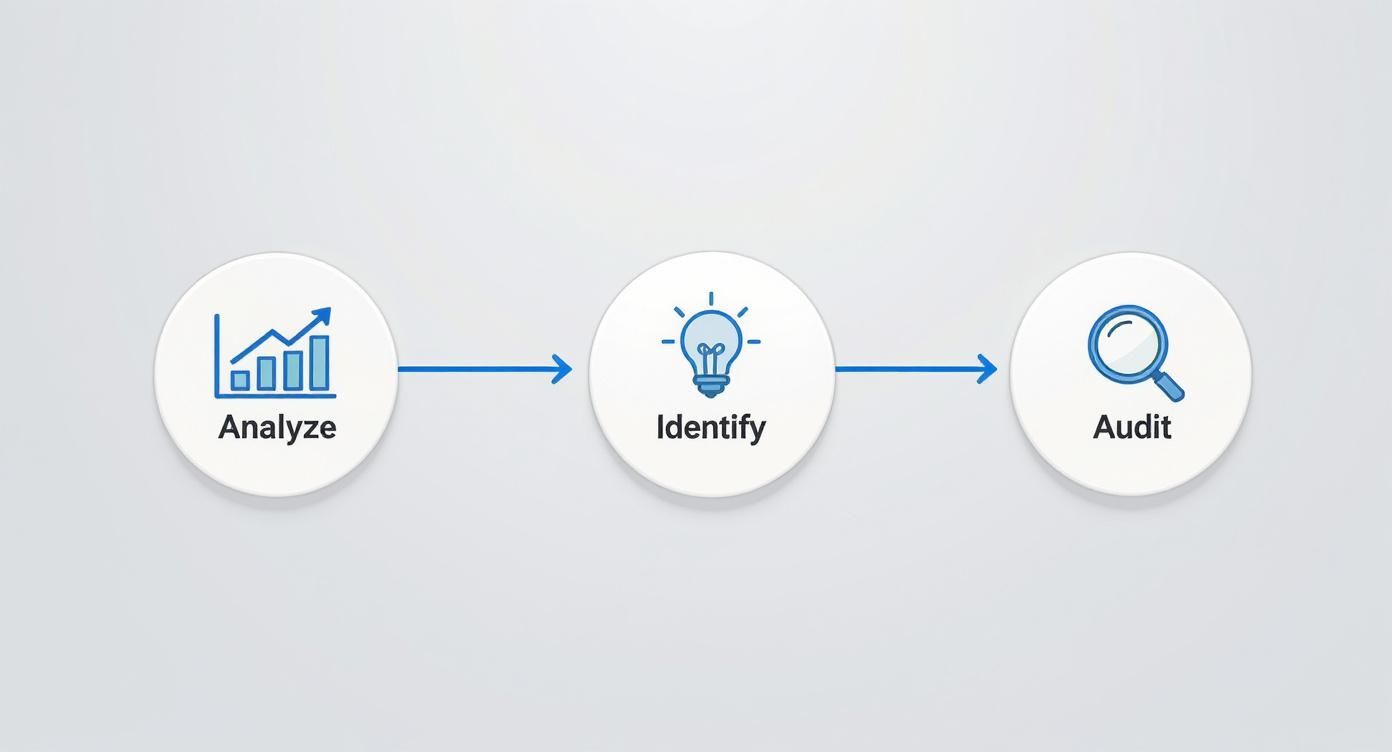
This teardown is the most important step. It turns a dense, intimidating article into a clean, structured list of potential micro-assets, making the rest of the process feel a lot less overwhelming.
Create a Content Repurposing Map
Okay, you've got your pile of content gold. Now you need to match each nugget to the right format and channel. This is where a content repurposing map becomes your best friend. It can be as simple as a spreadsheet or even a mind map—whatever helps you visualize the journey from your pillar piece to every single derivative asset.
Your map should track the original insight, the new format, the target platform, a quick note on the angle, and the status. This isn't just about getting organized; it's about being strategic. You're consciously deciding how to adapt each piece so it feels completely native to its new home.
A repurposing map turns a chaotic brainstorming session into an actionable production calendar. It provides clarity for your team and ensures every piece of repurposed content has a specific purpose and destination.
Let’s take one of our stats: "Companies using a defined LinkedIn strategy see a 45% increase in lead quality." That single data point can be mapped to several different formats.
- Format: Text-only LinkedIn post. Angle: Lead with a hook about the pain of bad leads, then drop the stat as the solution.
- Format: Single slide in a LinkedIn carousel. Angle: Use it as hard evidence to back up one of the carousel's main arguments.
- Format: Quote graphic for X/Instagram. Angle: Let the number do the talking with big, bold typography.
Mapping these pathways out ahead of time is the difference between thoughtful adaptation and lazy cross-posting.
Execute and Distribute in Batches
With your deconstructed list and your repurposing map in hand, it's time to get to work. The secret to doing this without losing your mind is to batch everything. Don't try to create one carousel today, then script a video tomorrow. Group similar tasks together and knock them out.
Block out time on your calendar for each activity:
- Writing and Scripting: Sit down and write all your LinkedIn post captions, newsletter snippets, and short-form video scripts in one go.
- Design and Visuals: Open up Canva or Figma and create all the carousel slides, quote graphics, and video thumbnails in another dedicated session.
- Video and Audio Production: Get in front of the camera or mic and record all your short-form video clips or audio snippets at once.
Batching is a game-changer. It slashes the time you waste switching between different types of tasks and dramatically speeds up your production. A single 3,000-word guide can easily fuel an entire month's worth of diverse, high-value content across multiple platforms—all from that one initial investment. That’s how you build a powerful and sustainable content engine.
How to Scale Repurposing with AI Tools
Let's be honest: manual content repurposing is a grind. It's effective, sure, but the process of breaking down a big piece of content, figuring out new angles, and rewriting it for a dozen different platforms is a massive time sink. This is where AI stops being a buzzword and starts being your most valuable team member for scaling your content strategy.
Don't think of AI as something that replaces your creativity. Think of it as a force multiplier. It crushes the repetitive, formulaic tasks that eat up your day, freeing you and your team to focus on what matters: strategy, nuance, and making a real connection with your audience. That shift is the key to scaling up without burning out.
Supercharge Your Initial Teardown
Remember the manual deconstruction process? Sifting through a 3,000-word guide to pull out key ideas can easily take an hour. An AI tool can give you a massive head start in seconds.
Here's how AI can help you hit the ground running:
- Instant Summaries: Drop a long article or webinar transcript into an AI tool and ask for a quick summary. Boom—you've got the core message ready for a newsletter blurb or the first slide of a carousel.
- Extracting Key Insights: Prompt the AI to find the top 5-10 takeaways, practical tips, or surprising stats. This builds your bank of micro-content without you having to touch a highlighter.
- Mining for Quotes: Ask the AI to pull out the most powerful or thought-provoking sentences. These are gold for simple text-based LinkedIn posts or eye-catching quote graphics.
For example, a platform like GetViews.AI can take a single article and instantly spin up multiple post ideas and hooks, essentially doing that initial teardown work for you.
Just look at how an AI can take one simple input and generate a bunch of distinct content ideas that are ready for you to polish.

This shows how AI can be an incredible brainstorming partner, turning one concept into a variety of formats and angles in a fraction of the time it would take to do it manually.
From One Format to Many—Instantly
The real magic kicks in when AI helps you transform your content from one format to another. This is where the efficiency gains become huge. A single video transcript, for instance, is a goldmine of potential content when you have the right AI prompts.
Picture this workflow for a 30-minute webinar:
- Get a Transcript: First, use an AI transcription service to get a clean text version of the audio.
- Create a Blog Post: Feed that transcript to an AI writer. Your prompt could be something like: "Turn this webinar transcript into a well-structured, 1,500-word blog post. Use the key talking points as H2s and H3s, and keep the tone conversational but informative."
- Draft Social Posts: Follow that up with another prompt: "From the blog post above, generate 5 engaging LinkedIn posts. Each one should focus on a different key insight. Give each a strong hook and a clear call-to-action."
- Script Short-Form Videos: Finally, ask the AI: "Create three 60-second video scripts based on the most actionable tips from the post. Structure them with a hook, three quick points, and a closing thought."
In less than an hour, you've spun one live event into a deep-dive blog post, a week's worth of LinkedIn content, and scripts for a whole series of short-form videos. That's the power of having AI as a creative partner.
The impact here is massive. AI-powered repurposing can cut your content creation time by up to 60%. I've seen businesses using this approach get a 25% wider reach and a 20% bump in SEO performance, simply because they can consistently publish more high-quality, relevant content. You can discover more insights about how AI streamlines content workflows and brings down production costs.
Keeping Your Brand Voice and Consistency
One of the biggest hang-ups people have with AI is the fear that it will make their content sound generic and dilute their brand's voice. It's a valid concern, but totally manageable if you're smart about it.
Modern AI tools, including GetViews.AI, are built to learn and adapt to your specific style. You can "train" the AI by feeding it examples of your best-performing content, teaching it to mimic your unique tone, vocabulary, and sentence structure. This ensures that even when you're cranking out content at scale, it still sounds like you.
The goal here isn't AI-generated content; it's AI-assisted, human-refined content. It’s a partnership that gives you both speed and quality.
Adapting Content for Different Platforms
If you're just blasting the same exact post across every social channel, you're setting yourself up for failure. I've seen it happen time and again. The real magic in a content repurposing strategy isn't just reusing your work; it's adapting it. You have to make every piece feel like it was born on the platform you're posting it to.
Think of it like this: you wouldn't give the same speech at a formal business conference and a casual meet-up, right? The core message might be the same, but the delivery, tone, and examples would change. The same goes for your content.
An insight from your latest blog post needs to look and feel completely different on LinkedIn than it does on Instagram or X. Each platform has its own unspoken rules, its own culture, and its own audience expectations. Get it wrong, and you'll stick out for all the wrong reasons.
A LinkedIn-First Approach to Adaptation
For anyone in B2B, LinkedIn is the main event. It’s where your ideal customers are actively looking for industry insights and real solutions to their problems. Your content absolutely has to match that mindset.
Let’s take a single idea from a bigger piece of content—say, "The top three mistakes new founders make with lead generation"—and break down how you'd spin that for LinkedIn.
This one idea can easily become several distinct posts:
- The Text-Only Thought Leadership Post: Kick it off with a hook that grabs them by the collar. Keep sentences short, use plenty of white space, and lean on bullet points to spell out the three mistakes. This format is gold for starting conversations and showing you know your stuff.
- The Engaging Carousel: Turn each mistake into its own slide. The first slide needs a bold, can't-miss title. Each following slide should break down a point with minimal text and clean graphics. And always, always end with a clear call-to-action on the final slide.
- The Short-Form Video Script: Rework those three mistakes into a quick script for a 60-second video. Look right into the camera and talk directly about their pain points. Video builds that human connection and trust way faster than text ever could.
See what we did there? We took the same core information and repackaged it for how different people browse the same platform. Someone might pause for a quick text post, swipe through a carousel, or hit play on a video—all depending on their mood and the moment.
You’re not just being repetitive. You're giving your audience multiple shots to connect with your message. In fact, we put together a guide that shows you exactly how to get 12 pieces of content from a single idea in 30 minutes, digging deeper into these LinkedIn-specific plays.
Contrasting Strategies for Other Platforms
Okay, so that’s LinkedIn. Now, how would that same "three mistakes" idea play out somewhere else? The message is the same, but the execution has to change completely.
X (Twitter) Strategy: X is all about being fast, punchy, and conversational. That idea about "three mistakes" is a perfect fit for a thread. The first tweet is your hook, the next few tweets break down each mistake, and the last one wraps it up with a solution or a question to get people talking. The tone here is much more direct and casual.
Instagram Strategy: Instagram is a visual-first world. That same content could become:
- An eye-catching Reel set to trending audio, where you physically point to text bubbles that pop up with each mistake.
- A beautifully designed carousel that feels more like a slick, mini-infographic than its more corporate LinkedIn cousin.
- A series of Stories using polls and question stickers to get people to engage directly about their own lead-gen headaches.
Tailoring your content like this isn't just a "nice-to-have" anymore—it's essential, especially if you have a global audience. While video dominates in North America, I've seen infographics and short-form text perform incredibly well in parts of Asia and Africa. The data backs this up: marketers who adapt their content see up to a 50% higher engagement rate in international markets.
By being thoughtful about how you adapt your core message, you meet your audience exactly where they are, in a format they actually want to see. That’s how you turn one piece of work into a true, multi-platform powerhouse.
Measuring the Impact of Your Strategy
You’ve built a content repurposing machine and are churning out assets. That’s great. But if you’re not measuring performance, you’re just creating noise.
Creating a mountain of content feels productive, but you’re flying blind without the data to back it up. A real content repurposing strategy needs a rock-solid way to track its return on investment (ROI). Otherwise, how can you prove its value or make smart calls on what to create next?
The whole point is to connect your efforts to actual business results. Did that LinkedIn carousel you spun from a blog post actually bring in qualified leads? Did that short video clip drive people back to the original webinar? Answering these questions is what turns this from a creative exercise into a scientific process.
Defining Your Key Performance Indicators
Before you even open an analytics dashboard, you have to know what you’re looking for. Vanity metrics like "views" or "likes" are nice for a quick ego boost, but they don't tell you much about the business impact. Your Key Performance Indicators (KPIs) must tie directly back to your overarching goals—whether that's building brand awareness, generating a pipeline, or closing deals.
Let's get specific. Focus on the metrics that tell the real story:
- Lead Generation: This is the big one. How many demo requests or MQLs came directly from your repurposed assets? This is the clearest proof that your content is moving the needle.
- Conversion Rate: Of all the people who saw your repurposed piece, what percentage actually took the next step? This could be downloading a guide, signing up for a newsletter, or registering for an event.
- Audience Growth: Are you gaining relevant followers or subscribers on the channels where you're pushing out this content? It’s a great leading indicator of growing influence.
- Traffic to Pillar Content: It's crucial to measure how many people are clicking through from a social post or email snippet back to your original, long-form asset. This shows the "hub and spoke" model is working.
The most powerful KPIs are the ones that connect content engagement directly to revenue. A post with a thousand likes is nice, but a post with three qualified leads is what actually justifies your budget and effort.
Getting a handle on these metrics is the first step. To dig even deeper, check out our guide on how to improve social media engagement, which details the platform-specific signals that indicate you're having high-quality conversations.
Setting Up a Reliable Tracking System
Once you know what to measure, you need a system to capture that data without any guesswork. When you have to report back to your boss or the C-suite, "I think it's working" just won't cut it. You need to draw a clear line from every single repurposed asset to its performance.
UTM parameters are your best friend here. They're just simple tags you add to the end of a URL to tell your analytics tools exactly where traffic is coming from. By creating a unique UTM link for every piece of repurposed content, you can pinpoint which assets, formats, and channels are driving clicks and conversions.
For example, a link from a LinkedIn carousel pointing to your blog should have different UTMs than a link from your email newsletter pointing to the same blog post. This precision is what allows you to attribute success accurately.
Here’s a breakdown of the essential KPIs you should be tracking to get a full picture of your repurposing success.
Essential KPIs for Content Repurposing
This table breaks down the most important metrics for tracking your content's journey from initial visibility all the way down to generating leads.
| KPI Category | Specific Metric | What It Tells You |
|---|---|---|
| Reach & Awareness | Impressions | How many times your repurposed content was displayed on a platform. |
| Engagement | Shares & Comments | How much your content resonates, sparking conversation and amplification. |
| Traffic | Click-Through Rate (CTR) | The percentage of viewers who clicked a link in your repurposed content. |
| Conversion | Form Submissions | The number of leads generated directly from a specific content asset. |
Keeping an eye on these numbers across the funnel gives you a holistic view, helping you spot both big wins and potential bottlenecks in your strategy.
Creating a Monthly Performance Report
Data is completely useless if it just sits in a dashboard collecting digital dust. To truly prove the value of what you’re doing, you have to communicate your results clearly and consistently. A simple monthly performance report can turn your raw numbers into a compelling story for your team and leadership.
This doesn't need to be a 20-page dissertation. A one-page summary is often far more effective.
Start with the big wins and overarching trends. From there, break down performance by channel and content format. Which platforms are sending the most qualified traffic? Are carousels crushing text-only posts on LinkedIn? Answering these questions helps you refine your strategy month after month. You'll know exactly what to double down on and what to cut loose.
This constant feedback loop is what transforms a good repurposing system into a predictable engine for growth.
Got Questions About Content Repurposing? We've Got Answers.
As you start weaving content repurposing into your marketing, some questions are bound to pop up. It's totally normal. Getting those questions answered is what turns a good idea into a repeatable, pipeline-driving system.
Let’s tackle some of the most common hurdles I see marketers face.
How Often Should I Actually Be Repurposing Content?
Forget about a magic number. The real key is to think in campaigns, not just one-off posts. The whole point is to squeeze every last drop of value from your best content.
When you drop a big "pillar" piece—like a beefy guide, an in-depth webinar, or a killer podcast episode—plan to spin off smaller assets from it for the next two to four weeks.
This approach keeps your core message front and center without boring your audience. A single blog post, for instance, could become a whole month's worth of content:
- Week 1: A slick LinkedIn carousel that breaks down the main framework.
- Week 2: A few sharp, text-only posts, each hammering home a single powerful takeaway.
- Week 3: A quick-hitter video that brings one of the key tips to life.
- Week 4: A snippet in your email newsletter that teases the best part and drives people back to the full article.
You’re not just repeating yourself; you're giving different parts of your audience a fresh look at a topic you already know they care about.
What Are the Best Tools for a Beginner?
Good news: you don't need to spend a fortune on a massive tech stack. The smartest move is to pick a few solid tools that solve your biggest headaches right now. For most, that means focusing on creating, scheduling, and drumming up new angles.
Here’s a lean, mean, and effective starter kit:
| Tool Category | Recommended Tool | What It's Great For |
|---|---|---|
| Visual Creation | Canva | Whipping up branded carousels, quote graphics, and video thumbnails in minutes. |
| AI Content Assistant | GetViews.AI | Spinning up post ideas, hooks, and drafts from your articles or videos. |
| Video Editing | CapCut | Easily editing short-form videos with captions and music—no film degree required. |
| Scheduling | Buffer / Later | Planning and automating your social media calendar so you can set it and forget it. |
The most critical tool isn't software—it's your process. Start simple, write down your steps, and only bring in a new tool when you hit a wall your current setup can't break through.
Is This Going to Wreck My SEO?
This is a big one, and I get it. The short answer is no, repurposing won't hurt your SEO—as long as you're smart about it. The old myth about getting hit with a "duplicate content penalty" is one of the most persistent misunderstandings out there.
Google is way more sophisticated than that. Repurposing is about reformatting and re-angling an idea for a new platform, not just copy-pasting text. A blog post, a YouTube video, and a LinkedIn article covering the same core topic are treated as unique assets because they serve different audiences and intents.
In fact, a good repurposing strategy can seriously boost your SEO. Think about it: you're building topical authority by creating a cluster of content around a central theme. You're also generating more social signals, backlinks, and brand mentions, all of which tell search engines that you're the real deal on that subject. Just make sure the big, definitive version lives on your website, and use all the other channels to point traffic back to it.
How Do I Know Which Content to Repurpose First?
Don't just grab the last thing you published. If you want to see a real return on your effort, you have to be methodical and let your data do the talking. The best place to start is with your proven winners.
Go digging through your analytics and look for content that's already crushing it in one of three ways:
- High Traffic: Find your top-performing blog posts in Google Analytics. If Google is already sending tons of people there, you know you've struck a nerve.
- High Engagement: Which of your social posts blew up with comments and shares? That's your audience telling you exactly what they want more of.
- High Conversion: Pinpoint the assets that generate the most leads—whether that's from a newsletter sign-up, a demo request, or a downloadable guide. This is content that makes people take action.
When you start with these proven assets, you’re not just guessing. You’re building on a foundation you already know is solid, which is the fastest way to see a real impact from your repurposing efforts.
Ready to put these content repurposing strategies on autopilot? GetViews.AI is an AI-powered growth platform that transforms your expertise into a consistent pipeline of high-performing LinkedIn content. Stop the content grind and start building your authority—discover how GetViews.AI can help you today.