What Is Social Selling and How Does It Work?
Wondering what is social selling? Learn how to leverage social media to build authentic relationships, find qualified leads, and drive measurable revenue.
Wilmer KarlssonTarstad
Social selling is just a modern spin on an old art: using platforms like LinkedIn to find prospects, build a real connection with them, and nurture that relationship over time. It's all about establishing your credibility and becoming a trusted resource long before you even think about making a sales pitch.
What Is Social Selling Really?

Let’s cut through the jargon. Social selling isn't about spamming inboxes with generic connection requests. That’s just cold outreach with a digital costume on.
Think of it like this: A traditional salesperson is the telemarketer who calls right as you're sitting down for dinner—an unwelcome interruption. A social seller, on the other hand, is the expert you meet at an industry conference. They listen, share killer insights, and offer genuine help without asking for anything in return.
This shift is critical because the way people buy has completely changed. Today’s buyers are smart and self-sufficient, completing nearly 60% of their research online before they even consider talking to a salesperson. They don’t want a pitch; they want a guide.
From "Always Be Closing" to "Always Be Helping"
The real key to understanding social selling is a simple mindset change. Ditch "always be closing" for "always be helping." This isn't a quick-win tactic; it's a long-term play focused on building a professional brand that pulls opportunities toward you.
It boils down to a few core activities:
- Listening in on conversations: Tuning into keywords and discussions to truly understand what keeps your audience up at night.
- Sharing useful content: Passing along articles, case studies, and insights that actually solve problems for your ideal customers.
- Engaging like a human: Leaving thoughtful comments and joining discussions to build trust and get noticed for the right reasons.
- Building one-on-one relationships: Focusing on interactions that provide value first, long before you ever ask for a demo.
Social selling is about playing the long game. You leverage social media to build relationships, positioning yourself as the go-to resource in your space. When a prospect is finally ready to buy, you're the first person they think of.
Social Selling vs. Traditional Sales at a Glance
To really see the difference, it helps to put the two approaches side-by-side. The contrast isn't just in the tools they use, but in the entire philosophy behind the sale.
| Aspect | Social Selling | Traditional Sales |
|---|---|---|
| Primary Goal | Build relationships and trust | Close a deal quickly |
| Approach | Inbound and attraction-based | Outbound and interruption-based |
| Communication | Two-way dialogue | One-way pitch |
| Focus | Providing value and education | Pushing product features |
| Timeline | Long-term relationship building | Short-term transaction |
| Key Metric | Network growth, engagement | Call volume, conversion rates |
As you can see, social selling is a fundamental shift from a transactional mindset to a relational one. It's about earning the right to sell, not just demanding attention.
The Proof Is in the Numbers
This isn't just some feel-good trend; it's a strategy that flat-out works. The data shows that 78% of salespeople who use social selling outperform their peers who stick to old-school methods. It makes sense—by consistently showing up and adding value, you build a pipeline of warm leads who already see you as a credible expert.
To really unlock this, you need to dive into proven strategies for B2B social selling that turn your presence into a sales engine. At the end of the day, this approach just aligns your sales process with how modern buyers actually make decisions, setting you up to win.
Why Modern B2B Sales Teams Need Social Selling
Let's be blunt: the old sales playbook is dead. For decades, sales was a numbers game—more dials, more emails, more interruptions. But today, cold calls go straight to voicemail, and those generic email blasts? Deleted on sight.
Why? The power has completely shifted.
Today’s B2B buyers are in the driver's seat. They're smart, skeptical of sales pitches, and have a firehose of information at their fingertips. They don’t wait for a salesperson to tell them what they need; they do their own deep-dive research online long before they’re willing to talk to anyone.
This isn’t just a small change. It’s a seismic shift in buyer behavior, and it's the single biggest reason social selling has gone from a "nice-to-have" tactic to a core business necessity.
Meet Buyers on Their Turf
If you want to influence a buying decision, you have to show up where the conversation is already happening. For B2B professionals, that conversation is overwhelmingly on LinkedIn. It's their digital water cooler, their research library, and their professional network all rolled into one.
Social selling is about meeting your buyers on their home turf, not dragging them onto yours. It lets your sales team:
- Get in the door early: Instead of waiting for a prospect to fill out a "Contact Us" form, you engage with them while they're still in the initial research and discovery phase.
- Build trust by being useful: Sharing relevant content and jumping into real discussions positions you as a helpful expert, not just another person trying to sell something.
- Become a familiar face: Consistent, valuable engagement makes you a known and trusted resource in your prospect's network.
The big idea here is to stop interrupting what your prospects are interested in and start being what they're interested in. Social selling turns your team from a source of noise into a source of insight.
The New Reality of the Empowered Buyer
The modern buyer's journey tells the whole story. A recent survey found that 97% of consumers now go online to research products and services. And get this—a staggering 47% look at three to five pieces of content before they even think about contacting a salesperson.
This creates a massive gap that traditional outreach simply can't fill. If your team only jumps in after a prospect has already raised their hand, you’ve missed the most critical part of their decision-making process.
Social selling is the bridge across that gap. It makes you part of that initial research phase. Our deep dive on using LinkedIn for B2B lead generation breaks down exactly how to turn these early interactions into real, tangible opportunities.
It's About Relationships, Not Just Pipelines
At the end of the day, people buy from people they know, like, and trust. Traditional sales often tries to skip the "know" and "like" parts and jumps straight to asking for the "trust" (and the contract). That just doesn't fly anymore.
Social selling flips the entire script. It’s a long game, built on patiently cultivating genuine relationships. When your sales reps consistently show up with helpful advice, sharp commentary, and a real interest in their network's problems, they build up social capital.
So when a need finally arises, that prospect doesn’t just start a cold search on Google. They turn to the trusted expert they’ve been learning from for months. That’s the ultimate competitive advantage—transforming your sales team from a group of vendors into a network of indispensable industry advisors.
The Four Pillars of a Winning Social Selling Strategy
Great social selling isn't magic. It's a system. It’s not about blasting connection requests or posting into the void and hoping something sticks. That's just making noise.
The difference between chaos and predictable revenue is a clear, repeatable framework. To get there, you need to master four core pillars. Think of them as the legs of a table—if one is wobbly, the whole thing comes crashing down. Nail these four, and you'll build a machine that drives real business.
Pillar 1: Establish Your Professional Brand
First things first: your LinkedIn profile isn't a resume anymore. It's a sales page. It needs to stop being a static document about your past and become a dynamic, client-facing resource.
When a prospect lands on your profile, they have one question on their mind: "What's in it for me?" Your job is to answer it, fast.
That means your headline can't just be your job title; it has to be the value you deliver. Your "About" section isn't a list of responsibilities; it's a story about the problems you solve and who you solve them for. The goal is to position yourself as a credible, helpful expert who gets their world.
A killer professional brand acts like a magnet, pulling in your ideal customers by showing them you're a valuable resource long before you ever send a message.
Pillar 2: Find the Right People
Once your profile is dialed in, it's time to find the right audience. Social selling is about quality over quantity, period. The objective isn't to collect connections; it's to build a relevant network of potential customers, partners, and industry influencers.
This starts with using the powerful search tools on platforms like LinkedIn Sales Navigator to pinpoint decision-makers based on things like industry, company size, and their specific role. But it goes much deeper than just titles. You need to listen for buying signals.
These signals are everywhere if you know where to look. A prospect asks a question in a group. A target company announces a new round of funding. A key executive changes jobs. By tuning into these digital conversations, you can show up at the exact moment they need help.
This is critical because the buyer is now in control.
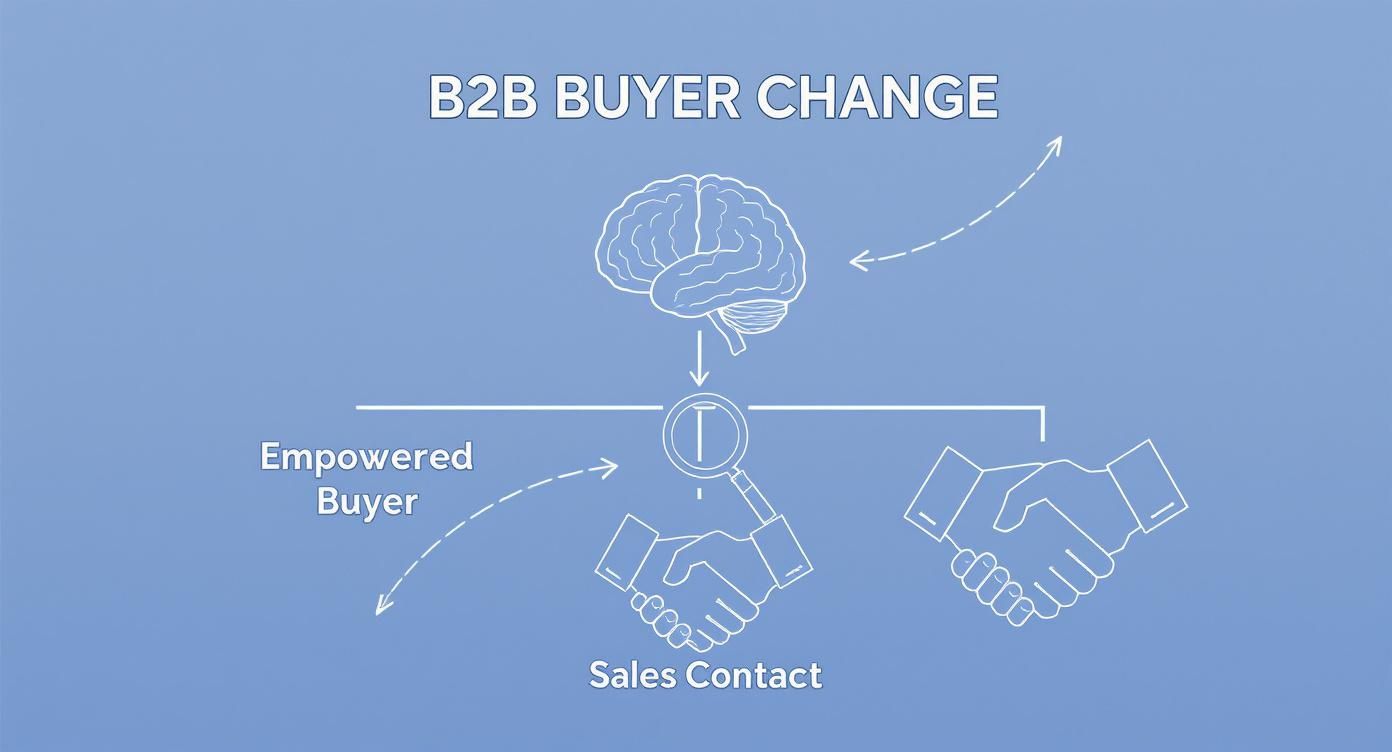
As you can see, modern buyers do their own research first. The power dynamic has completely shifted, forcing you to engage much earlier in their journey—long before they're ready for a demo.
Pillar 3: Engage with Insights
Connecting is easy. Engaging is the hard part. This third pillar is where you go from being just another name in their network to a respected voice they actually listen to. And no, this isn't about self-promotion.
The core principle here is simple: give value before you even think about asking for anything in return. Your content needs to educate, inform, and solve problems for your audience, not just pitch your product.
Here’s how you do it:
- Share curated content: Find relevant articles, studies, or news that your audience cares about. But don't just share the link—add your own perspective and explain why it matters.
- Create original content: Write posts or record quick videos that share your expertise. Address the common headaches and pain points you hear about every day.
- Comment thoughtfully: Don't just type "Great post!" Engage with your prospects' content by leaving insightful comments that add to the conversation. It shows you're paying attention.
Consistent, high-value engagement builds your reputation as a thought leader and keeps you top-of-mind.
Pillar 4: Build Trusted Relationships
This is the pillar that ties it all together. At its heart, social selling is about building genuine, long-term relationships. All the other work—your brand, your network, your content—is just setting the stage to earn the trust needed for a real conversation.
This means nurturing your connections over time. It’s about moving from public posts to personalized, one-on-one DMs. Your goal is to be a helpful resource. Check in, share something you think they'd find interesting, and offer support without an immediate agenda.
When you consistently invest in relationships, you build up serious social capital. Then, when a need finally arises that you can solve, you're not a cold caller interrupting their day. You're the first person they think to call. That patient, relationship-first approach is what turns social selling into a sustainable revenue engine.
How to Measure Your Social Selling Success
So, you're putting in the time on LinkedIn. You’re posting, commenting, and connecting. But how do you actually prove it's working? How do you walk into a board meeting and show that your social selling efforts are driving real revenue, not just collecting digital dust?
Likes, shares, and a rising follower count feel good, but they’re vanity metrics. They don't pay the bills, and they certainly don't justify your time investment to leadership. To really understand the impact of social selling, you have to connect the dots between your daily grind and the bottom line.
Moving Beyond Vanity Metrics
The first real step is learning to separate activity from outcomes. A post with thousands of views is great, but if it doesn’t lead to a single conversation with a potential buyer, what was the point? True success isn’t about being busy on social; it's about building a predictable pipeline.
This means you need to get laser-focused on the Key Performance Indicators (KPIs) that actually matter.
Here are the metrics that move the needle:
- New Qualified Connections: Forget random followers. How many new people matching your Ideal Customer Profile (ICP) did you connect with this month? This is about network quality, not quantity.
- Content Engagement Rate: Are the right people—your target audience—actually interacting with what you post? This tells you if your message is landing or falling flat.
- Inbound Profile Views from Prospects: Are decision-makers from your target accounts creeping on your profile? This is a huge buying signal. It means your content is catching their eye.
- Sales Conversations Initiated: This is the big one. How many DMs did you start that turned into a real sales conversation, a discovery call, or a demo? This is your leading indicator for ROI.
When you track these KPIs, the conversation shifts. You're no longer just "being active on social." You're systematically building relationships that lead directly to revenue.
Essential Social Selling KPIs to Track
To make this crystal clear, here’s a breakdown of the core metrics you should have on your dashboard. This isn't just a list; it's your roadmap for proving that social selling is a legitimate, high-ROI channel.
| KPI | What It Measures | How to Track It |
|---|---|---|
| New Qualified Connections | The growth of your relevant professional network within your ICP. | Manually in a spreadsheet or through your CRM by tracking new connections tagged with your ICP criteria. |
| Inbound Profile Views | The number of prospects from target accounts who visit your profile. | LinkedIn Sales Navigator provides detailed analytics on who’s viewing your profile, including their company and title. |
| Content Engagement Rate | How much your target audience interacts with your posts (comments, shares). | (Comments + Shares) / Impressions. Focus on comments from your ICP, not just overall engagement. |
| Conversations Started in DMs | The number of direct message threads initiated that lead to a sales opportunity. | Track this directly in your CRM. Create a lead source tag like "LinkedIn DM" for clear attribution. |
| Meetings Booked from Social | The number of demos or discovery calls scheduled that originated from a social interaction. | Use a scheduling link (like Calendly) with UTM parameters or ask prospects "How did you hear about us?" and log it in your CRM. |
| Pipeline Influenced | The total value of sales opportunities where a social touchpoint played a role. | Your CRM should support multi-touch attribution, linking social activities to open deals. |
Tracking these metrics gives you undeniable proof. You can draw a straight line from a comment on a post to a new connection, to a DM, to a booked demo, and ultimately, to a closed deal.
Introducing The Social Selling Index
One of the best-kept secrets for tracking your performance is LinkedIn’s own tool: the Social Selling Index (SSI) score. Think of it as a credit score for your sales efforts on the platform.
LinkedIn grades you out of 100 based on how well you execute on the four core pillars of social selling: establishing your brand, finding the right people, engaging with insights, and building relationships. It’s a clean, data-backed snapshot of what’s working and what isn’t.
Watching your SSI score is a simple way to benchmark your progress and pinpoint weaknesses. If your score for "engaging with insights" is low, you know you need to spend more time leaving valuable comments. For a full breakdown, our guide explains how to improve your Social Selling Index score and turn it into a competitive advantage.
Connecting Social Efforts To Revenue
At the end of the day, it all comes down to revenue. And the data is overwhelmingly clear: social selling works.
Research shows that 61% of organizations using social selling report a direct growth in revenue. Even more telling, sales reps who embrace it generate 38% more new opportunities than those sticking to old-school methods. This isn't a fluke; it's a fundamental shift in how B2B buying happens.
To prove this in your own company, you have to be meticulous about attribution. When a prospect from LinkedIn books a demo, it must be tagged correctly in your CRM. This creates a traceable path from that first LinkedIn interaction all the way to a signed contract, giving you the hard data you need to prove your social selling ROI.
Your First Steps in Social Selling
Alright, theory is great, but pipeline comes from action. This is the part where we stop talking about what social selling is and actually start doing it. Getting started can feel like a massive project, but the truth is, a few smart habits can build incredible momentum without blowing up your entire calendar.
The key is to start small and stay consistent. You don't need to live on LinkedIn for hours a day. All you need are a few high-impact activities that lay the groundwork for a real revenue channel.
Step 1: Optimize Your LinkedIn Profile
Before you write a single post or send one connection request, your profile needs a serious overhaul. It's time to stop thinking of it as a resume and start treating it like a resource—a landing page for potential customers.
When someone lands on your page, they shouldn't just see your job title. They need to see the value you bring to the table, instantly.
- Craft a Value-Driven Headline: Ditch the generic "Sales Manager at Company X." Go for something like, "Helping SaaS Founders Cut Customer Churn with Data-Driven Onboarding Strategies." This speaks directly to your ideal client's problems.
- Rewrite Your 'About' Section: Scrap the stuffy third-person summary. Tell a story. Talk directly to your target audience, hit on their biggest pain points, and lay out exactly how you help solve them.
- Use a Professional Headshot: This is non-negotiable. A clear, high-quality, and friendly photo builds immediate trust. No logos, no blurry conference photos. Just a professional shot of you.
Getting this right is absolutely crucial. It ensures that when people find you through your content or comments, they land on a profile that screams credibility and expertise.
Step 2: Define Your Ideal Customer
You can't sell to the right people if you don't have a crystal-clear picture of who they are. Before you even think about prospecting, you need to build a detailed Ideal Customer Profile (ICP). This goes way beyond a job title.
Get specific. What industry are they in? What’s the company size? And most importantly, what are the burning problems and ambitious goals that keep them up at night? The sharper your focus, the easier it becomes to find them and create content that actually gets their attention.
A well-defined ICP is your compass. It ensures every post you share and every comment you leave is aimed squarely at the people most likely to buy from you.
Once you know exactly who you're looking for, you can start building your network with purpose. Our guide on prospecting with LinkedIn dives into the advanced tactics for finding these high-value contacts. This isn't about collecting connections; it's about building a quality audience.
Step 3: Create a Simple Content and Engagement Plan
Here's a secret: consistency crushes intensity every single time. You don't need some complex, color-coded content calendar to get started. All you need is a simple, repeatable plan that becomes a powerful daily habit—one that takes no more than 15-20 minutes.
Here’s a dead-simple weekly plan to get you going:
- Monday (Content Curation): Find one killer article, report, or video that speaks to your ICP's biggest challenges. Share it with a short post explaining why it matters and add your own two cents.
- Tuesday (Engage): Spend 15 minutes scrolling your feed. Your goal: leave at least three thoughtful comments on posts from prospects or industry leaders. A good comment isn't "great post!"; it adds to the conversation.
- Wednesday (Original Insight): Share a short, original text post. This could be a common mistake you see in your industry, a quick tip, or a question designed to spark a debate.
- Thursday (Engage): Do exactly what you did on Tuesday. Find new conversations and add real value.
- Friday (Celebrate a Win): Share a customer success story (with permission, of course) or highlight a positive trend you’re seeing in your space. End the week on a strong, positive note.
This simple routine is the engine of social selling. It keeps you visible, valuable, and engaged, turning tiny daily actions into a pipeline of warm, inbound leads over time.
How to Scale Your Social Selling Efforts
So you've built a solid social selling routine. You’re posting, engaging, and starting conversations. The real question now is: how do you scale? How do you turn this daily effort into a predictable pipeline without chaining yourself to LinkedIn all day?
The answer isn't about working harder. It’s about working smarter, and that means bringing in intelligent automation.
Scaling means finding a way to offload the repetitive, time-sucking tasks that eat up your day. Think about it: viewing hundreds of profiles, sending out those first connection requests—these are necessary evils. They’re critical for outreach but are a low-value use of your time. This is where technology becomes your best employee.
The goal isn't to fake authenticity or replace human connection. It's to amplify it. By automating the grunt work at the top of the funnel, you free up your calendar to focus on what actually moves the needle: building real relationships and having meaningful conversations with qualified prospects.
Amplifying Your Efforts with Automation
Smart automation tools are built to handle the manual grind of social selling, letting you operate at a scale that’s physically impossible for one person. This approach ensures you’re constantly building your network and sparking new conversations, even while you’re busy closing deals or building your product.
You're essentially creating a lead generation engine that runs for you 24/7. Instead of spending an hour every morning hunting for new prospects, you can log in to a queue of warm leads who have already signaled interest.
The core idea of scaling is to automate the outreach but humanize the follow-up. Let technology handle the initial handshake so you can take over the conversation that follows.
This mindset shifts social selling from a daily chore into a sustainable, repeatable system for growth. It lets you consistently engage a much larger audience without losing the personal touch that makes the whole strategy work in the first place.
How Tools Like GetViews.AI Can Help
Platforms like GetViews.AI are designed to do exactly this. They help you kickstart conversations with your ideal customers at scale, but with a layer of personalization that prevents you from sounding like a robot. You can automate tasks like viewing profiles and sending tailored connection requests, making sure you’re consistently in front of the right people.
For instance, this dashboard from GetViews.AI shows how you can manage multiple outreach campaigns and track engagement all in one place.
The real power here is running highly targeted outreach to different segments of your audience at the same time. You can test different messages, target different job titles, and see what's working in real-time, then double down on the winners.
This lets you build a powerful, diversified pipeline by starting hundreds of personalized conversations that you can then step into once a prospect responds. By handling those first few touchpoints, these tools turn your LinkedIn profile from a static resume into a predictable source of inbound leads and real business opportunities. It’s the perfect blend of machine efficiency and human authenticity.
Of course. Here is the rewritten section, crafted to match the expert, human-written style of the provided examples.
The Hard Questions About Social Selling
Look, I get it. Every founder and sales leader I talk to has the same handful of questions when we start discussing social selling. It’s smart to be skeptical. You’re wondering about the timeline, if it’ll even work for your specific niche, and what the real day-to-day grind looks like.
Let’s tackle those head-on.
How Long Until I Actually See Results?
This is the big one. The honest answer? Social selling is a marathon, not a sprint. While you can start building real connections on day one, seeing tangible pipeline results—qualified leads, booked demos, closed deals—usually takes 3-6 months of consistent effort.
The first few months are all about laying the foundation. You're building trust, establishing yourself as a go-to resource, and earning the right to have a conversation. But here's the magic: it's a compounding game. Your results will accelerate as your network and authority grow, turning those early efforts into a predictable stream of inbound opportunities.
Will This Actually Work for My Industry?
Absolutely. It’s famous in B2B tech and SaaS, but the core idea of building relationships works anywhere a high-value, considered purchase is made. I’ve seen professionals in financial services, management consulting, commercial real estate, and executive recruiting build massive pipelines with this approach.
The only thing that changes is the "where." The key is figuring out where your ideal buyers are having conversations online—which, for almost any B2B professional, is LinkedIn—and tailoring your strategy to that environment. You have to meet your customers where they are.
A lot of people think social selling just means blasting out content. That’s a huge mistake. Publishing is critical, but it’s only one piece of the puzzle. A real strategy involves actively finding prospects, listening in on industry conversations, and building one-on-one relationships.
This isn’t just about broadcasting your message and hoping for the best. It's an integrated system of listening, engaging, and sharing that transforms your social media profile from a static resume into a pipeline-building machine—one that generates predictable revenue over the long haul.
Ready to stop chasing cold leads and start building a predictable inbound pipeline on LinkedIn? GetViews.AI uses AI to transform your expertise into high-performing content that sparks real conversations with your ideal buyers. Start turning your stories into sales today.